· By Ryan Solberg, Broker #BK3354351
Seller Concessions in Orlando: How to Ask for Them and What You Can Actually Get
!Two people signing a real estate contract with a fountain pen beside a set of house keys
The Leverage Is There If You Use It
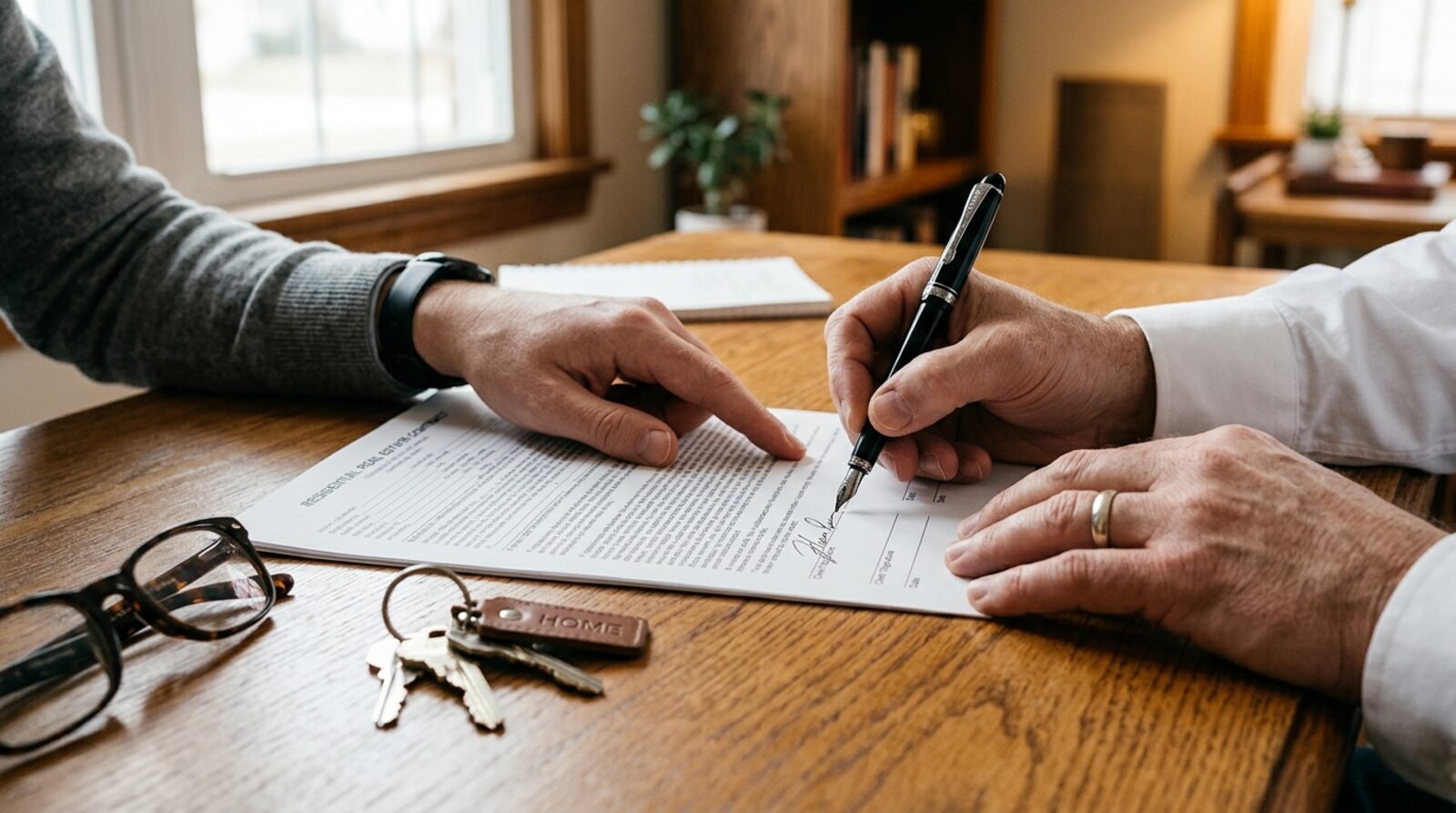
Seller concessions were nearly extinct in Orlando during 2021 and 2022. Multiple offers, waived inspections, buyers begging just to get an offer looked at — sellers had no reason to give anything. That market is gone. In 2026, inventory is up, days on market have stretched back to something resembling normal, and sellers who need to close are negotiating again.
Concessions are now one of the cleanest tools a buyer has to reduce out-of-pocket costs at closing without changing the purchase price on paper. If you're buying in the $400K–$800K range in Central Florida and you're not asking for concessions, you're leaving money on the table.
What Seller Concessions Actually Are
A seller concession is money the seller contributes toward the buyer's closing costs or financing. It appears as a credit on the closing disclosure and reduces what the buyer brings to the table at closing. Common uses:
- Paying buyer's closing costs — title insurance, lender fees, escrow impounds, recording fees. Florida buyer closing costs typically run 2%–3% of purchase price. On a $500K home, that's $10K–$15K.
- Permanent rate buydown — the seller buys down the buyer's interest rate for the life of the loan. At current rate levels (~6.3% on a 30-year fixed), a one-point buydown to ~5.3% reduces the monthly payment by roughly $300/month on a $500K mortgage.
- Temporary rate buydown (2-1 buydown) — seller funds a 2% lower rate in year one, 1% lower in year two, full rate in year three. Lower initial payments while rates potentially drop and refinancing becomes viable.
- HOA prepayment — seller prepays 6–12 months of HOA dues, reducing the buyer's first-year housing cost.
- Repair credit — seller credits the buyer for identified inspection issues instead of repairing them directly. Common on older Orlando homes.
How Much Can You Ask For?
Seller concession limits depend on your loan type:
| Loan Type | Max Concession (typical down payment) |
|---|---|
| Conventional (5–9% down) | 3% of purchase price |
| Conventional (10–24% down) | 6% |
| Conventional (25%+ down) | 9% |
| FHA | 6% |
| VA | 4% + unlimited for genuine closing costs |
These are lender maximums, not what sellers will accept. In practice, I'm seeing Orlando sellers agree to $5K–$15K in concessions on homes in the $400K–$700K range when the home has been on the market 21+ days. On newer listings or well-positioned homes in Winter Park, Dr. Phillips, or Baldwin Park, sellers are less motivated — those markets are still moving.
How to Ask Without Blowing the Deal
The mistake buyers make is treating concessions as an afterthought — asking for them after submitting the offer as if it's a second negotiation. The better approach: structure them into the offer from the beginning.
Two ways to frame it:
Offer slightly above asking, with concessions baked in. If a home is listed at $520K, offer $530K with $10K in seller-paid closing costs. The seller nets approximately the same; you preserve cash at closing. This works in markets where comps support the $530K number.
Offer at asking, explicitly requesting concessions. In a slower market (Osceola County, outer Orange, some Horizon West phases), offer list price with a direct request for closing cost credits. Sellers who have been on the market 30+ days often prefer a clean deal with a concession over a price reduction — it photographs better for their appraisal history.
What I Tell My Buyers
Concessions are a financing tool, not a sign that the seller is desperate. The best time to ask is when you have a specific use — a rate buydown with real math attached, or a closing cost credit that bridges a genuine gap. Sellers respond better to "we'd like a $12,000 credit to cover our closing costs so we can preserve our down payment" than to a vague request for "help with closing costs."
If the seller says no, you know where you stand. If they say yes, you've potentially saved $10K–$15K that stays in your pocket. It's always worth asking.
The Orlando market in 2026 has more homes, more days on market, and more motivated sellers than it did 18 months ago. The conditions that make concessions viable are present right now — for most buyers, this window is better than what's coming when rates eventually drop and buyer competition picks back up.
If you're on the other side of this negotiation — a seller trying to figure out how much room you actually have before concessions eat into your bottom line — start by getting a free home valuation so you know your real number before a buyer's offer lands on your desk.
How to Negotiate Seller Concessions When Buying a Home in Orlando
How to structure a seller concession ask in 2026's Central Florida market — concession limits by loan type, how to frame the request, and how to deploy the credit most effectively.
Step 1
Know the Concession Limits for Your Loan Type
Every loan type has a maximum seller concession the lender will allow. Conventional loans: 3% for down payments under 10%, 6% for down payments of 10–24%, 9% for 25%+ down payment. FHA loans: 6% maximum. VA loans: 4% maximum (covers non-allowable buyer fees plus prepaid items). USDA loans: up to 6%. Cash purchases: no limit. Asking for a concession that exceeds the limit for your loan type doesn't help you — the lender won't allow the excess to credit to you, and it won't reduce the purchase price. Know your limit before structuring the ask.
Step 2
Determine What You Want the Concession to Cover
Seller concessions can be applied to: closing costs (lender fees, title, escrow impounds, recording fees); prepaid items (first-year insurance premium, prepaid interest, property tax escrow); interest rate buydown (a permanent or temporary rate reduction paid with seller credit); or repair credits to compensate for issues found in inspection. Closing cost credits are the most common and simplest application — on a $500,000 purchase, Florida buyer closing costs run $12,000–$20,000, and a $10,000 concession eliminates most of that. A rate buydown credit is more financially complex but can produce a lower monthly payment than a price reduction would.
Step 3
Frame the Concession as Part of the Offer Structure, Not a Separate Demand
Concessions should be built into your initial offer, not added after price negotiations. A clean offer structure is: purchase price + concession amount on page one of the FR/BAR contract, worded as 'seller to contribute $X toward buyer's closing costs and prepaids.' This frames it as a unified offer with a known net cost to the seller, rather than a post-acceptance demand. In a market where multiple offers are possible, a concession request alongside a strong price is often more palatable to sellers than a lower price alone — the listing price is preserved on paper, which matters for comp purposes.
Step 4
Know What the Concession Costs the Seller in Real Terms
A $10,000 concession on a $600,000 purchase is 1.67% of the sale price — typically a small number relative to the commission already built into the transaction. Sellers who understand this are generally willing to grant reasonable concessions when the alternative is a price reduction of similar size. In 2026's more balanced Orlando market, sellers in the $400K–$800K range who need to close are granting concessions regularly. Where sellers push back is on concession requests that come after a low-ball price offer — the two reductions combined may put their net below an acceptable threshold. Structure one reasonable combined package rather than layering multiple negotiating asks.
Step 5
Consider Using the Concession for a Rate Buydown
If your primary concern is monthly payment rather than cash at closing, a seller-funded rate buydown often delivers more value than a closing cost credit. A permanent buydown of 1 point (1% of loan amount) typically reduces your rate by approximately 0.25%. On a $480,000 loan, a 2-point buydown ($9,600) reduces the rate by roughly 0.5%, saving approximately $155/month — $1,860/year and $55,800 over 30 years. Alternatively, a temporary 2-1 buydown ($10,000–$14,000) reduces the rate by 2 points in year one and 1 point in year two, significantly lowering the initial payment during the period when your housing costs are highest relative to income.
Step 6
Verify the Concession Appears Correctly on the Closing Disclosure
Three business days before closing, your lender delivers the Closing Disclosure (CD). Review page 2, Section A (origination charges) and Section K (due from borrower at closing) to confirm the seller concession is correctly reflected. The concession reduces your cash to close — if the concession was $10,000 and the CD doesn't show it or shows a different amount, notify your agent and lender immediately. Errors in concession amounts on the CD must be corrected before closing; closing with an incorrect CD means you'll overpay at closing and need to pursue a post-closing correction, which is time-consuming.
Frequently asked questions
- What are seller concessions and how do they work in Orlando?
- Seller concessions are credits from the seller to the buyer, applied at closing to cover the buyer's closing costs, prepaids, or interest rate buydown. In Florida, seller concessions are written into the purchase contract as 'seller to contribute $X toward buyer's closing costs and prepaids' — the credit reduces the cash the buyer needs to bring to closing. Concession limits vary by loan type: conventional loans allow 3–9% depending on down payment; FHA loans allow 6%; VA loans allow 4%; USDA loans allow up to 6%. In Orlando's 2026 market, seller concessions are regularly granted in the $400K–$800K range as sellers compete for qualified buyers.
- How much in seller concessions can I ask for in Orlando in 2026?
- In Orlando's 2026 market, buyers are regularly receiving $10,000–$20,000 in seller concessions on homes priced $400K–$800K. Florida buyer closing costs on a $500K purchase run approximately $12,000–$20,000 including lender fees, title, escrow, and prepaids — a full concession can eliminate most of this cash requirement. The ceiling is your loan type's maximum: 3% for conventional with under 10% down (e.g., $15,000 on a $500K purchase), 6% for FHA ($30,000 on $500K), 4% for VA. Asking above the loan limit wastes negotiating capital — structure the concession to match your actual closing cost needs.
- Is it better to ask for a lower price or seller concessions in Florida?
- In most Florida buying scenarios, seller concessions are more financially advantageous than an equivalent price reduction. A $10,000 price reduction lowers your loan amount by $10,000 and saves approximately $45–$55/month in P&I payments. A $10,000 closing cost credit reduces your cash to close by $10,000 immediately — a dollar-for-dollar benefit if you need the liquidity. For buyers with cash constraints, a concession is clearly superior. For buyers deploying a rate buydown, the long-term benefit of a lower rate can exceed the price reduction alternative. The exception: if you're buying near the top of your price range and a reduction keeps you below a round appraisal threshold, price may matter more.
- How should seller concessions be structured in a Florida purchase contract?
- Seller concessions in Florida should be written into the initial offer as part of the FR/BAR contract — typically worded as 'seller to contribute $X toward buyer's closing costs, prepaids, and/or discount points.' Building the concession into the original offer (rather than requesting it post-acceptance) frames it as a unified deal structure rather than a secondary demand. In a competitive offer situation, a concession alongside a strong price is often more palatable to sellers than a lower price alone, because the listed price is preserved. Ensure the concession amount appears on the purchase contract, is reflected on the appraisal addendum, and ultimately appears on the Closing Disclosure.
- What is a rate buydown and can seller concessions pay for it?
- A rate buydown is a prepaid interest payment that reduces your mortgage rate — either permanently (permanent buydown) or for the first 1–3 years (temporary buydown, such as a 2-1 buydown). Seller concessions can be applied to rate buydowns under all major loan types (conventional, FHA, VA, USDA). A 2-1 temporary buydown on a $500K loan costs approximately $8,000–$12,000 in points. In 2026's rate environment, many Orlando buyers are using seller concessions specifically for buydowns rather than closing cost offsets — the effective monthly payment reduction can exceed what a price reduction of the same dollar amount would produce. Ask your lender to model the buydown vs. price reduction comparison for your specific loan.
The next step
Thinking about a move?
Whether you're two months out or two years out, the right information now saves real money later. Let's talk — no pressure, no pitch.