· Updated · By Ryan Solberg, Broker #BK3354351
CDD Fees in Central Florida: What Every New Construction Buyer Needs to Know
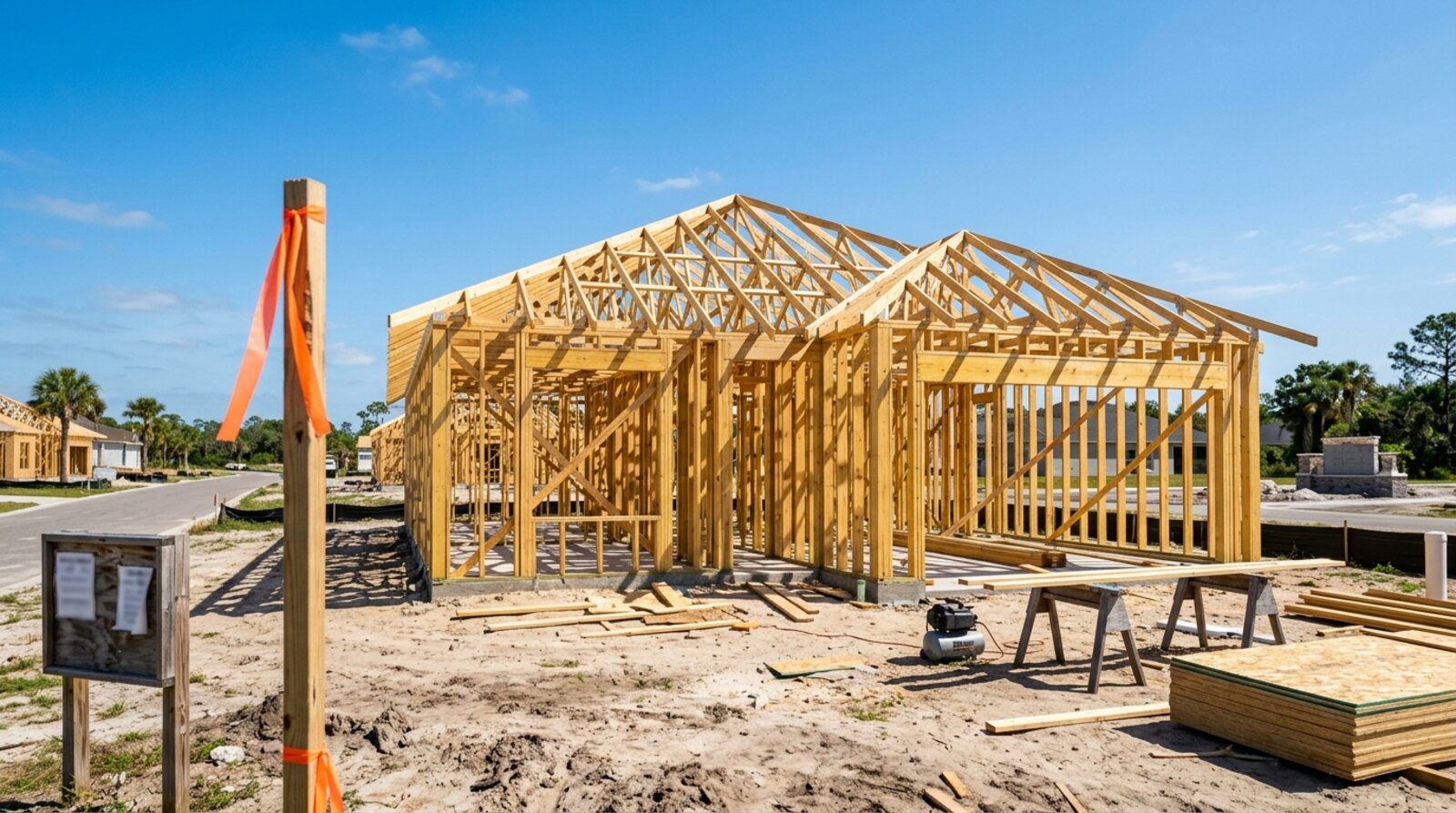
!A new-construction Florida home at framing stage with fresh lumber trusses, a survey stake, and a community sign under construction down the street
Central Florida · 2026 CDD Reference
CDD Fees in Orlando New Construction
What new construction buyers actually pay — and why a $480K home with a CDD can cost more per month than a $500K resale without one. Three views of the same number.
View 1 of 3 · Reference
Annual CDD Fees by Community
Mixed (1990s–2020s)
$135 – $1,135
per year
Some older phases nearly paid off; new phases at the high end.
2015–2024 (mostly fresh)
$1,500 – $3,500
per year
Town Center Village, Bridgewater, Independence — varies by phase.
Harmony
2010s
$1,000 – $1,800
per year
Osceola County master-planned; mid-life CDD.
2000s (mostly retired)
$100 – $400
per year
Navy Base redevelopment; ongoing assessment is mostly O&M.
Waterford Lakes
1990s (paid off)
$200 – $600
per year
Mature community; minimal residual.
View 2 of 3 · The Real Math
CDD vs. Non-CDD: True Monthly Cost
Scenario A
$480K new construction
Horizon West · with $3,000/yr CDD
- Mortgage P&I30-yr at 6.75%, 20% down$2,860
- Property tax (est)$480
- Homeowner's insurance$220
- HOA dues$175
- CDD assessment ÷ 12$3,000/yr → $250/mo$250
Scenario B
$500K resale
Winter Garden · no CDD
- Mortgage P&I$2,980
- Property tax (est)$500
- Homeowner's insurance$250
- HOA dues$80
- CDD assessment ÷ 12—
The headline number
The cheaper-on-paper new construction costs $175/month more than the more expensive resale.
Listing price ≠ carrying cost
View 3 of 3 · The Decay Curve
How CDD Fees Decline Over the Bond Life
CDD fees have two parts: debt service (which retires the infrastructure bonds) and operations & maintenance (ongoing). The debt service portion declines as bonds are paid off, then disappears at maturity. O&M continues indefinitely.
Year 0
100% of original
Year 10
80% of original
Year 20
50% of original
Year 30
Bonds retired
Buying a 20-year-old CDD community can mean a materially smaller annual assessment than buying brand-new. Always ask for the current bond balance and remaining term, not just the original CDD amount.
The Number That Doesn't Show Up in the Listing Price
Community Development District fees are one of the most consequential costs in Central Florida real estate, and one of the most consistently misunderstood. I talk to buyers who have been touring new construction communities in Horizon West, Lake Nona, and Viera for weeks without realizing that their monthly housing cost is significantly higher than what the builder's payment calculator showed them.
The builder's payment calculator almost always shows mortgage + estimated HOA. It does not always prominently display the CDD fee — which can add $150–$350 per month to the real carrying cost.
Here's what CDDs actually are and how to evaluate them properly before you buy.
What a CDD Is
A Community Development District is a special-purpose local government entity created under Florida law (Chapter 190, Florida Statutes) that issues bonds to finance the construction of infrastructure — roads, utilities, drainage, parks, recreation facilities, and other community amenities — for a new development. The bonds are repaid through an annual assessment levied on property owners within the district, which appears as a line item on your property tax bill.
CDDs are created when a developer wants to build a large-scale community but doesn't want to pay for all of the infrastructure costs upfront out of the purchase price. Instead, those costs are spread across the eventual property owners over 20–30 years. The result: the homes look cheaper than they actually are when you factor in the CDD obligation.
This is not inherently bad — the infrastructure funded by the CDD is real and valuable. Roads, utilities, and community amenities that are built and maintained to a high standard add genuine value. The question is whether you're accounting for the full cost.
How CDD Fees Are Structured
Your annual CDD assessment has two components:
Debt service — the repayment of the bonds issued to fund infrastructure construction. This is the larger component in the early years and is fixed by the bond terms. It does not vary based on community amenity usage. This component decreases over time as the bonds are paid off.
Operations and maintenance — funding for ongoing maintenance of community infrastructure (common areas, stormwater systems, amenity upkeep). This component can adjust annually based on actual costs and is governed by the CDD board, which is initially controlled by the developer and transitions to landowner control over time.
The total annual CDD assessment in Central Florida communities typically runs:
| Community Type | Annual CDD Fee Range |
|---|---|
| Townhome / entry-level new construction | $1,200–$2,200/year |
| Standard single-family new construction | $2,000–$3,500/year |
| Larger lot or amenity-heavy community | $3,000–$5,000/year |
Divide by 12 to get the monthly impact: a $3,000/year CDD fee adds $250/month to your housing cost — in addition to your mortgage payment and HOA dues.
Central Florida Communities with CDDs
CDDs are extremely common in Central Florida's planned growth corridors. Communities with CDD assessments include:
- Horizon West — virtually all Horizon West communities. Town Center Village, Lakeside Village, Bridgewater, Independence — all have CDDs. The specific assessment varies by village and phase.
- Lake Nona — Laureate Park, Storey Park, and other planned communities within the Lake Nona master plan carry CDDs.
- Viera — Brevard County's master-planned community has CDDs across most of its residential phases. We wrote a detailed piece on Viera CDD fees here.
- Celebration — older but still has CDD assessments; some bond debt has paid off in earlier phases.
- Waterford Lakes — older Orange County community with CDD structure.
- New construction in Osceola and eastern Orange County — most large-scale new communities in these growth corridors carry CDDs.
Baldwin Park — technically part of the Navy Base Redevelopment — has a CDD structure but it has largely paid off in most sub-phases; the ongoing assessment is primarily operations and maintenance.
When CDDs Are Worth It
The bond-funded infrastructure paid for by a CDD is real. The question is whether you're getting value commensurate with the cost.
CDDs make sense when:
- The community infrastructure is genuinely high quality (amenity centers, resort pools, multi-use trails, maintained common areas)
- The debt service component is declining as bonds pay off
- The home price reflects the ongoing CDD obligation (i.e., you're not paying market-rate pricing plus a CDD on top)
CDDs become a problem when:
- You compare a CDD community to a non-CDD resale home without accounting for the full carrying cost
- The builder's incentive package emphasizes closing cost credits while downplaying CDD exposure
- You buy in an early phase where CDD fees are highest and the amenities aren't built yet
How to Evaluate a CDD Before Buying
1. Get the full CDD assessment amount. Ask the builder or listing agent for the current annual CDD fee — both the debt service component and the operations and maintenance component. Some communities show these as separate line items; make sure you have both.
2. Check the bond maturity schedule. If you're buying in an older Horizon West community or a community where the CDD is 10+ years old, the debt service component may have declined significantly or even paid off. Resale homes in older phases of Summerport or early Lakeside Village may have CDD balances substantially lower than new construction in adjacent phases. Always ask the current amount, not the original amount.
3. Calculate the true monthly housing cost. Mortgage P&I + property taxes + homeowner's insurance + HOA + CDD/12. That's your monthly number. Run it before you fall in love with a specific community.
4. Compare to non-CDD alternatives. A $500K resale home in an established neighborhood without a CDD might have lower total monthly cost than a $480K new construction home in Horizon West with a $3,000/year CDD. Compare what $500K buys in different Orlando neighborhoods to see resale options side-by-side. The listing price comparison is misleading; the monthly cost comparison is accurate.
5. Understand what the CDD funds. The amenity center, the pool, the trail system — these are things you're paying for with the CDD. If you'll use them heavily, the value case is stronger. If you travel frequently and won't use community amenities, you're still paying for them.
The Disclosure Requirement
Florida law requires sellers and builders to disclose CDD assessments in a real estate transaction. Resale sellers are required to provide an estoppel letter that includes any outstanding CDD balance. Builder contracts typically include CDD disclosure, but it's often buried. I read every line of builder contracts for my clients and flag CDD obligations explicitly before signing.
Why Bringing Your Own Realtor Saves You Thousands
Walking into a builder's model home without your own agent is the single most expensive mistake new construction buyers make in CDD communities. The on-site sales agent is friendly, knowledgeable, and helpful — but they work for the builder. Their job is to maximize the builder's revenue, not your long-term economics.
Here's what changes when you bring a buyer's agent like me into the deal — at no cost to you, because the builder pays the commission either way:
1. Negotiating CDD bond prepayment at closing. Many builders allow prepayment of the outstanding CDD bond balance, eliminating the debt service portion permanently. The on-site agent rarely brings this up. I push for it as a closing-cost concession or builder credit, which can save $40,000–$80,000 in lifetime CDD payments on a typical Central Florida home.
2. Catching CDD overlap. Several Central Florida communities sit inside both a master CDD and a sub-district CDD, each with separate annual assessments. The builder's marketing typically discloses one. I verify total CDD obligation across all overlapping districts on the county property appraiser site before you sign — buyers who skip this step have been blindsided by an extra $800–$1,500/year they didn't budget for.
3. Reading the actual contract. Builder contracts run 80–120 pages. CDD disclosures are buried in attachments. Construction warranty caps, lender-favoring language, mandatory arbitration clauses, and timeline penalty asymmetries are all written to favor the builder. I read every line and flag anything that costs you money or limits your remedies.
4. Negotiating builder incentives the right way. Buyers without an agent typically take the first incentive package the builder offers — closing cost credit, free upgrades, rate buy-down. Builders move on price, upgrades, and lot premium when there's a knowledgeable buyer's agent in the room. The difference between a self-represented buyer's incentives and what I get my clients in identical homes is often $15,000–$35,000.
5. Avoiding a bad lender push. Builders push their preferred lender hard, sometimes tying the largest incentives to using that lender. Sometimes the preferred lender is competitive; sometimes the rate is 0.25–0.50% higher than what you can get elsewhere, which costs more over the life of the loan than the incentive saves. I run the math on builder lender vs. open-market financing for every client. As a dual-licensed mortgage loan originator (NMLS #1784218), I can also originate the loan myself when the math points that direction.
6. Independent inspection at frame and final. The builder's quality control isn't designed to catch problems before warranty service requests pile up. I bring an independent third-party inspector at the frame stage and at final walkthrough. Issues caught at frame cost the builder to fix; issues caught after closing cost you.
The buyers who do best in CDD communities are the ones who treat the purchase like the seven-figure transaction it is — and bring professional representation to the table. The cost is zero. The savings, on a typical Horizon West or Lake Nona purchase, run from $20,000 to over $100,000 depending on the home, the lender path, and whether bond prepayment is negotiable.
If you're touring model homes in any new construction CDD community in Central Florida, let me know before you sign anything. See our Orlando home buyer's guide for the complete playbook on new construction purchases. The builder will pay my commission. You will keep tens of thousands more of your own money.
My Recommendation
Don't let a CDD make or break a home purchase decision — but don't ignore it either. Factor it in from day one, compare alternatives on total carrying cost rather than purchase price, and understand what you're getting for the fee. A well-run CDD with excellent community infrastructure and a declining bond balance is a very different thing from a newer CDD in an early-phase community where the amenities are years away from completion.
The buyers who regret CDD communities are almost always the ones who didn't understand the math before they signed. The buyers who are happy with them understood exactly what they were buying.
I help buyers evaluate new construction and CDD communities across Central Florida. Let's talk before you visit model homes.
How to Evaluate CDD Fees When Buying New Construction in Central Florida
How to find, understand, and compare CDD fees on new construction homes in Horizon West, Lake Nona, Viera, and other master-planned communities — including what the fee funds, when it burns off, and how to model total carrying cost.
Step 1
Ask the Builder for the Exact Annual CDD Assessment Amount
The CDD fee is a government assessment that appears on the annual property tax bill — not in the monthly HOA fee. Builders are required to disclose the CDD assessment but do not always prominently display it in marketing materials or payment calculators. When you ask about monthly costs, explicitly say: 'What is the annual CDD assessment for this home?' — not 'what are my HOA and taxes?' The CDD fee in active Central Florida communities ranges from $1,500 to $3,500 per year depending on the community and the home's lot type. Divide by 12 and add it to your true monthly housing cost. A $3,000/year CDD is $250/month that often doesn't appear in the builder's quoted payment.
Step 2
Understand the Two Components of Any CDD Assessment
CDD assessments typically have two components. The debt service component repays the infrastructure bonds the CDD issued — this is fixed in amount and has a defined payoff date based on the bond term (typically 20–30 years from issuance). The operations and maintenance component covers ongoing maintenance of CDD-maintained infrastructure (roads, stormwater, common areas, recreation facilities) and is ongoing for as long as the CDD exists. When evaluating a CDD, ask for a breakdown of debt service versus O&M and the date the debt service portion expires — a home 15 years into a 30-year bond has a lower remaining debt service obligation than a brand-new community with fresh bonds.
Step 3
Check the Outstanding Bond Balance and Payoff Date
Under Florida law, the CDD's outstanding bond balance is public information and must be disclosed to buyers. The builder or community HOA management company can provide the current bond balance per unit and the final payoff year. In an older community like Laureate Park (Lake Nona, bonds issued around 2012), the per-unit debt service obligation is materially lower than in newer communities — Storey Park (established 2015), or communities with bonds issued in 2022–2024. A community where the debt service portion of the CDD burns off in 5–8 years carries a lower long-term carrying cost burden than a new community where 25 years of bond payments remain.
Step 4
Compare Total Monthly Cost Against Equivalent Resale Homes
Calculate the true total monthly housing cost for a new construction home in a CDD community: mortgage P&I + property taxes (assessed at purchase price) + homeowners insurance + HOA fees + CDD annual assessment ÷ 12. Compare this number against what the same purchase price buys in a resale home without a CDD. In many cases, the resale home in an established neighborhood carries meaningfully lower monthly cost because there is no CDD assessment layered on top. If the new construction home's total monthly cost exceeds the resale alternative by $400–$600/month, that is the price of the new construction warranty, energy efficiency, and builder incentives — evaluate whether it's worth it.
Step 5
Verify the CDD Assessment on the County Property Appraiser Site
Before closing, verify the CDD assessment amount on the county property appraiser or county tax collector website. Look up the property parcel and examine the prior year's tax bill (or the current year's if available). The CDD assessment should appear as a separate line item. If the builder's stated amount differs from the public record, request an explanation. Some communities have multiple overlapping CDD districts — a property might be in both a master CDD and a sub-district CDD, each with separate assessments. Confirm the total CDD obligation from all applicable districts, not just the one the builder mentioned.
Step 6
Factor the CDD Into Your Long-Term Exit Analysis
When you eventually sell, the CDD assessment transfers to the buyer. The buyer's lender factors it into DTI calculations, making properties with high CDD assessments effectively less affordable for future buyers — which can pressure your resale value relative to lower-CDD or non-CDD alternatives. In some communities, buyers have the option to prepay the outstanding bond balance at closing (eliminating the debt service component permanently) — ask the builder whether prepayment is available and calculate whether the economics of prepaying at purchase make sense given your expected hold period.
Frequently asked questions
- What is a CDD fee on new construction in Orlando?
- A CDD (Community Development District) fee is an annual government assessment that appears on your property tax bill — not an HOA fee. In Orlando-area new construction communities, CDDs are special-purpose local governments created under Florida Chapter 190 to finance infrastructure (roads, utilities, stormwater, parks, amenities) through bond issuances. Homeowners repay the bonds annually over 20–30 years. CDD fees in new construction communities typically range from $500 to $3,000/year depending on the infrastructure financed and the bond structure. The fee is in addition to ad valorem property taxes and any HOA fees.
- How much are CDD fees in new construction communities near Orlando in 2026?
- CDD fees in Orlando-area new construction communities in 2026 range widely: Viera (Brevard County) new construction communities run $135–$1,135/year; Lake Nona (Orange County) new-construction communities run roughly $1,200–$2,300/year (Storey Park runs about $1,216–$2,279 by home series); Laureate Park runs about $1,385/year on a typical home. Harmony (Osceola County) runs approximately $1,000–$1,800/year. New communities with large amenity packages (clubhouses, resort pools, golf courses) carry the highest CDDs. Always ask for the full CDD annual amount — not just the HOA — before calculating your total monthly carrying cost.
- Do CDD fees go away eventually?
- Yes — CDD fees decrease and can effectively disappear once the infrastructure bonds are fully retired. The timeline depends on the original bond term and whether the bonds have been refinanced. Older Florida master-planned communities with CDDs from the 1990s–early 2000s sometimes carry very low residual assessments ($100–$300/year) because the bonds are nearly paid off. Newer communities issued bonds in the 2015–2024 era typically have 20–30 years remaining. Some communities offer buyer prepayment of the outstanding bond balance at closing — ask the builder or HOA whether this option is available and the current payoff amount.
- Can you prepay a CDD bond at closing in Florida?
- Yes — many Florida CDD communities allow homeowners to prepay the outstanding infrastructure bond balance at closing, eliminating the annual debt service component of the CDD fee going forward. Only the maintenance assessment (typically $100–$300/year) remains after prepayment. Whether prepaying makes financial sense depends on: the outstanding bond balance, your expected hold period, and the effective interest rate on the CDD bonds relative to your alternative uses of that capital. Ask the builder or CDD management company for the current prepayment amount before you close — this information is publicly available for all registered Florida CDDs.
- How do CDD fees affect resale value of new construction homes?
- CDD fees affect resale value in two ways: first, they increase the effective monthly carrying cost for future buyers, which reduces the buyer pool and purchase price ceiling compared to identical homes without CDDs; second, they appear in lender DTI calculations, making the property less affordable for income-constrained buyers. Communities with low CDDs ($135–$400/year) have minimal resale impact. Communities with high CDDs ($1,500–$3,000/year) can see meaningful price compression relative to comparable non-CDD homes, especially in softer markets. When evaluating new construction, compare the total carrying cost (mortgage + HOA + CDD) against comparable resale options in the same school zone.
The next step
Thinking about a move?
Whether you're two months out or two years out, the right information now saves real money later. Let's talk — no pressure, no pitch.