· 8 min read· By Ryan Solberg, Broker #BK3354351
Moving to Orlando: Everything You Need to Know Before You Relocate
Orlando is the #1 domestic relocation destination for households leaving New York, New Jersey, and Illinois. Here's what actually matters for people moving here from out of state — the good, the bad, and the practical.
Orlando is the #1 domestic relocation destination for households leaving New York, New Jersey, and Illinois — not because of the theme parks, but because of the financial math. No state income tax, lower housing costs, direct flights to every major Northeast hub, and a job market that has diversified well beyond hospitality. This guide covers what actually matters for people making this move, including the things that surprise people when they get here.
The Financial Case for Relocating to Orlando

The income tax savings alone are significant. Florida has no state income tax. New York City residents pay a combined state and city rate that reaches 13.65% on higher incomes. New Jersey's top rate is 10.75%. Illinois is 4.95%.
For a household earning $150,000, the annual tax savings by relocating to Florida typically fall between $8,000 and $14,000 depending on the origin state and specific income composition. That is real money every year.
Compounded over 10 years with modest investment returns on that annual savings, you are looking at $120,000–$200,000 in accumulated wealth that simply didn't exist before. This is the math that is driving household formation in Central Florida from the Northeast, and it shows up in the housing data every year.
Housing costs reinforce the case. A house in suburban Orlando that costs $550,000 would be $900,000 or more in comparable New Jersey suburbs, and multiples higher in comparable Connecticut or Westchester County locations. The price-to-quality ratio is genuinely different.
What Actually Surprises People (The Honest List)
Real estate agents who tell you everything is perfect aren't helping you make a good decision. Here is what catches people off guard when they move from the Northeast.
1. The summer heat is genuinely brutal.
June through September, Orlando posts daily highs of 92–96°F with heat index values regularly hitting 100–108°F. Humidity runs 80–90%. This is not like hot days in New Jersey or Maryland where you go inside and wait for the evening to cool down. The evenings don't cool down until October. If you are an outdoor runner, gardener, or someone who spends significant time outside by preference, adjust your expectations. People who move here and thrive adapt their schedules — outdoor activities happen at 6 AM or after sunset in summer.
2. You need a car for everything.
Orlando has no meaningful public transit infrastructure. The SunRail commuter rail connects a few stops along a north-south corridor, but it doesn't serve most neighborhoods and doesn't run frequently. There is no subway. Bus service exists but is not a practical transportation solution for most residents. Budget $600–$800 per month for a car payment, gas, and Florida auto insurance, which is higher than most states due to litigation environment and storm risk exposure.
3. I-4 is a problem during rush hour.
Interstate 4 runs diagonally through the metro from southwest (the theme park corridor) to northeast (Daytona Beach direction). During morning and evening rush hours, particularly between downtown Orlando and the theme park / I-Drive area, it backs up significantly. If your job or lifestyle requires that commute daily, account for it. Living east of downtown (Baldwin Park, Winter Park, Maitland, Oviedo) mostly avoids the worst of it.
4. Homeowner's insurance sticker shock.
Florida's insurance market has been in distress for several years following storm losses and litigation patterns. Homeowner's insurance in the Orlando area now typically runs $4,000–$8,000 per year for a standard single-family home, compared to $1,500–$2,000 in many Northeast states. This is not a temporary condition — it is structural to the Florida market. Factor it into your total housing cost calculation before comparing to a Northeast mortgage payment.
5. The tourist corridor is not where locals live.
International Drive, US 192 (the Kissimmee tourist strip), and the area immediately surrounding Disney are built for tourism, not daily living. Traffic is slow, restaurants are overpriced, and everything is designed for people visiting for three days. Locals almost never go there. When evaluating neighborhoods, ignore proximity to I-Drive as a quality metric.
Picking the Right Neighborhood for Your Situation
The Orlando metro has genuinely distinct submarkets, and the right one depends on what you're optimizing for.
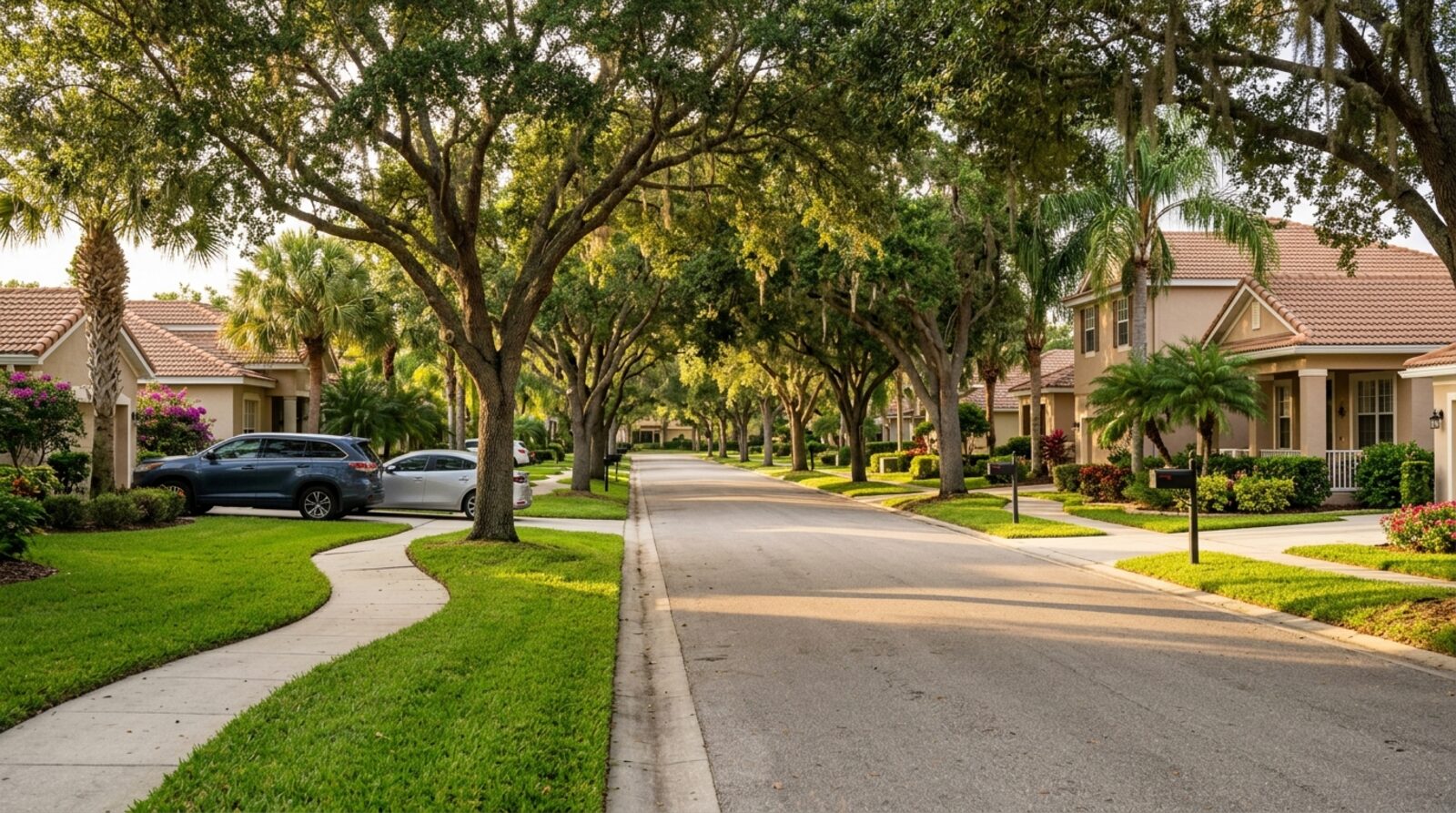
Northeast corridor transplants who want something that feels urban and walkable typically land in Winter Park, Maitland, or Baldwin Park. These areas have tree-lined streets, walkable town centers with restaurants and shops, and a density of character that the newer master-planned suburbs don't have. Housing prices are higher — $600K–$1.5M for a quality SFR — but the lifestyle is more familiar for people coming from New England or New York suburbs.
Tech workers and remote professionals consistently choose Lake Nona. The Medical City anchor brings a professional community, the schools are strong, infrastructure is new, and the highway access is good. Housing in the $500K–$900K range is newer construction with modern finishes.
If schools are the priority, look at Oviedo and the Lake Mary / Heathrow corridor in Seminole County first. Seminole County's public school system consistently outperforms Orange County (OCPS) overall. If school quality is your first filter, it should literally be the first filter — figure out which school zones meet your standard and then look for homes within those zones, not the other way around.
Value buyers who want newer construction, more square footage, and lower traffic than the urban core should look at Winter Garden and Horizon West on the western edge of Orange County. Excellent growth story, newer infrastructure, and prices that still deliver meaningful space for $450,000–$650,000.
The Practical Relocation Checklist
These are the things that have actual deadlines or financial consequences.
Florida driver's license: Required within 30 days of establishing residency. Bring your out-of-state license, proof of identity (birth certificate or passport), proof of Social Security number, and two documents showing your Florida address. Do this early — DMV appointments fill up.
Vehicle registration: Florida requires you to register your vehicle within 10 days of becoming a resident. This is faster than the license requirement. You'll pay sales tax on the vehicle value (if you haven't already paid Florida tax) and a registration fee.
Homestead Exemption: This is the most financially consequential deadline on the list. If you close on a Florida home and establish it as your primary residence by December 31 of any given year, you must apply for the Homestead Exemption by March 1 of the following year. Missing that deadline costs you $550–$700 in real tax savings for the entire year, and you cannot back-date it. File at your county property appraiser's website as soon as you close and move in.
Voter registration: Update your registration to Florida within 29 days before any election you want to vote in.
Change your address: Bank accounts, IRS address on file, employer payroll, subscriptions, brokerage accounts, and USPS mail forwarding. Do these all at once — most people forget one or two and spend months chasing stray mail.
The Homestead Exemption in More Detail
Because it's worth understanding: the Homestead Exemption does two things, not one.
First, it reduces your home's assessed value by $50,000 for property tax calculation purposes. On a $600,000 home, you're taxed on $550,000 instead. At Orlando-area millage rates, that saves approximately $550–$700 per year.
Second, and more valuable over time, it activates the Save Our Homes cap, which limits annual increases in your home's assessed value to 3% or CPI (whichever is lower), regardless of how fast actual market values rise. Over a 10–15 year hold in a market that appreciates 5–7% annually, the SOH cap compresses your tax bill dramatically compared to market rates. It is one of the best long-term financial benefits of Florida homeownership.
Schools: Make This Your First Filter If It Matters
If schools matter to you, use school zone as your primary search filter — not neighborhood name, not commute time, not price range. Those can all be compromised. School zone is harder to change.
Seminole County Public Schools (Oviedo, Lake Mary, Longwood, Casselberry) consistently receive higher state grades than OCPS overall. The Oviedo and Lake Mary corridors are the strongest options in the metro if public school quality is a priority.
Orange County Public Schools has significant variance by school. Some schools in Winter Park, Baldwin Park, and Lake Nona zones are excellent. Others are not. You have to check the specific school assigned to a specific address, not the neighborhood.
Use our school zone tool to look up assigned schools by address before you narrow your search. Take our neighborhood quiz to get a personalized recommendation based on your priorities.
Orlando is a legitimate relocation destination with real financial advantages. The households coming from the Northeast and Midwest are not moving for the weather in August — they're moving for the math. If you go in with clear eyes about the summer, the car dependency, and the insurance costs, and you pick a neighborhood that fits your actual lifestyle priorities rather than a name you've heard, this market delivers.
I work with relocating buyers from out of state every week. The people who have the smoothest transitions are the ones who spent time on the fundamentals before they toured a single house. If you want a conversation about what makes sense for your specific situation, reach out directly.
Frequently asked questions
- What do I need to know before moving to Orlando?
- The most important things to understand before relocating to Orlando: (1) Car dependency is absolute — there is no meaningful public transit; budget for two cars for a two-adult household; (2) Summer heat is more intense than most visitors expect — 90°F + 80% humidity, June through September, with daily afternoon thunderstorms; (3) HOA and CDD fees are common and real budget items in the best communities ($300–$600+/month); (4) School zones must be verified by specific address — neighborhood reputation doesn't guarantee a school assignment; (5) Homestead exemption requires filing an application by March 1 of the year following purchase — it's not automatic; (6) Homeowners insurance quotes should be obtained before making an offer, not after.
- What is the best area of Orlando to move to?
- The best area depends on your priority: for schools, Winter Park (top schools, walkable), Oviedo/Seminole County (best value-to-school ratio), or Dr. Phillips (established community, restaurant access); for healthcare/Medical City employment, Lake Nona; for defense/aerospace employment, east Orange County near the Research Park or Brevard County; for Disney/tourism employment, the Celebration or Horizon West corridor; for urban lifestyle, downtown Orlando or SODO; for luxury estate living, Windermere or Dr. Phillips. The single best general-purpose recommendation if schools are your priority: Oviedo or Dr. Phillips, depending on which school zone profile and price point fits better.
- How do I establish Florida residency when I move to Orlando?
- To establish Florida residency: (1) Obtain a Florida driver's license within 30 days of becoming a Florida resident (visit a DMV; bring current license, proof of address, Social Security card); (2) Register your vehicles in Florida within 10 days of establishing residence (bring out-of-state title, odometer disclosure, and proof of Florida insurance); (3) File for homestead exemption by March 1 of the year following your purchase date — file online or at the Orange County Property Appraiser's office; (4) Update your voter registration if applicable; (5) For income tax purposes, document Florida as your domicile with dated utility bills, bank statements, and other evidence — especially important for transplants from high-income-tax states who may face back-tax scrutiny.
- What surprises people most about living in Orlando?
- The most common surprises from new Orlando residents: (1) The suburban quality is higher than expected — the best neighborhoods (Winter Park, Dr. Phillips, Windermere) are genuinely excellent communities, not just theme-park-adjacent sprawl; (2) The summer heat is harder to adjust to than anticipated — even people who've visited in summer underestimate the lifestyle impact of June–September heat and humidity; (3) Restaurant and dining quality is better than the tourist-focused stereotype suggests — Dr. Phillips' Restaurant Row and Winter Park's Park Avenue are genuinely strong dining corridors; (4) Traffic on I-4 is as bad as advertised; (5) The financial savings from no state income tax register more significantly in the first tax season than most new residents anticipated.
- What is the job market like in Orlando for people relocating?
- Orlando's job market is diversified and growing. Key employment sectors: tourism and hospitality (Disney, Universal, Marriott, convention center — largest single employer base); healthcare and life sciences (Lake Nona Medical City, Orlando Health, AdventHealth, Nemours); defense and aerospace (L3Harris, Lockheed Martin, Northrop Grumman, Siemens — concentrated near UCF Research Park and the I-4/SR-528 corridor); technology (EA, Microsoft, Cloudflare, growing tech cluster); and education (UCF is the largest university in the U.S. by enrollment). Remote workers from any industry can access all of Orlando's lifestyle advantages while maintaining remote employment. For local employment, healthcare, defense, and tech offer the strongest compensation relative to cost of living.
The next step
Thinking about a move?
Whether you're two months out or two years out, the right information now saves real money later. Let's talk — no pressure, no pitch.