· Updated · 12 min read· By Ryan Solberg, Broker #BK3354351
What Orlando Sellers With Low Mortgage Rates Need to Know Before Listing
You locked in at 3.25%, and the average 30-year mortgage is now 7.28%. That gap is real, but it is one line in a longer calculation. Here is the worksheet to find out whether you are actually stuck.
The average 30-year mortgage hit 7.28% on October 1, 2026, up from 6.75% when I first wrote this guide in May. If you're sitting on a 3% loan, that is the widest gap yet between what you have and what you'd get. But feeling locked in and being locked in are different things. The first is a feeling. The second is a calculation, and most homeowners I talk to have never actually run it.
This is a math problem. Let's run it.
Where Rates Are Right Now
Freddie Mac's weekly survey tells the recent story. The Fed raised its benchmark rate on September 16 for the first time since 2023, and mortgage rates had already been climbing in anticipation. I covered what it means for Orlando in our Fed rate hike breakdown.
| Week of | 30-year fixed average |
|---|---|
| February 26, 2026 (2026 low) | 5.98% |
| September 3, 2026 | 6.71% |
| September 17, 2026 | 6.95% |
| September 24, 2026 | 7.03% |
| October 1, 2026 | 7.28% |
The 15-year fixed averaged 6.60% on October 1. These are national averages, not quotes, and your own rate depends on your credit, down payment, and loan type. You can see this week's number any time on our mortgage rates page.
You are also in the majority. Realtor.com's analysis of FHFA data found that about 49.9% of outstanding U.S. mortgages carried a rate of 4% or lower in Q1 2026, down slightly from 50.6% in Q4 2025. That is why so many homeowners feel stuck, and why the number of homes for sale has been tighter than it would otherwise be.
Do the Math: A Worksheet You Can Run in an Hour
Here's the worked example I walk sellers through. Use your own numbers in each line. The example homeowner has a $290,000 balance at 3.25% with 25 years left, a home worth $450,000, and today's 7.28% rate.
Step 1: Price your handcuff
Your current principal-and-interest payment on $290,000 at 3.25% with 25 years remaining: about $1,413 a month.
What that same $290,000 would cost over 25 years at 7.28%: about $2,102 a month.
The difference, about $689 a month or $8,268 a year, is what your low rate is worth. That's the real size of the handcuff for this homeowner. It's a lot, and it's also a number. Anything the move gives you has to be worth more than that to you.
Step 2: Find your net cash from the sale
| Line | Amount |
|---|---|
| Sale price | $450,000 |
| Listing fee at MaxLife (1%) | −$4,500 |
| Buyer's-agent compensation (2.5%, negotiable) | −$11,250 |
| Florida documentary stamp tax (0.7%) | −$3,150 |
| Title and closing costs (estimate) | −$2,500 |
| Buyer concessions (2%, a typical allowance) | −$9,000 |
| Loan payoff | −$290,000 |
| Net cash to you | about $129,600 |
Total selling costs here are about 6.8% of the price. Buyer's-agent compensation and concessions are negotiated deal by deal, so treat those two lines as planning assumptions. Our seller net sheet calculator lets you put in your own price and terms, and how to read a seller's net sheet explains each line.
Step 3: Model the new payment for each destination
Take your net cash, subtract about 3% of the new price for your buying closing costs, and put the rest down. Everything else is the new loan at 7.28% over 30 years.
| Where you're going | Down payment | New loan | New P&I | Change vs. $1,413 today |
|---|---|---|---|---|
| Lateral: $450,000 home | $116,100 | $333,900 | $2,285 | +$871/mo |
| Move up: $600,000 home | $111,600 | $488,400 | $3,342 | +$1,928/mo |
| Downsize: $300,000 home | $120,600 | $179,400 | $1,227 | −$186/mo |
A few things jump out:
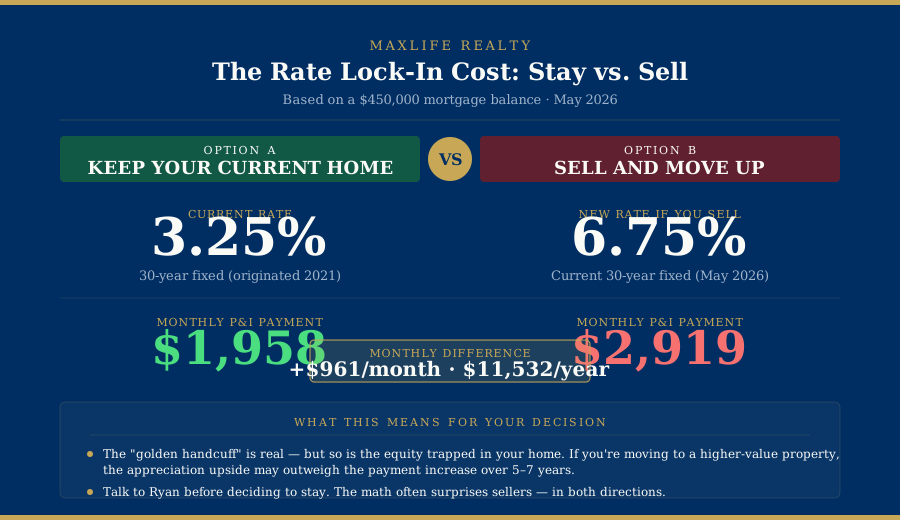
- The lateral move costs about $871 more per month. That's less than the $1,121 gap you get from the headline-rate comparison in the graphic, because your sale equity shrinks the new loan. But it's still real money, and you get no bigger asset for it. This is the move that needs a non-financial reason: schools, family, a layout that no longer works, a job change.
- Moving up is where the payment hurts most, because you're buying more house with a similar amount of cash down. The question is whether the bigger home is worth about $1,928 a month more.
- Downsizing can lower your payment even at 7.28%, but only if you go meaningfully smaller. In this example, a $350,000 home would still raise the payment by about $167 a month.
Step 4: Add the costs that are not principal and interest
Principal and interest is the easiest number to compare and the one most likely to mislead you. Before you decide, compare total monthly housing cost:
- Property taxes. If you have a homestead exemption, Save Our Homes caps how fast your assessed value can rise each year. A new purchase resets the assessed value to market, so the tax bill on your next home can be meaningfully higher than on the one you own. Florida allows you to transfer, or "port," part of your accumulated cap benefit to a new homestead, up to a limit, if you buy within the required window. Ask your county property appraiser how much you'd keep.
- Homeowners insurance. It gets priced fresh on the new home's age, roof, and location. Insurance has been easing for many Florida homeowners this year (see our 2026 insurance breakdown), but your quote is what matters.
- HOA and CDD fees. They vary widely between communities, and they stay with the house.
- Your cost of staying. Roof, HVAC, and other deferred maintenance on the home you own are part of the comparison, too.
Step 5: Test two rate scenarios
Waiting for a lower rate is a bet. Here's how a $300,000 loan responds so you can see the stakes:
| Rate | Monthly P&I on $300,000 |
|---|---|
| 7.28% (Oct 1, 2026) | $2,053 |
| 6.75% | $1,946 |
| 6.00% | $1,799 |
| 5.50% | $1,703 |
Every full point is about $190 to $200 a month on a $300,000 loan. That's meaningful, but even a two-point drop wouldn't close the gap between 3.25% and today's rates. As of the Fed's September projections, most officials expected one more hike this year, not a cut, so I wouldn't plan around a lower rate arriving soon. If it does, you can refinance. If you wait and it doesn't, you've spent that time in a home that doesn't fit.
Step 6: Make the call
Put the numbers next to the reason you want to move.
- Sell now if the move solves a real problem and the full monthly cost fits your budget without strain.
- Wait if the move is optional and the payment would genuinely hurt.
- Stay, and invest in the house you have, if the only thing pulling you out is wanting something new and the handcuff is worth more than the benefit.
The Equity You're Sitting On
Rate anxiety makes many homeowners focus on the payment and ignore the asset. Start with a free home valuation so you have a real number. Many Orlando homeowners who bought in 2019 to 2021 have meaningful equity today, even after the market softened this year. The August 2026 median sale price in the Orlando metro was $400,676, down 0.6% from a year earlier, per the Orlando Regional REALTOR Association, so prices have flattened rather than fallen. Your equity is the asset that unlocks the next purchase, which is why Step 2 above matters as much as the rate.
Principal paydown matters too. After five years of payments on a 3.25% loan, you've been building equity from both sides, and that balance is what your down payment is made of.
Four Strategies to Soften the Rate Impact
If you decide to sell, these four moves can take real money off the new payment.
1. Make a larger down payment
Your rate applies to your loan balance, not your purchase price. Every extra dollar down reduces the principal charged at 7.28%.
Example: On a $650,000 purchase, 20% down ($130,000) leaves a $520,000 loan, and principal and interest is about $3,558 a month. Putting 35% down ($227,500) leaves $422,500 and about $2,891 a month. The extra $97,500 saves about $667 a month, or about $8,005 a year, which works out to roughly 8.2% a year on the extra cash you put in. That isn't a guaranteed investment return, and the money is less liquid once it's in the house, so keep a healthy cash cushion. But it's a useful yardstick to compare against what that cash would otherwise earn.
2. Negotiate a rate buydown or builder incentive
A buydown lowers your rate for a period of time, paid for by the seller or builder. On a $400,000 loan at 7.28%, a 2-1 buydown gives you about $2,216 a month in year one, $2,471 in year two, and $2,737 from year three. The seller or builder funds the roughly $9,400 difference. That buys you time, but the full payment still arrives in year three, so only use it if you can afford the permanent payment.
Many Central Florida builders have been advertising financing incentives on inventory homes. Compare each offer against a straight price reduction using the full loan terms, not the headline rate. Our new construction incentives breakdown shows how. For resale, our guide to buyer concessions covers how credits and buydowns compare.
3. Look for assumable FHA or VA loans
FHA and VA loans are assumable, which means a qualified buyer can take over the seller's existing loan at its original rate. A home with an assumable 3% loan is a valuable find. The catch: you pay the seller the difference between the price and the loan balance, in cash or with secondary financing. On a $450,000 home with a $250,000 assumable loan, that's $200,000 you need to bring. They're rare and the lender must approve you, but if you have the cash, they're worth searching for.
4. Use Florida portability on your property taxes
If you're moving within Florida and have a homestead exemption, ask your county property appraiser about Save Our Homes portability. It can carry part of your assessed-value cap to the new home, which can lower your property-tax bill and offset some of the payment increase. It has requirements and a filing window, so check before you close.
Other Options Besides Selling
Selling isn't the only way out of the handcuff.
- Improve the house you have. If you love the location and the problem is the home itself, a renovation, an addition, or a pool can be cheaper than the payment jump. A home-equity loan or line carries a higher rate than your first mortgage, but only on the amount you borrow, so your 3% loan stays intact on the rest.
- Keep it and rent it out. If you've outgrown the house but not the rate, renting it lets you keep the cheap loan while you buy elsewhere. You'll need to qualify for the second mortgage, and the math on rental income, vacancy, and taxes matters. We walk through that in selling versus renting out your Orlando house.
- Wait. If the move is optional, waiting is a legitimate choice. Just wait deliberately, with a trigger like a rate level or a life event, rather than by default.
What the Rate Environment Is Likely to Do
I can't predict rates, and neither can anyone else. What I can tell you is what's known. The Fed raised its rate in September and most officials projected another increase before year-end. Rates are not going back to 3%. The pandemic-era conditions that produced them are gone.
Orlando has been a buyer-leaning market this fall, with 4.9 months of supply and 64 average days on market in August, per the Orlando Regional REALTOR Association. If you list, price for today's buyer from day one. That matters more now than it did in the spring.
If rates fall meaningfully, some locked-in owners will list, and competition among sellers will rise. If they stay high, the lock-in persists. Either way, the decision that holds up is one based on your numbers and your life, not on a rate forecast.
Making the Decision
The rate lock-in is a real constraint. A payment jump of $871 a month on a lateral move is hard to justify on money alone. But selling is rarely just a financial decision. It's a life decision with financial consequences you can price.
The questions worth sitting with:
- Does my current home still serve my life? What is staying costing me in ways that aren't on a statement?
- What does my total monthly cost look like on the next home, with taxes and insurance, after I put my full equity down?
- Is the value of the move bigger than what my rate is worth, about $689 a month in the example above?
- What is waiting costing me, in life terms as well as dollars?
Send me your balance, rate, and where you're thinking of going, and I'll run the worksheet with your real numbers. The result surprises most homeowners, in both directions. Reach out or start with a free home valuation.
Ryan Solberg · MaxLife Realty · 321-373-3536. Rates as of October 1, 2026: Freddie Mac Primary Mortgage Market Survey (via FRED); mortgage-rate distribution from Realtor.com's analysis of FHFA National Mortgage Database data (Q1 2026); Orlando market figures from the Orlando Regional REALTOR Association (August 2026). Payment figures are calculated principal and interest only, using the stated assumptions, and are illustrations rather than quotes. Mortgage rates quoted are national averages, not an offer of credit. This is market analysis and general education, not financial or tax advice. Consult your lender, CPA, or financial advisor for your specific situation.
How to Decide Whether to Sell Your Orlando Home When You Have a Low Mortgage Rate
A step-by-step worksheet for rate-locked Orlando homeowners: price the handcuff, compute your net cash, model the new payment for your destination, and decide whether to sell, wait, or stay.
Step 1
Pull Your Loan Balance, Rate, Payment, and Years Remaining
Get your latest mortgage statement. You need your current principal balance, interest rate, monthly principal-and-interest payment, and the number of years left on the loan. Use the balance, not the original loan amount, because the balance drives every later step.
Step 2
Price Your Handcuff
Compare your current principal-and-interest payment with what the same balance would cost at today's rate over the same remaining term. At 7.28%, a $290,000 balance with 25 years left costs about $2,102 a month, versus $1,413 at 3.25%. The gap, about $689 a month, is the dollar value of your low rate. It is the number to weigh against the value of the move.
Step 3
Calculate Your Net Cash From the Sale
Estimate your sale price, then subtract the listing fee, any buyer's-agent compensation you offer, Florida documentary stamp tax on the deed (0.7% of the price), title and closing costs, expected buyer concessions, and your loan payoff. The result is the cash you can put into the next home. Use our seller net sheet calculator for your own price.
Step 4
Model the New Payment for Each Destination
Subtract your estimated closing costs on the next purchase from your net cash to get your down payment. Subtract that from the purchase price to get the new loan, then calculate principal and interest at today's rate. Run it for a lateral move, a move up, and a downsize if you are considering more than one.
Step 5
Add Taxes, Insurance, and Florida Portability
Compare total monthly cost, not just principal and interest. A new purchase resets your assessed value for property tax, homeowners insurance gets repriced on the new home, and HOA or CDD fees may differ. If you have a homestead exemption, ask your county property appraiser how much Save Our Homes portability you can carry to a new Florida homestead.
Step 6
Test Two Rate Scenarios
Repeat the new-payment calculation at the current rate and at a rate one point lower. Waiting for a lower rate is a bet, not a plan, so see what the decision looks like if rates stay where they are.
Step 7
Decide to Sell, Wait, or Stay
Sell if the move solves a real problem and the full monthly cost fits your budget without strain. Wait if the move is optional and the payment would hurt. Stay, and consider improving the home you have, if the only reason to move is that you want to, and the handcuff is worth more than the benefit.
Frequently asked questions
- Should I sell my house if I have a low mortgage rate?
- It depends on where you're moving and why. If you're upsizing, the equity from your current home often offsets part of the payment increase. If you're downsizing, you may shrink or eliminate the new mortgage. If you're moving laterally to a similar price, the payment jump is hardest to absorb, so there should be a real life reason, such as schools, family, or a home that no longer fits. Run your own numbers before deciding.
- How much more will I pay per month if I sell my low-rate home and buy a new one?
- It depends on the size of your new loan, not the price of the home. As an illustration, a $450,000 loan costs about $1,958 a month in principal and interest at 3.25% and about $3,079 at 7.28%, a difference of roughly $1,121 a month. But if you put your sale equity into the new home, your new loan is usually much smaller than $450,000, so the real difference is lower. The worksheet in this guide shows how to calculate it for your own balance.
- What is the mortgage rate lock-in effect?
- The lock-in effect is the reluctance of homeowners with a much lower rate than today's to sell, because moving means trading a cheap loan for an expensive one. Realtor.com's analysis of FHFA data put about 49.9% of outstanding U.S. mortgages at 4% or lower in Q1 2026. It suppresses the number of homes for sale, though Orlando has had more inventory than most markets: 4.9 months of supply in August 2026, per the Orlando Regional REALTOR Association.
- What are mortgage rates right now?
- Freddie Mac's weekly survey put the average 30-year fixed rate at 7.28% on October 1, 2026, and the 15-year fixed at 6.60%. These are national averages, not quotes. Your rate depends on your credit, down payment, loan type, and points, so get a written quote from a lender. Our mortgage rates page updates weekly from Freddie Mac data.
- Are there strategies to reduce the rate impact when selling and buying in Orlando?
- Yes. You can put your sale equity toward a larger down payment so the new loan is smaller, negotiate a seller-paid rate buydown or a builder's financing incentive, buy a home with an assumable FHA or VA loan if you can cover the gap between the price and the loan balance, and use Florida's Save Our Homes portability to carry part of your property-tax cap to a new homestead. Each has trade-offs, so price them against each other for your situation.
- What is a 2-1 rate buydown and does it help?
- A 2-1 buydown lowers the buyer's rate by 2 points in year one and 1 point in year two before settling at the note rate. On a $400,000 loan at 7.28%, the payment would be about $2,216 in year one, $2,471 in year two, and $2,737 from year three on. The seller or builder pays the cost, which in that example works out to roughly $9,400. It gives you time, but the rate does not stay low, so plan for the full payment.
- Can I keep my low rate and move?
- Sometimes. Most conventional loans are not portable, so the rate stays with the house. Options are to keep the house as a rental and buy another home, which means qualifying for the second loan and meeting investment-property or second-home terms, or to buy a home with an assumable FHA or VA loan. Neither is simple, so talk to a lender before you count on it.
The next step
Thinking about a move?
Whether you're two months out or two years out, the right information now saves real money later. Let's talk — no pressure, no pitch.