· Updated · 5 min read· By Ryan Solberg, Broker #BK3354351
Property Tax in Orange County Florida: What Buyers Pay in 2026
Orange County's combined millage runs about 16.2 mills in unincorporated areas (≈1.6% of taxable value). A homesteaded $500,000 home runs roughly $7,200–$7,800 in year one — and the Homestead Exemption plus the Save Our Homes cap brings that down over time.
Watch the video
Orange County's combined millage is about 16.2 mills in unincorporated areas — roughly 1.6% of taxable value (per the Property Appraiser's 2025 final millage). On a homesteaded $500,000 home, that's roughly $7,300 per year in the first year, after the $50,000 Homestead Exemption drops the taxable base to $450,000. Inside the City of Orlando (~18.1 mills) it runs higher; non-homestead investment properties pay more still, with no cap on assessed value increases.
Here's how the system actually works — including the two Florida-specific benefits that make a significant long-term difference for primary residents.
2026 update: Florida voters will decide a property tax cut in November 2026 that could sharply raise the homestead exemption on non-school taxes. See Florida Property Tax Relief in 2026 for the details and what they mean for Orange County buyers.
How Florida Property Taxes Are Calculated
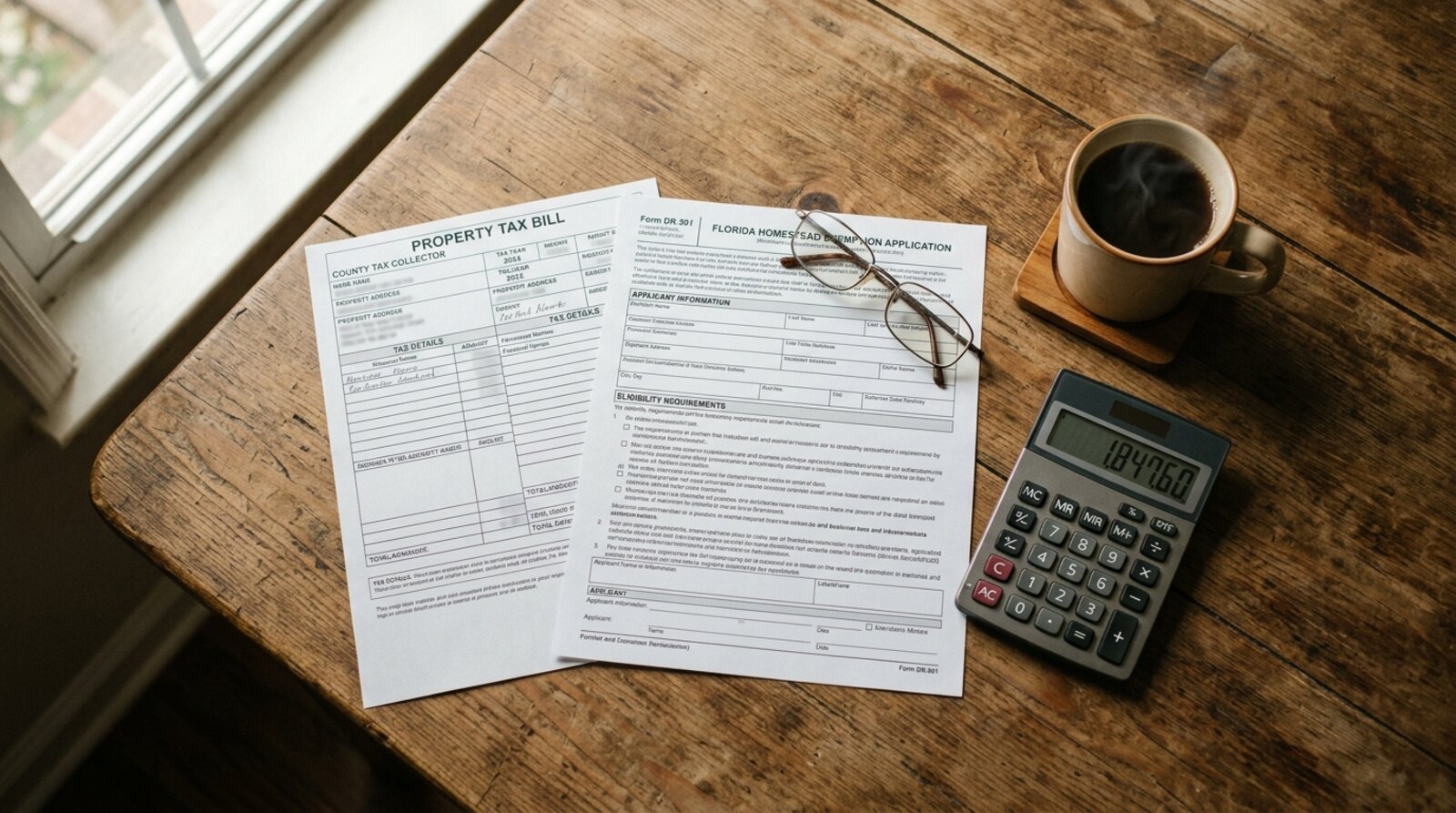
Florida property taxes use a millage rate system. "Mill" means one-tenth of one cent, or $1 for every $1,000 of taxable value. The formula is:
Taxable Value × Millage Rate = Annual Property Tax
For Orange County in 2025, the combined millage rate — county government, school board, water management, library, and applicable special districts — is approximately 16.2 mills for most unincorporated areas (per the Orange County Property Appraiser's 2025 final millage). That equals about $1,620 per $100,000 of taxable value.
Properties inside city limits (Orlando, Apopka, Ocoee, Winter Garden, etc.) carry additional municipal millage, so their total rates run higher — inside the City of Orlando the combined rate is about 18.1 mills, and a handful of special districts run into the 19s.
The Property Appraiser's office determines your "just value" (market value) each January 1st. That just value, reduced by any exemptions you qualify for, becomes your taxable value. Multiply by the millage rate, and you have your tax bill.
The Homestead Exemption: Up to $51,411 Off Your Assessed Value (2026)
If you own and occupy a Florida home as your primary residence, you qualify for the Homestead Exemption. For 2026 it reduces your assessed value by up to $51,411 — a first $25,000 that applies to all taxing authorities, plus a second portion that applies to everything except school taxes. That second portion has a $25,000 base but is now inflation-indexed under Amendment 5, reaching $26,411 for 2026.
Example — $500,000 home with Homestead (unincorporated):
- Just value: $500,000
- Homestead exemption: −$50,000
- Taxable value: $450,000
- At ~16.2 mills: $450,000 × 0.0162 ≈ $7,300/year
A small nuance: the second $25,000 of the exemption doesn't apply to school taxes (~7 of the ~16.2 mills), so the true figure lands a touch higher — roughly $7,300–$7,800 for the total bill on a homesteaded $500K home. Inside the City of Orlando, at ~18.1 mills, the same home runs closer to $8,200–$8,700.
The key planning number: budget roughly 1.4–1.6% of your purchase price in year one (a bit higher inside Orlando city limits), before the Save Our Homes cap begins to compress your assessed value. One caveat on the often-quoted "~1.0–1.1% effective rate" for Orange County: that's a county-wide average, pulled down by long-time owners whose Save Our Homes-capped assessments sit far below market. A brand-new buyer, assessed at close to purchase price, pays nearer the full millage.
Homestead application deadline: March 1 of the year following your purchase. If you close in October 2026, apply by March 1, 2027 to receive the exemption on your 2027 tax bill.
Save Our Homes Cap: The Long-Term Benefit No One Talks About Enough
Once you have Homestead, Florida's Save Our Homes amendment caps how fast your assessed value can increase. Annual assessment increases are limited to 3% or the Consumer Price Index (CPI) — whichever is lower.
This is transformative for long-term residents. If you bought a home in 2016 for $350,000 and it's now worth $650,000 on the open market, your assessed value is only allowed to have grown 3% per year from your original assessed value. Many longtime Florida homeowners pay taxes on assessed values that are $150,000–$300,000 below current market value. If you're not sure where your home stands today, check your home's current market value and compare it against the assessed value on your tax bill.
For buyers, the implication is immediate: year one is the expensive year. Your assessed value starts at your purchase price (the Property Appraiser resets to market on sale). After that, Save Our Homes limits how fast your bill can grow. A $500,000 home purchased in 2026 can't see its assessed value increase by more than $15,000/year — regardless of what the market does.
Portability: Taking Your Tax Benefit With You When You Move
If you sell your Florida primary residence and buy another one in Florida, you can transfer ("port") your accumulated Save Our Homes benefit to your new home. The benefit is the difference between your home's just value and its capped assessed value.
Example:
- Current home just value: $700,000
- Current home assessed value (after years of 3% caps): $480,000
- Portability benefit: $220,000
- New home purchase price: $900,000
- New home taxable value after porting: $900,000 − $220,000 = $680,000
This substantially lowers the tax bill on your new purchase compared to what a new-to-Florida buyer at the same price would pay. Portability must be applied for within 3 years of selling your previous Florida homestead.
Investment Property and Non-Homestead Taxes
Investment properties, rental homes, and second homes receive no Homestead Exemption and no Save Our Homes cap. The Property Appraiser assesses them at full market value every year, and there's no ceiling on how fast that assessed value can rise.
Over time, non-homestead properties pay meaningfully more than equivalent homesteaded properties in the same neighborhood, because they get neither the exemption nor the Save Our Homes cap. Budget roughly 1.6–1.8% of market value per year for investment properties in unincorporated Orange County (higher inside city limits), and expect that assessed value to track the market with no ceiling.
Estimated Annual Taxes by Purchase Price (2026, Orange County)

These ranges reflect typical outcomes for a primary residence buyer with Homestead applied, in unincorporated Orange County. City properties add municipal millage.
| Purchase Price | Homestead (Annual) | Non-Homestead (Annual) |
|---|---|---|
| $300,000 | $4,000–$4,500 | $4,700–$5,100 |
| $400,000 | $5,600–$6,100 | $6,300–$6,800 |
| $500,000 | $7,200–$7,800 | $7,900–$8,500 |
| $700,000 | $10,200–$11,200 | $11,000–$11,900 |
| $1,000,000 | $15,000–$16,500 | $15,800–$17,000 |
Note: Year-one estimates. Save Our Homes gradually compresses your assessed value relative to market in subsequent years.
When Florida Property Taxes Are Paid
Florida property taxes are assessed as of January 1 and billed in November. They're paid in arrears — your 2026 taxes are assessed January 1, 2026, and due by March 31, 2027.
Florida offers an early payment discount structure that rewards paying early:
| Payment Month | Discount |
|---|---|
| November | 4% |
| December | 3% |
| January | 2% |
| February | 1% |
| March | 0% (face value) |
| April+ | Delinquent — penalties apply |
On a $7,500 tax bill, paying in November (the 4% discount) instead of March saves about $300. Most homeowners pay in November or set up escrow through their mortgage lender.
Escrow note: If you have a mortgage, your lender almost certainly collects 1/12 of your estimated annual taxes each month in escrow and pays the November bill for you. Review your escrow statement to confirm the amount being collected is accurate.
How to Estimate Your Specific Tax Bill
The Orange County Property Appraiser's website (ocpafl.org) has a tax estimator tool where you can input any address and purchase price to get a projected bill. This is the most accurate way to estimate your specific situation before closing.
Your title company will also provide a tax proration calculation at closing — the seller pays taxes for the portion of the year they owned the home, and you're credited accordingly on your closing statement.
Run your monthly payment estimates — including property taxes — with the MaxLife Mortgage Calculator. It lets you input annual tax amounts so you see the true all-in monthly cost before making an offer.
Questions About a Specific Property's Tax History?
I pull tax records on every property I help clients evaluate. If you're looking at a home and want to know what the current owner is paying — and what you'd pay after the assessment resets — reach out and I'll run the numbers before you spend time on a showing.
Frequently asked questions
- What is the property tax rate in Orange County Florida?
- Per the Orange County Property Appraiser's 2025 final millage, the combined rate in most unincorporated areas is about 16.2 mills — roughly $1,620 per $100,000 of taxable value. Properties inside city limits carry additional municipal millage: inside the City of Orlando the combined rate runs about 18.1 mills, and a few special districts run into the 19s.
- How much is property tax on a $400,000 home in Orange County Florida?
- A homesteaded $400,000 primary residence in unincorporated Orange County runs roughly $5,600–$6,100 per year in the first year. Without homestead, the same home runs about $6,300–$6,800. Budget roughly 1.4–1.6% of your purchase price in year one (a bit higher inside Orlando city limits), before the Save Our Homes cap starts compressing your assessed value.
- What is the homestead exemption in Orange County Florida?
- The Homestead Exemption reduces your home's assessed value by up to $51,411 for 2026. A first $25,000 applies to all taxing authorities, and a second portion — inflation-indexed to $26,411 for 2026 under Amendment 5 — applies to everything except school taxes. You must apply by March 1 of the year following your purchase.
- When are Orange County Florida property taxes due?
- Orange County property taxes are billed in November and must be paid by March 31 of the following year. Florida rewards early payment with discounts: 4% off in November, 3% in December, 2% in January, and 1% in February. Payments after March 31 are delinquent and subject to penalties.
- How do I lower my property taxes in Orange County Florida?
- File for the Homestead Exemption by March 1 after your purchase, which removes $50,000 from your taxable assessed value. Once homesteaded, the Save Our Homes cap limits your annual assessment increase to 3% or CPI, whichever is lower, creating growing savings over time. If you previously owned a homesteaded Florida property, file for portability to transfer your accumulated tax benefit.
The next step
Thinking about a move?
Whether you're two months out or two years out, the right information now saves real money later. Let's talk — no pressure, no pitch.