· 6 min read· By Ryan Solberg, Broker #BK3354351
Orlando Rental Vacancy Rates by Neighborhood (2026)
Metro-wide vacancy is climbing in 2026 after two years of record apartment deliveries. But the story is not uniform — here's what vacancy looks like by neighborhood, and what it means for investors buying today.
Metro-wide vacancy is climbing in 2026 after two years of record apartment deliveries. But the story is not uniform — here's what vacancy looks like by neighborhood, and what it means for investors buying today.
The Macro Picture: A Supply Cycle, Not a Structural Break

Orlando absorbed somewhere between 12,000 and 15,000 new apartment units between 2022 and 2024 — a delivery pace that would stress any market, even one with genuine population growth. The result is visible in the numbers: metro-wide vacancy has climbed to roughly 8–9% as of early 2026, compared to 4–5% during the tight 2021–2022 period when tenants were signing leases sight-unseen and landlords were fielding multiple applications per unit.
That climb sounds alarming until you put it in context. Orlando is still adding approximately 50,000 net new residents per year. The metro is not losing population; it absorbed the demand shock from the pandemic migration surge and built a corresponding supply response. What we're seeing now is the digestion phase — when the construction pipeline outruns household formation by a few thousand units per year for a couple of years before the two lines cross again.
More importantly, the supply side is already tapering. The construction pipeline that was delivering ~12,000 units annually in 2024 is scheduled to produce closer to 6,000 units in 2026. Projects that didn't pencil when cap rates moved are sitting as graded lots. New starts fell off sharply in 2023–2024 as construction financing tightened. The math points toward a tighter rental market by late 2026 or early 2027 — not an oversupplied one.
Investors who understand cycles buy near the bottom of the vacancy curve, not after rents have already recovered. That's approximately where we are right now.
Where Vacancy Is Highest
Not all of Orlando's 8–9% metro vacancy average deserves equal concern. The soft pockets are concentrated and, for the most part, predictable.
Downtown Orlando and the Millenia corridor are carrying the heaviest load. The luxury tower pipeline that delivered through 2023–2024 — projects along the Sand Lake Road corridor, Colonial Drive, and the Uptown district — created direct head-to-head competition among Class A buildings with similar amenity packages and similar rent targets. Vacancy in that segment is running 10–12% in a number of buildings, and concessions are visible: one to two months of free rent at move-in has become standard practice at the Class A level. That's not the market collapsing. That's the market clearing. But it does mean an investor buying a Class A downtown unit today is purchasing into a concession environment where effective rents are meaningfully below face rents, and that spread needs to be underwritten honestly.
The I-Drive and tourism corridor is not a long-term rental market. Short-term and vacation rental demand drives pricing there, and it's seasonal by definition. Investors who purchased condo-hotel or STR-zoned product in that corridor expecting stable long-term rental income learned an expensive lesson in 2023–2024 when travel patterns normalized and management fees compressed net yields. Vacancy there is structurally elevated for LTR purposes.
Kissimmee and Osceola County present a different version of the same problem. The short-term rental boom attracted heavy investment in the Celebration, Windtree, and Champions Gate corridors — single-family communities purpose-built or partially converted for Airbnb and VRBO. As STR occupancy softened from 2022 peaks and some owners converted to long-term rental to cover mortgages, that conversion pressure added supply to the Osceola LTR market that wasn't there in prior cycles. Pockets of Kissimmee are running 10%+ LTR vacancy as a result, and rents on conversion product are being bid down by competing units in the same subdivisions.
Where Vacancy Is Tightest
The tight markets in 2026 share a common characteristic: they either never attracted significant new supply, or they have demand drivers that don't correlate with the apartment construction cycle.
Seminole County — specifically Lake Mary, Oviedo, and Longwood — has been consistently running 4–6% vacancy throughout this cycle. The reason is structural: land constraints limit large-scale apartment development, the household formation profile skews toward renters who want school access over walkability, and the Seminole County school district generates its own demand that doesn't disappear when a new luxury tower opens in Millenia. Landlords in Seminole County are not offering free rent. They are, in most cases, still fielding multiple qualified applicants per available unit.
Single-family rentals across Orange County are performing differently than apartments even within the same zip codes. Metro-wide SFR vacancy is running 3–5%, and it hasn't moved much despite the apartment supply cycle. The reason is simple: apartments compete with apartments, and SFRs compete with SFRs. A renter who wants a yard and a two-car garage is not cross-shopping a high-rise in Millenia. That buyer — tenant — pool has its own supply constraint because new SFR inventory in established Orange County communities is genuinely limited. Build-to-rent communities have added some supply in the far suburbs, but the established corridors where tenants want to be have not seen meaningful new SFR inventory.
Dr. Phillips and southwest Orange County specifically benefit from demand drivers that the broader apartment market doesn't see. Renters in this corridor have a strong preference for single-family housing near good schools and restaurant access. Orlando Health and AdventHealth physician populations are renting in this corridor. Those tenants are sticky, creditworthy, and not responding to free-month concessions at a downtown tower. SFR vacancy in this submarket has consistently run below 4% and rents have held up better than anywhere else in the metro.
What This Means for Investors Buying in 2026
The simplest framework: avoid Class A apartment exposure in submarkets with heavy new supply; lean into SFR in tight-inventory corridors.
On the multifamily side, the correct posture right now is extreme submarket selectivity. A value-add apartment deal in Seminole County or an infill Orange County submarket that hasn't seen new supply looks different from a comparable deal in downtown Orlando where you're competing with buildings offering move-in specials. Underwrite to effective rent, not face rent. If the building across the street is offering six weeks free, your building's face rent isn't your real market rent.
On the SFR side, the risk-adjusted picture has materially improved from the 2022 peak. Cap rates on single-family rentals in Orange and Seminole County have expanded from the 4.0–4.5% range at the 2022 price peak to 5.5–6.5% depending on submarket and condition — with Seminole County and southwest Orange County on the lower end of that range and further-out corridors on the higher end. That's a legitimately better entry point than three years ago, and it comes with vacancy performance that has held up through the cycle.
The strongest risk-adjusted position I'd identify today: value-add SFR in Seminole County or the southwest Orange County corridors — properties that need cosmetic work, priced below retail, in zip codes where vacancy is structurally low and new supply isn't coming. That combination is harder to find than it was in 2020, but it exists — and our deals page is where I'd start looking, since it flags active listings across Central Florida currently priced below our comp-based estimate.
Rent Trajectory
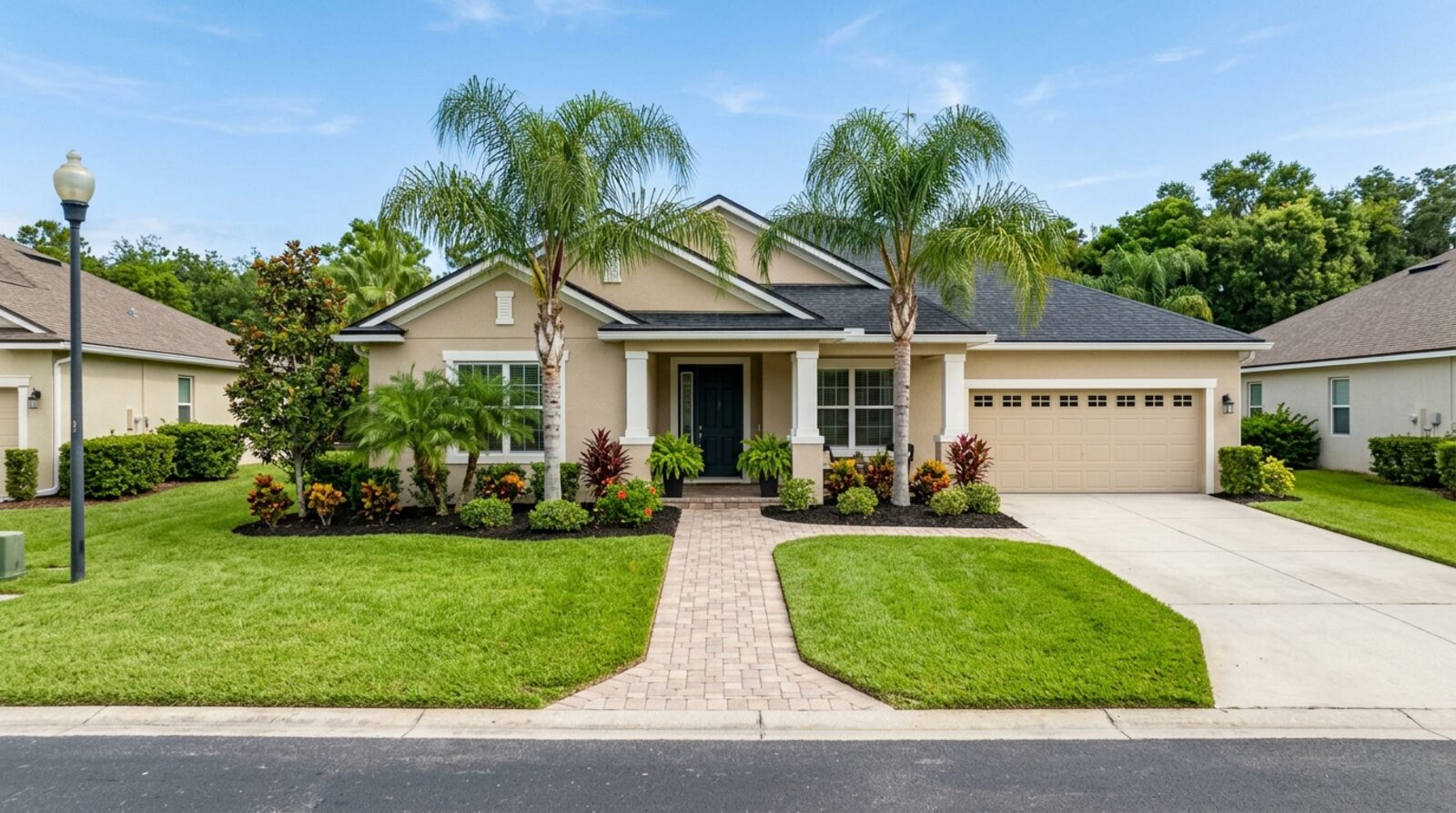
After the extraordinary 2022 cycle — when Orlando single-family rents ran up 20–25% year-over-year at the peak — the market has settled. SFR rents in 2026 are running roughly $1,900–$2,400 per month for a standard 3-bedroom, 2-bathroom home depending on location: Kissimmee and eastern Orange County at the lower end, Dr. Phillips and Lake Mary at the upper end. Those numbers represent stabilization, not collapse — they're higher in nominal terms than pre-pandemic, just no longer growing at a pace that generates unearned equity.
Multifamily rents have compressed more meaningfully — 5–8% from their 2022–2023 peaks in the Class A downtown segment as concessions do their work. Effective rents have fallen more than face rents because landlords have kept sticker prices flat while offering one to two months free upfront.
The recovery timeline depends on supply tapering actually materializing. If the 2026 delivery count stays near the projected 6,000 units and new starts remain suppressed through 2025–2026, the tightening math should be visible in vacancy data by Q3–Q4 2026 and in rent growth by early 2027. That's the base case. Investors buying stabilized assets today are positioning for that inflection.
Tracking the Data Yourself
Primary sources I use:
CoStar is the institutional standard for apartment-level vacancy data — submarket, class, and building-specific. It's expensive for individual access, but most commercial brokers can pull a CoStar report on any submarket you're underwriting. Ask for it. If a broker is pitching you an apartment deal and can't produce CoStar submarket vacancy data, that's diagnostic.
Apartment List publishes free monthly rent trend data by metro and submarket. It skews toward the online-listing tenant pool, so it's better for trend direction than absolute vacancy levels, but it's useful and it's free.
Rentometer is the practical tool for SFR comp analysis. Run it on any address you're underwriting and pull the 25th–75th percentile rent range for comparable bedrooms and bathrooms within a half-mile to one-mile radius. It won't replace local knowledge, but it will flag if a rent assumption is wildly off.
OCPA tax records — the Orange County Property Appraiser database — are publicly searchable and can tell you ownership history, assessed values, and in some cases rental income disclosure on multifamily properties. For value-add deals, pulling the OCPA record on a 10-unit before making an offer is basic due diligence.
The drive test still works. A building with banners offering six weeks free rent, fresh paint on a ten-year-old exterior, and a leasing agent who wants to have a long conversation about your lifestyle rather than your income is a building under pressure. That's not necessarily a building to avoid — it might be an acquisition target at the right price — but it is not a building to overpay for based on pro forma rents that assume no concessions. The vacancy data in any submarket is ultimately just a quantification of what you can see from the road.
Ryan Solberg is a licensed Florida real estate broker specializing in luxury residential and investment properties across the Orlando metro. This post reflects current market conditions as of April 2026 and is intended as market commentary, not financial or investment advice.
Frequently asked questions
- What is the rental vacancy rate in Orlando in 2026?
- Metro-wide rental vacancy in Orlando has climbed to approximately 8–9% in 2026 after record apartment deliveries of 12,000–15,000 units between 2022 and 2024. However, vacancy is not uniform across neighborhoods. High-new-supply corridors (downtown Orlando, southeast Orlando near new apartment clusters) have higher vacancy; established single-family rental neighborhoods with limited competing product have much lower vacancy (3–5%). For single-family rental investors, the relevant vacancy metric is not metro-wide apartment vacancy but the SFR vacancy rate in the specific neighborhood and price tier you are targeting.
- Is Orlando a good rental market for investors in 2026?
- Orlando remains a viable long-term rental market in 2026 for investors who target single-family rental (SFR) rather than competing directly with new apartment inventory. The SFR market in desirable school-zone neighborhoods — Viera, Lake Nona, Winter Park, Dr. Phillips — has different supply dynamics than the apartment corridor. Strong fundamentals: Florida population in-migration continues, Space Coast aerospace employment supports consistent tenant demand in Brevard County, and healthcare sector employment anchors demand near Lake Nona Medical City. Cash flow is thinner than 2019–2021 due to higher purchase prices and elevated rates, but appreciation and depreciation tax benefits support the long-term case.
- What neighborhoods in Orlando have the lowest rental vacancy?
- Orlando neighborhoods with the lowest rental vacancy in 2026 tend to be areas with strong employment anchors and limited competing supply: Viera and Rockledge (Brevard County) — aerospace workforce demand from KSC, Patrick SFB, L3Harris; Lake Nona (32827) — Medical City healthcare employment, limited SFR rental inventory; Winter Park and Maitland — premium renter pool, limited competing product; and Dr. Phillips (32819) — professionals, healthcare workers, limited affordable competing options. High vacancy is concentrated in downtown Orlando and southeast Orange County apartment corridors where new supply was concentrated.
- What rent prices are typical for single-family rentals in Orlando in 2026?
- Single-family rental rates in the Orlando metro area in 2026: 3BR/2BA in established Orlando suburbs (Dr. Phillips, Winter Park adjacent, East Orlando): $2,200–$3,200/month. 4BR/3BA in Viera or Rockledge (Brevard County): $2,400–$3,400/month. 3BR in Lake Nona or Horizon West: $2,500–$3,500/month. Premium communities (Windermere, Dr. Phillips lakefront-adjacent): $3,000–$5,000/month. Short-term rental rates in Cape Canaveral/Cocoa Beach: $2,500–$4,500/month for furnished 2BR. Rates have softened 5–10% from the 2022 peak in most markets due to new apartment deliveries providing alternatives for some renters.
- How does new apartment construction affect Orlando single-family rental investors?
- New apartment construction in Orlando primarily affects investors in the $1,500–$2,200/month rent tier — the range where new apartments compete most directly with entry-level single-family rentals. Investors in the $2,500–$3,500/month SFR range compete less directly with apartment product because renters who want a yard and extra bedrooms — the core SFR tenant — are not substituting a 3BR house for an apartment regardless of apartment quality. The risk to SFR investors from new apartments is greatest in submarkets where luxury apartment amenities (resort pools, co-working spaces, pet facilities) can attract renters who would otherwise have considered a single-family home.
The next step
Thinking about a move?
Whether you're two months out or two years out, the right information now saves real money later. Let's talk — no pressure, no pitch.