· Updated · 7 min read· By Ryan Solberg, Broker #BK3354351
Orlando Real Estate Outlook: The 5–10 Year Case for Buying Here
The short-term market fluctuations get the headlines. But the structural case for Orlando real estate over 5–10 years is built on fundamentals that don't show up in monthly reports. Here's the long view.
Every month, someone publishes a headline about the Orlando housing market. Inventory up. Days on market extended. Prices off the 2022 peak. These numbers are real, but they're also noise if you're making a decision that will play out over a decade.
Real estate markets are mean-reverting over 7–10 year cycles. The buyers who purchased in Orlando in 2012 — when the post-recession mood was still grim and inventory was bloated with distressed properties — made generational wealth. Those who panicked in 2008 and sold, or waited on the sidelines through 2011 and 2012, missed a full cycle of appreciation. The same story is probable for buyers who entered in 2023 and 2024, when rate shock had cooled sentiment but the structural drivers had not changed.
This post is about those structural drivers — the population, economic, and geographic factors that don't change quarter to quarter and that make the long-term case for Central Florida real estate one of the more compelling in the country.
The Population Engine Doesn't Switch Off
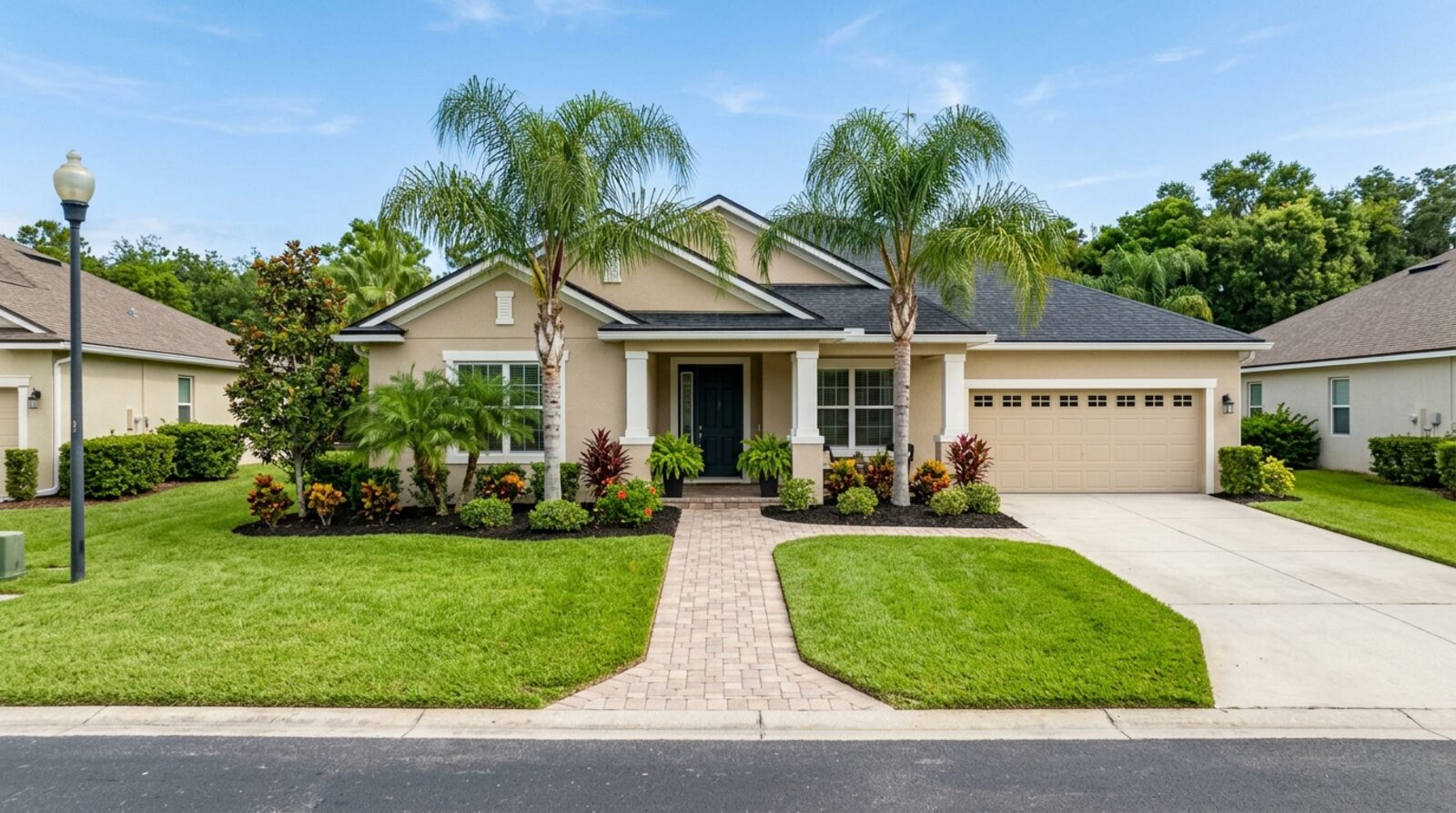
Florida adds 300,000 to 400,000 net new residents per year. The Orlando metro specifically absorbs roughly 50,000 to 60,000 per year, a pace that has been remarkably consistent across the past decade despite rate cycles, pandemic disruption, and political news cycles.
These inflows are not tourist behavior — they are household formation. The dominant sources: Northeastern transplants from New Jersey, New York, Connecticut, and Massachusetts trading high tax burdens and cost of living for Florida's structure; professionals relocating from Puerto Rico in significant numbers since Maria who have not reversed course; buyers using Miami as an entry point but pricing into Central Florida once they've built assets; and remote-flexible workers from across the country who have made a deliberate choice to base their household in a zero-income-tax state.
Every one of those households needs a place to live. Most of them eventually buy. That demand curve does not show up in the monthly absorption report, but it shows up in price appreciation over a full cycle.
The Income-Tax Calculation Has Become Mainstream
A professional earning $150,000 per year who relocates from New Jersey or New York to Florida saves, conservatively, $8,000 to $14,000 annually in state income tax. California transplants save more. At a 7% compound return on those savings reinvested over 10 years, the wealth differential between staying and moving approaches six figures before any housing appreciation is counted.
This arithmetic is no longer obscure. It is understood by the professional class that drives demand in Orlando's most consequential submarkets. It is not coincidental that Lake Nona has attracted physicians and life-sciences professionals at a density unusual for a mid-size metro, or that Windermere and the Butler Chain corridor disproportionately draw tech and finance executives who have worked remote or flexible since 2020. The tax arbitrage is a structural buyer subsidy that competing markets in the Northeast and California cannot replicate.
Orlando's Job Market Is Not 2007
The bear case on Orlando through most of the 2000s was legitimate: a tourism-dependent economy, cyclically exposed, without enough diversification to weather a demand shock. That economy is materially different today.
Tourism still matters — it always will in a market anchored by Disney, Universal, and one of the world's busiest international airports. But by 2026, key economic anchors include Lockheed Martin's Orlando operations on Sand Lake Road and in east Orlando; the UCF research corridor feeding one of the three largest university campuses in the United States (70,000-plus students, a growing startup culture, and a meaningful defense-tech pipeline); the USTA National Campus and US Soccer Federation's national training center; two major hospital systems — AdventHealth and Orlando Health — in active facility expansion; and a concentration of cybersecurity and defense contractors clustering near the intelligence and simulation corridor that runs from Lake Nona through East Orange County.
An economy with this composition is not immune to recession, but it does not collapse the way a single-industry economy collapses. The diversification reduces the severity of the downside cycle, which is the primary variable that determines whether a real estate market makes or destroys wealth over a 10-year hold.
Supply Constraints That Actually Hold
Phoenix and Austin taught buyers a hard lesson between 2022 and 2025: in markets with no geographic or political constraints on development, builders can add supply fast enough to cap — or reverse — appreciation during rate-driven demand pullbacks. Orlando's most desirable submarkets are not those markets.
The Butler Chain of Lakes and the broader lake network across southwest Orange County physically prevent grid development in the corridors buyers want most. Seminole County has operated under strict growth management policies for decades, limiting the type of horizontal suburban expansion that dilutes value in other Sun Belt markets. Orange County's most sought-after corridors — Dr. Phillips, Windermere, Lake Nona — are substantially built out on the desirable parcels. The remaining developable land is priced at a level that ensures new construction enters the market at price points that support, rather than undercut, existing home values.
Supply-constrained submarkets appreciate faster than metro averages over full cycles. This is a durable structural advantage.
The Insurance Issue: An Honest Assessment
The bear case for Florida real estate over the next decade is not imaginary, and any broker who waves it away is not serving you honestly. Insurance costs rose 40 to 60 percent across the state from 2021 to 2025. Several major carriers exited Florida entirely. The combination of hurricane exposure, flood risk, and deteriorating reinsurance economics has created a cost structure that will not fully normalize in the near term, and that creates real pressure on net housing costs for Florida owners.
The nuanced version of this risk is geographic. It is not uniformly distributed. Interior Central Florida — Orange, Seminole, and Lake counties along the I-4 corridor — sits well inland, without the coastal exposure that drives the most severe wind and flood underwriting. If you are buying in this market, you are buying the Florida economic advantage with a materially lower share of the coastal climate risk that has driven the worst of the insurance deterioration. Coastal buyers in Miami-Dade, Tampa Bay, and Fort Myers face a different calculus. The I-4 corridor is not equivalent to those markets on climate-risk exposure.
This distinction matters for long-term underwriting. Know your flood zone before you buy. Understand what wind mitigation features are present in the structure. The buyers who do this work are insulating themselves from the worst of the insurance trajectory.
What Prices Likely Look Like in 2030–2031

Straight-line forecasts fail in real estate as reliably as they do in equities. That said, structural analysis points toward a few probabilities worth understanding.
After the normalization period working off the inventory overhang from 2025 into 2026, appreciation in supply-constrained Central Florida submarkets is likely to resume in the 3 to 6 percent annualized range — not the 15 to 20 percent of the pandemic era, but consistent with the long-run demographic pressure described above. Prices today in most Orlando submarkets are 7 to 10 percent off the 2022 peak. That entry point, paired with structural long-term demand, represents one of the better risk-adjusted windows for buyers with a 5-plus-year horizon in a decade.
Price reversion toward the national median is unlikely given the compounding effect of the income-tax and climate-arbitrage dynamics. The inflow of high-income professionals choosing Florida specifically for its fiscal structure means Orlando's demand pool skews toward buyers with real purchasing power. That keeps a floor under prices in quality locations that weaker-demand markets cannot match.
Who the 10-Year Case Is Strongest For
Primary buyers in the $400,000 to $750,000 range purchasing in supply-constrained locations for personal use. If you plan to live in the home, quarterly market fluctuations are financially irrelevant. You are buying a home and capturing the long-term appreciation as a byproduct. The structural case works strongly in your favor.
Long-hold investors with a 7-plus-year horizon buying single-family rentals in Seminole County or southwest Orange County. The cash-flow math at current rates is tight, but the equity accumulation over a full cycle in supply-constrained submarkets has historically been significant.
Buyers relocating from high-tax states who receive the income-tax arbitrage benefit from the day they close. For this buyer, the financial case for Orlando is strongest: you're getting the appreciation potential and a structural operating cost reduction that builds wealth in parallel.
Who Should Wait
Short-term speculators expecting a repeat of 2020–2022. That cycle required a combination of zero interest rates, pandemic-driven migration surge, and supply shock that is not repeating on a 3-year timeline.
Over-leveraged buyers depending on near-term appreciation to cover negative cash flow. The normalization period still has room to run in some submarkets, and leverage amplifies both the upside and the downside.
Buyers in flood-exposed coastal zones where the insurance trajectory is less predictable and where the structural supply dynamics differ from interior Central Florida.
The long-term case for Orlando real estate is not a pitch. It is a structural argument built on population flows that show up in census data, fiscal dynamics that show up in tax returns, and supply constraints that show up in satellite imagery. None of these factors change because rates moved 50 basis points or because a monthly inventory report reads bearish.
The buyers who will look back on 2026 as an excellent entry year are the ones who understood this before the headlines changed.
Frequently asked questions
- What is the Orlando real estate market forecast for 2026 to 2031?
- The 5-year outlook for Orlando real estate (2026–2031) is constructive for long-term holders. Structural drivers remain intact: Florida population growth (about 196,700 new residents in the year to July 2025 per Census — roughly 540 a day, down from the 2022 peak), aerospace and defense expansion on the Space Coast (SpaceX, Boeing, KSC modernization), continued healthcare sector growth in Lake Nona's Medical City corridor, and no state income tax. Near-term headwinds include elevated inventory from 2022–2024 apartment deliveries and affordability pressure from rate levels. Long-term, Orlando's fundamentals — diversified employment, population inflow, and constrained coastal land supply — support continued appreciation over a 7–10 year horizon.
- Is Orlando real estate a good long-term investment?
- Orlando has been one of the strongest long-term real estate investment markets in the United States over the past 30 years, driven by population growth, tourism infrastructure, and expanding employment in aerospace, defense, healthcare, and technology. Buyers who purchased during cyclical downturns (2009–2012, 2023) have consistently generated above-average returns. The structural case for 2026–2031 includes Florida's ongoing in-migration from high-tax states, the Space Coast aerospace expansion, Lake Nona's continued Medical City buildout, and the I-4 corridor's continued commercial development. Long-term holders who buy at reasonable prices relative to current comps are well-positioned.
- Will Orlando home prices go up in the next 5 years?
- The consensus view among Central Florida housing economists for 2026–2031 is modest appreciation of 2–5% annually in most submarkets, with higher appreciation in supply-constrained high-demand areas (Viera, Lake Nona, Dr. Phillips) and softer appreciation in oversupplied apartment-heavy corridors. The significant appreciation years of 2020–2022 are not expected to repeat in the near term, but the structural case for long-term price growth in Orlando remains strong. The biggest risk to the 5-year outlook is a sustained high-rate environment that dampens demand, or a recession that slows Florida's in-migration trend.
- What are the best areas to invest in real estate near Orlando in 2026?
- The strongest investment areas near Orlando in 2026 for long-term appreciation: Viera/Brevard County — aerospace employment drives consistent high-income demand, and master-planned infrastructure supports resale values; Lake Nona (32827) — Medical City expansion continues, strong school zone, limited supply of SFR; Horizon West (34786/34787) — school zone quality, continued master-planned buildout, strong buyer demand; Winter Park (32789) — supply-constrained, premium buyer pool, limited new construction; and Sanford/Heathrow (32771) — lower entry prices with improving amenity access and employment growth.
- How does Florida's population growth affect Orlando real estate?
- Florida adds approximately 1,000 net new residents per day, and a substantial portion settle in the greater Orlando metro area (Orange, Osceola, Seminole, Lake, and Brevard counties). This sustained in-migration creates consistent housing demand that supports both pricing and rental rates. The in-migrants skew toward working-age households relocating from high-tax states, which sustains the employment base. For Orlando real estate investors and buyers, this demographic tailwind makes the market structurally more durable than metros with flat or declining population trends.
The next step
Thinking about a move?
Whether you're two months out or two years out, the right information now saves real money later. Let's talk — no pressure, no pitch.