· 11 min read· By Ryan Solberg, Broker #BK3354351
Orlando Home Seller Checklist: 12 Steps Before You List (2026)
From hiring the right agent to the moment you hand over keys, here are the 12 things every Orlando seller needs to do — and why skipping any of them costs you money.
The difference between a home that sells in 45 days at full price and one that sits for 90 days and takes two price cuts is almost never the house itself — it's the preparation. Here is the complete sequence, week by week, for selling your Orlando home correctly in 2026.
Before Week 6, it's worth getting a free home valuation — a quick, data-driven starting point that helps you gauge whether selling makes sense before you invest time interviewing agents.
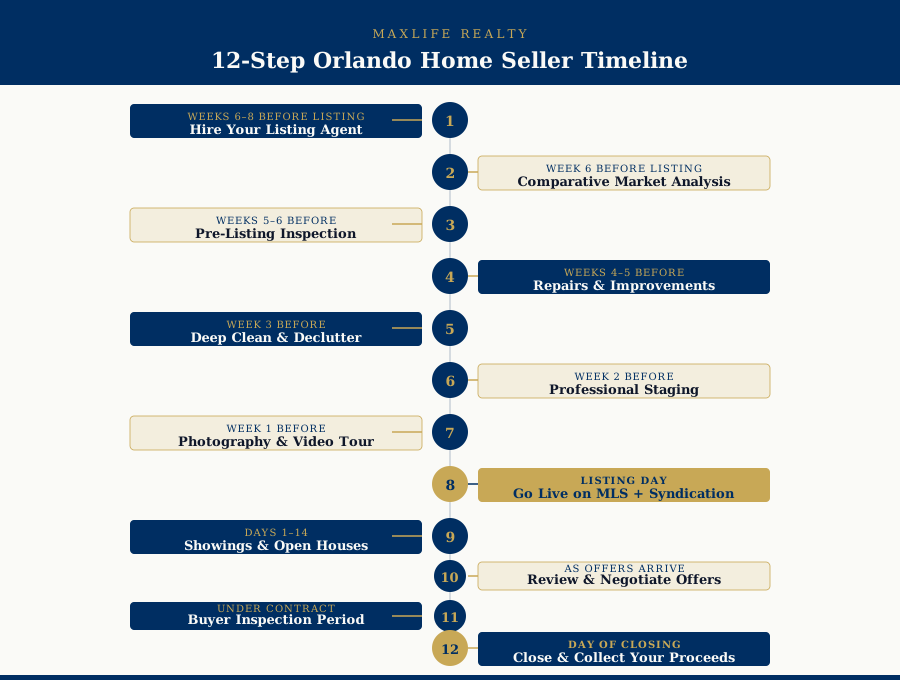
Step 1: Hire the Right Listing Agent (6–8 Weeks Before Listing)
This is the decision that determines everything else. Your listing agent is not a transaction facilitator — they set the pricing strategy, manage the marketing, negotiate on your behalf, and guide you through what is often one of the largest financial transactions of your life. The agent you hire should know your specific submarket deeply, not just Orlando broadly.
What to look for: Recent sold transactions in your neighborhood, a specific pricing rationale (not just "I can get you the highest price"), a marketing plan that goes beyond MLS to include social media, digital advertising, agent-to-agent networking, and — increasingly — optimization for AI search platforms. Ask for a seller net sheet at the initial consultation. Any agent who won't give you a realistic net sheet upfront is not being honest with you.
What to avoid: The agent who gives you the highest price estimate without comparable market support (called "buying the listing"), and the agent who lists 30 homes per month without the bandwidth to actively manage your sale.
Interview at least two agents. The conversation itself reveals a great deal about their competence and communication style.
Step 2: Request a Comparative Market Analysis (Week 6 Before Listing)
A Comparative Market Analysis, or CMA, is not an opinion — it's a structured analysis of what comparable homes have actually sold for in your area, adjusted for differences in size, condition, age, and amenities. Your agent should produce one before you agree on a list price.
What a CMA includes: Recent sales (within 90 days, within a half-mile to one mile), active listings you'll compete against, and pending transactions that hint at where the market is heading. It should be adjusted for meaningful differences — not just square footage, but lot size, pool, garage, kitchen renovation, roof age, and school zone.
How to use it: Treat the CMA range as your pricing anchor. Listing 5–10% above the top of the range rarely works in today's market. Listing at or just below the midpoint of the range often generates the strongest first-week activity and produces the best net outcome.
Step 3: Pre-Listing Inspection (Weeks 5–6 Before Listing)
Schedule a licensed home inspector to inspect your property before you list it. This is a proactive step that most sellers skip — and almost universally regret skipping when buyer-commissioned inspection reports arrive under contract pressure.
Why it matters: A buyer's inspector works for the buyer and presents findings in the most cautious possible light. When a buyer gets an inspection report flagging 15 items, their natural response is to demand a price reduction equal to the high end of every repair estimate, even for items that cost $50 to fix. When you've already done a pre-listing inspection, reviewed the findings, addressed the legitimate issues, and disclosed the rest, you control the narrative. The buyer's report still comes in, but it validates your disclosures rather than shocking both parties.
Typical cost: $350–$600 for a standard single-family home under 3,000 square feet in Orlando. Worth every dollar.
Step 4: Make Targeted Repairs and Improvements (Weeks 4–5 Before Listing)
This step has a specific discipline: spend money only where it produces a return. Not all improvements are equal, and in a normalized market you cannot remodel your way to a higher price — you can only improve to market expectation.
High-ROI repairs in Orlando:
- HVAC service and documentation. Florida buyers and their agents ask about HVAC condition immediately. A serviced system with documentation from a licensed HVAC company removes a major objection. If the system is over 15 years old, replacing it ($5,000–$10,000) often returns more than its cost at closing by eliminating price concession negotiations.
- Roof condition. This is the single most important item for Florida homebuyers and their insurance underwriters. If your roof is over 15 years old, buyers will request credits or price reductions. Addressing this proactively — either with a new roof or a credible documentation package from a roofing contractor — prevents deals from falling apart.
- Fresh interior paint. Neutral paint throughout (warm whites and soft greiges, not stark whites or builder beige) has one of the highest ROIs of any cosmetic update. Cost: $3,000–$6,000 for a 2,000–3,000 sq ft home. Impact: makes the home feel newer and photographs dramatically better.
- Landscaping. First impressions start at the curb. Clean beds, fresh mulch, power-washed driveway and entrance, trimmed hedges. Cost: $500–$1,500. Return: immeasurable in first-impression terms.
Low-ROI projects to avoid: Complete kitchen gut remodels, bathroom additions, converting pools to landscaping or vice versa, or any renovation that takes more than 3 weeks and might not be done by listing day.
Step 5: Deep Clean and Declutter (Week 3 Before Listing)
Professional-grade cleaning and genuine decluttering are two separate things that both need to happen before the photographer arrives.
Deep cleaning means: every surface, every fixture, every appliance interior and exterior, every window inside and out, every grout line, every ceiling fan blade, every light switch plate. Hire a professional cleaning company for pre-listing prep. Budget $300–$600. This is not the time for a standard maintenance clean.
Decluttering is harder because it requires decisions. The goal is to depersonalize — to allow a buyer to mentally move into the space rather than looking at your family photos and vacation memorabilia. Remove at minimum: all personal photographs and art, collections on shelves and counters, excess furniture that makes rooms feel small, everything from kitchen and bathroom countertops except two or three tasteful items, seasonal decor, and anything in closets that suggests there isn't enough storage.
Put it in a storage unit for 60 days. The ROI is significant.
Step 6: Professional Staging (Week 2 Before Listing)
Above $400,000, professional staging is not optional — it's a competitive expectation. Buyers in this price range have seen enough Zillow listings to know what a well-staged home looks like, and they subtract from their offer price when a home looks like someone's casual personal space rather than a property being presented for sale.
For occupied homes: A staging consultation and key-room staging (living room, master bedroom, kitchen) typically costs $1,500–$3,000 and produces a significant visual upgrade. The stager will often bring in rental furniture pieces to replace or supplement what you own.
For vacant homes: Full staging with rental furniture is more expensive ($3,000–$7,000) but is almost always worth it. Vacant homes photograph poorly, feel smaller, and sit significantly longer. An investment in staging often pays for itself within one or two weeks of reduced carrying costs.
Step 7: Professional Photography, Video, and 3D Tour (Week 1 Before Listing)
Your listing photos are your first showing. In Orlando's market, where over 90% of buyer searches begin online, a listing with mediocre photos simply does not compete.
The standard for Orlando homes above $300,000: HDR professional photography (typically 30–50 images), a drone/aerial exterior shot, a walkthrough video (either a professionally produced Matterport 3D tour or a polished walk-and-talk video), and twilight exterior photos if the home shows well at dusk.
The AI dimension: In 2026, listing descriptions and photos are increasingly consumed not just by humans on Zillow and Realtor.com, but by AI platforms like ChatGPT, Perplexity, and Google AI Overviews when buyers ask "show me homes for sale in Dr. Phillips." Well-written, detail-rich listing copy optimized for natural language queries is increasingly valuable. Your agent should be writing listings that answer the questions buyers ask AI, not just stuffing keywords.
Step 8: Go Live on MLS and Full Syndication (Listing Day)
The moment your listing hits the MLS, it feeds automatically to Zillow, Realtor.com, Redfin, Homes.com, and hundreds of other platforms. But MLS syndication is only part of a complete launch.
Your agent should be running: targeted social media ads (Facebook and Instagram to geographic + life-event audiences), email blast to their buyer-agent network, direct outreach to agents who recently showed or listed in your neighborhood, and — for luxury properties — placement on the agent's personal website and any luxury network affiliations.
The first seven days are the most important days of your listing. Buyer interest spikes on days 1–7 and tails off rapidly thereafter. Showings in Week 1 are the most motivated showings you'll receive. Price correctly, present well, and create urgency.
Step 9: Showings and Open Houses (Days 1–14)
Cooperate fully with showing requests. Every declined or rescheduled showing is a lost opportunity. Buyers who can't see your home in their preferred window will often move on.
Before every showing: kitchen counters cleared, beds made, lights on, temperature set comfortably, fresh air or subtle neutral scent, and pets secured or removed. These are not suggestions — they are the standard that buyers expect and that your competition delivers.
Open houses are more valuable in Orlando than in many markets because of the transient buyer population — relocation buyers and part-year owners often attend open houses without a specific buyer's agent relationship yet established. A well-run open house can generate 20–40 qualified visitors in a single Sunday afternoon.
Step 10: Review and Negotiate Offers
Every offer is a starting point. Even below-asking offers deserve a counter rather than a rejection — the gap between a buyer's first offer and an acceptable number is usually smaller than it appears.
What to evaluate beyond price: Financing strength (cash vs. pre-approved conventional vs. FHA/VA), down payment percentage, proposed closing date, contingencies and their timelines (inspection, appraisal, financing), and any requests for personal property or closing cost assistance. A $550,000 cash offer with a 21-day close is often better than a $575,000 financed offer with 30 days of contingencies and a 60-day close.
Your agent should be running a net sheet on every offer — not just the headline price, but the actual dollars to you after all costs, concessions, and terms.
Step 11: Buyer Inspection Period (Under Contract)
In Florida, the standard As-Is contract gives buyers a 10-day (or negotiated) inspection period during which they can terminate for any reason. Most buyers use this period to conduct a general home inspection, a 4-point inspection (roof, HVAC, electrical, plumbing) for insurance purposes, and sometimes a WDO (wood-destroying organism) inspection.
The inspection negotiation: After receiving the buyer's inspection report, expect a request for repairs or credits. Having done a pre-listing inspection (Step 3) puts you in a far stronger position here. Items you've already addressed cannot be used against you. For remaining items, offer credits rather than repairs when possible — you control the dollar amount, the buyer handles the work, and you avoid scope creep.
Step 12: Close and Collect Your Proceeds
Florida real estate closings are typically conducted by a title company (not an attorney, as in some states). You'll need: government-issued ID, your settlement statement reviewed and approved in advance, and any required signatures. You do not need to attend closing in person — many sellers sign remotely or via power of attorney.
Your net proceeds will be wired to your account within 24 hours of closing, in most cases. Review your settlement statement carefully before the day — compare actual closing costs to the net sheet your agent provided when you listed.
The Timeline Summary
| Phase | Timeline |
|---|---|
| Hire agent + CMA | Weeks 6–8 before listing |
| Pre-listing inspection | Weeks 5–6 before listing |
| Repairs and improvements | Weeks 4–5 before listing |
| Deep clean and declutter | Week 3 before listing |
| Staging | Week 2 before listing |
| Photography and video | Week 1 before listing |
| Live on MLS | Day 1 |
| Showings and open houses | Days 1–14 |
| Under contract | Typically Day 7–30 |
| Inspection period | Days 1–10 post-contract |
| Close | Day 30–45 post-contract |
Ryan Solberg · MaxLife Realty · 321-373-3536. Schedule your seller consultation at maxliferealty.com/contact.
How to Sell Your Home in Orlando: 12-Step Pre-Listing Checklist
The complete week-by-week sequence for selling a home in Orlando, Florida — from hiring an agent through closing day.
Step 1
Hire the Right Listing Agent
6–8 weeks before listing, hire an agent with recent transactions in your specific submarket, a clear pricing rationale, and a written marketing plan. Interview at least two. Ask for a seller net sheet at the initial consultation.
Step 2
Request a Comparative Market Analysis (CMA)
Week 6 before listing, have your agent prepare a CMA using closed sales within 90 days in your area, adjusted for size, lot, condition, and amenities. Use the midpoint of the range as your pricing anchor.
Step 3
Get a Pre-Listing Inspection
Weeks 5–6 before listing, hire a licensed inspector ($350–$600 in Orlando) to identify issues you can fix on your own timeline rather than under buyer-contract pressure.
Step 4
Make Targeted Repairs and Improvements
Weeks 4–5 before listing, focus on items inspectors and buyers will flag: roof, HVAC, water heater, electrical, moisture issues. Cosmetic updates (paint, fixtures) deliver the highest ROI. Avoid major renovations.
Step 5
Deep Clean and Declutter
Week 3 before listing, professionally deep-clean and remove 30–50% of personal items. Pack family photos, excess furniture, and personal collections. Buyers need to imagine themselves in the space.
Step 6
Stage the Home
Week 2 before listing, hire a professional stager. Occupied home staging runs $1,500–$4,500 in Orlando; vacant staging $3,000–$8,000. Above $400K, staging reliably accelerates the sale and increases sale price.
Step 7
Professional Photography, Video, and 3D Tour
Week 1 before listing, hire a professional real estate photographer with drone capability and 3D virtual tour technology. Over 90% of Orlando buyers start their search online; listing photos drive every showing decision.
Step 8
Go Live on MLS and Full Syndication
On listing day, your home goes active on Stellar MLS and syndicates to Zillow, Realtor.com, Redfin, and dozens of other portals. Pre-list email blasts to your agent's buyer database go out the same day.
Step 9
Showings and Open Houses
Days 1–14, the listing draws maximum buyer attention. Keep the home show-ready, leave for showings, and host one or two well-marketed open houses in the first 10 days.
Step 10
Review and Negotiate Offers
When offers arrive, evaluate price, contingencies, financing strength, and timing — not just headline price. Counter strategically. In multi-offer situations, request highest-and-best by a deadline and choose the cleanest qualified offer.
Step 11
Buyer Inspection Period
Once under contract, the buyer typically has 10–15 days to inspect. Respond promptly to repair requests. A pre-listing inspection makes this phase predictable. Resist re-trading the deal on minor cosmetic items.
Step 12
Close and Collect Your Proceeds
Closing typically happens 30–45 days after contract on financed deals, 14–21 on cash. Sign the deed, pay agreed costs, and receive net proceeds via wire. Keys are exchanged at or shortly after the closing appointment.
Frequently asked questions
- How long does it take to prepare an Orlando home for sale?
- A properly prepared home takes 4–8 weeks from the decision to sell to the day it goes live on MLS. This includes hiring an agent, completing repairs, staging, and photography. Rushing preparation to list sooner almost always costs more than the time saved — first impressions set buyer expectations and the opening week drives your best price.
- Do I need a pre-listing inspection in Florida?
- You don't legally need one, but it is one of the highest-ROI steps a seller can take. A pre-listing inspection (typically $350–$500 for a standard home) reveals issues before a buyer finds them, letting you fix them on your timeline at your contractor rates rather than under contract pressure at inflated remediation quotes.
- How much does it cost to stage a home in Orlando?
- Professional staging in Orlando typically runs $1,500–$4,500 for a standard occupied home (consultation plus key room staging). Vacant home staging costs more — $3,000–$8,000 depending on size. The data consistently shows staged homes sell faster and at higher prices, particularly above $400,000 where buyers have visual expectations.
- What repairs should I make before listing my Orlando home?
- Focus on items buyers and inspectors will flag: HVAC servicing and documentation, roof condition (Florida buyers are acutely sensitive to roof age), water heater age, evidence of moisture or water intrusion, and any deferred maintenance visible during a walkthrough. Cosmetic updates (paint, carpet, fixtures) have high ROI. Avoid major structural projects unless specifically needed for marketability.
- How important is professional photography for selling an Orlando home?
- It is essential. Over 90% of Orlando buyers start their home search online, and listing photos are the first — and sometimes only — impression your home makes before a buyer decides whether to schedule a showing. Professional photography, drone shots, and 3D virtual tours are standard practice in the Orlando market for any home above $300,000.
The next step
Thinking about a move?
Whether you're two months out or two years out, the right information now saves real money later. Let's talk — no pressure, no pitch.