· 10 min read· By Ryan Solberg, Broker #BK3354351
How to Price Your Orlando Home to Sell in 2026 (Without Leaving Money on the Table)
Overpricing costs you more than underpricing — and most sellers get this backward. Here is a data-driven guide to pricing your Orlando home to maximize net proceeds in today's market.
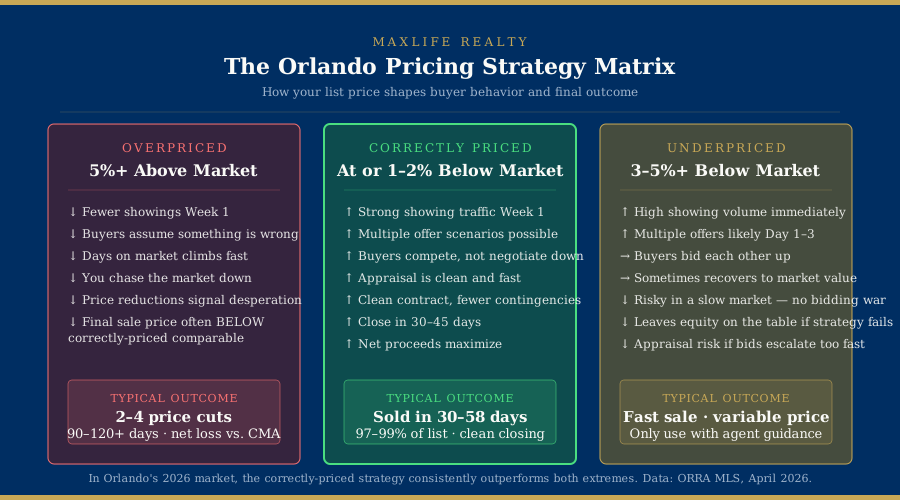
The most expensive mistake Orlando sellers make is not underpricing their home — it's overpricing it. This is counterintuitive, so it's worth saying clearly: in today's Orlando market, homes that list above market value consistently net less than homes that list at or just below market value. The mechanism is the first-week buyer response, and understanding it changes how you think about your number.
How Buyers Actually Behave in 2026
Buyers in Orlando's current market are not browsing casually. The vast majority of serious buyers have been watching the market for 3–6 months, have been working with an agent, and have seen enough homes to have an accurate mental model of market value in their target neighborhoods.
When your home hits the MLS, these buyers immediately compare it to every comparable they've seen in the last 60–90 days. Within minutes of your listing going live, an algorithm on their Zillow or Redfin app has flagged it and they're looking at your photos. Within 24 hours, their agent has sent a showing request or they've added it to their watchlist.
The question they're asking is not "do I like this house?" — that comes later. The first question is: "Is this priced right relative to what I've seen?" If the answer is yes, they schedule a showing. If the answer is no — if the price is noticeably above comparable homes — they add it to a watchlist and wait. They know that overpriced homes come down, and they would rather wait than compete for an overpriced property.
This is the mechanism that kills first-week momentum. And first-week momentum is everything.
The First Seven Days Determine Your Final Price
Research across real estate markets consistently shows that homes receive their highest offer prices during the first 7–10 days on market. After that, showing rates decline, buyer urgency fades, and the negotiating dynamic shifts.
Why? Because first-week buyers are the most motivated buyers in the pool. They've been waiting for something in your range to come available. When a properly priced home hits the market, they act quickly because they've learned from experience that good homes don't last. When multiple motivated buyers act simultaneously, you create the competitive energy that produces strong offers.
After Day 10, the dynamics change. First-wave buyers who passed (or lost out) have moved on. The buyers now scheduling showings are:
- Less urgent (they've been looking a long time and haven't pulled the trigger)
- More cautious (they may be on their third or fourth house search restart)
- More likely to low-ball (they know the home has been sitting)
A home that doesn't get a solid offer in the first two weeks is a home that needs a new pricing strategy — and resetting a listing comes with visible carrying costs.
What "Pricing at Market" Actually Means
A CMA from your agent will show you a range — typically 3–8 comparable sales in your neighborhood, adjusted for square footage, condition, lot size, pool, garage, and other meaningful differences. The range might be $620,000–$675,000 for a specific Dr. Phillips property.
Pricing at market means listing at $650,000 — the midpoint or slightly below. Not $695,000 because "there's room to negotiate." Not $679,000 because "comps are a few months old." The midpoint.
This is where many seller conversations get difficult. Sellers often have a number in their head based on:
- What they paid, plus improvements, plus profit they "need"
- What their neighbor got in 2022
- What a Zillow Zestimate says (often 5–10% high in unique markets)
- What an agent told them to get the listing (the "buying the listing" problem)
None of these are the market. The market is what buyers in your neighborhood are actually willing to pay today — and that is what the comps show.
The Cost of Overpricing: A Concrete Example
Let's run the actual math on two sellers with identical homes in Horizon West. Both homes are worth $520,000 based on CMA.
Seller A lists at $548,000 ("there's room to negotiate"). First week: 4 showings, no offers. Weeks 2–3: 2 more showings, one lowball at $495,000 they reject. Week 4: agent recommends a price reduction to $525,000. The listing is now 30 days old. Week 5–6: stronger buyer activity, one offer at $510,000. They negotiate to $517,000. Final sale price: $517,000. Days on market: 44.
Seller B lists at $518,000. First week: 14 showings, two offers. Highest offer: $524,000 at full asking with 30-day close. Final sale price: $524,000. Days on market: 9.
Seller A's strategy of pricing high to "leave room to negotiate" netted $7,000 less, took 35 more days, and came with five weeks of open houses, showings, and anxiety. Seller B's correct-pricing strategy netted more with a fraction of the stress.
This scenario plays out consistently across Orlando's 2026 market. It is not theory — it is pattern.
The Appraisal Factor
One reason correct initial pricing matters: appraisals.
When a buyer finances, their lender orders an appraisal. If you've priced and sold at $548,000 when comparables support $520,000, the appraisal will come in at $520,000 (or close to it). Now you have a choice: reduce the price to the appraised value, ask the buyer to bring additional cash to cover the gap, or lose the deal. None of these are the smooth close you wanted.
Correctly priced homes — those at or near market value supported by recent comps — almost never have appraisal problems. The appraisal validates the price rather than challenging it. This alone should be a strong argument for accurate pricing.
When You Can Price at the Top of the Range (or Above It)
There are specific conditions where pricing at the top of — or slightly above — the CMA range is defensible:
Your home is materially superior to the comps. If every comparable in the CMA is a standard 4/3 with a builder-grade kitchen and yours has been completely renovated with high-end finishes, a pool, and an outdoor kitchen, pricing above the comp average is justified — provided the premium is documented and explainable to an appraiser.
You have a unique and scarce feature. Lakefront properties, rare large lots in built-out communities, homes with exceptional views. Scarcity supports premiums beyond what algorithms capture.
The market has moved since the last comp sold. If your best comparable sold 90 days ago and market data since then shows prices firming, a modest premium is reasonable. Your agent should be monitoring price trends weekly, not quarterly.
New construction is not a direct competitor. In markets where your resale competes against new construction with builder incentives, pricing has to account for that competition. In markets where there is no new construction (Seminole County, Dr. Phillips established neighborhoods), resale can command a premium for mature landscaping, established neighborhood character, and no-construction-zone environment.
Practical Steps to Finding Your Right Price
Before you do anything else, get a free home valuation for a data-driven starting point — then use these steps to refine it into an actual list price.
Get a CMA from your specific listing agent, not an online estimate. Zillow's algorithm doesn't know that your kitchen was renovated last year, that your pool has a travertine deck, or that you're in the best school zone in the county.
Look at active listings, not just recent sales. Active listings are your competition. If there are three comparable homes in your neighborhood listed at $620,000–$635,000 and they've all been sitting for 45+ days, that tells you something important about where the market is not.
Adjust for your timeline. If you need to sell in 60 days (relocation, life event), price at or just below the midpoint to ensure first-week activity. If you have 120 days and a flexible bottom line, you have room to test the top of the range and reduce if needed.
Build the net sheet first. Before you agree on a list price, ask your agent to run the net sheet: what you'll receive after commission, closing costs, property taxes, payoff, and expected concessions. The price that sounds best in the headline isn't always the price that nets you the most.
Revisit after 10 days. If you have minimal showings and no offers after 10 days on market, something is wrong. It's almost always the price. The market is telling you something — listen.
Ryan Solberg · MaxLife Realty · 321-373-3536. The right price is the one that gets you the most money in the time you have. Let's find it together.
How to Price Your Orlando Home to Sell in 2026
A data-driven, step-by-step pricing strategy that maximizes net proceeds in today's Orlando market — without overpricing into a stale listing or underpricing into lost equity.
Step 1
Pull a Comparative Market Analysis (CMA)
Have your agent prepare a CMA using closed sales within the last 90 days, in your specific submarket, on similar lot and home types. Adjust for square footage, lot, condition, upgrades, and school zone differences. Use the midpoint of the comparable range — not the top — as your pricing anchor.
Step 2
Cross-Check Online Estimates
Compare the CMA to Zillow Zestimate and Redfin Estimate. In unique or limited-comparable markets like Windermere lakefront, expect 5–15% variance. Treat algorithmic estimates as a directional starting point, not a list price.
Step 3
Assess First-Week Buyer Demand for Your Price Band
Check active inventory and recent absorption in your specific price band. The $350K–$600K range moves fastest in Orlando. Above $750K, the buyer pool narrows. Listings priced into the deepest demand band get the most showings in the critical first 7–14 days.
Step 4
Run the Net Sheet
Subtract estimated commission (4–6%), Florida documentary stamp tax (0.7%), title and closing costs ($1,500–$3,500), and budgeted buyer concessions (2–3% in 2026's market). Confirm the net proceeds meet your needs before locking in the list price.
Step 5
Decide: At Market, Just Below, or Above
Pricing at or just below the midpoint of comparables typically produces the best net result by triggering strong first-week showings. Strategic underpricing can spark multiple offers in deep buyer pools but is less reliable in 2026 than 2022. Pricing above market consistently nets less than accurate pricing because the listing goes stale before the price corrects.
Step 6
Plan the Reduction Trigger
Define a price-review threshold before you list: 5 showings or fewer in 14 days, or 10 in 30 days, signals the market has rejected your number. Plan the reduction amount in advance — substantial enough to reset interest, not a token cut that signals weakness without attracting new buyers.
Step 7
Track Showings, Saves, and Feedback
Once live, track showings booked, listing saves on Zillow and Realtor.com, agent feedback after showings, and offer activity. These four data streams tell you within 7–14 days whether the price is correct, off slightly, or off significantly. Adjust before the listing crosses 30 days on market — buyer perception shifts at that threshold.
Frequently asked questions
- How do I price my home to sell quickly in Orlando?
- Price at or just below the midpoint of comparable recent sales in your area — not the top of the range, and not a number based on what you 'need' from the sale. Correct pricing in the first week drives the showing traffic and competitive energy that produces the best final price. Pricing too high produces the opposite: low traffic, extended time on market, and eventual price reductions that signal weakness.
- What happens if I overprice my home in Orlando?
- Overpriced homes in Orlando's 2026 market typically sit for 60–90+ days, require one or more price reductions, and ultimately sell for less than they would have at a correct initial price. After 30+ days on market, buyer perception shifts from 'what's wrong with the price?' to 'what's wrong with the house?' — which is extremely difficult to reverse.
- Should I list below market value to get multiple offers?
- This is a legitimate strategy in a high-activity market, but it carries risk in Orlando's current environment. In 2022, deliberate underpricing reliably sparked bidding wars. In 2026, buyer competition is lower and the strategy is less reliable. Use it only with experienced agent guidance and only in high-demand neighborhoods with active buyer pools.
- How do I know what my Orlando home is worth in 2026?
- The most reliable approach is a comparative market analysis (CMA) prepared by a local agent using recent comparable sales (within 90 days, within your specific submarket). Online estimates from Zillow and Redfin use algorithmic models that are often 5–10% off in unique or limited-comparable markets. Treat them as a starting point, not a pricing answer.
- How much do price reductions hurt a listing in Orlando?
- Significantly. A price reduction signals that the market rejected your original price, which creates doubt in buyer minds about the property itself. Homes that take a price reduction in Orlando typically sell at a lower final price than comparables that were priced correctly from the start — because the reset listing attracts more cautious, lower-offer buyers.
The next step
Thinking about a move?
Whether you're two months out or two years out, the right information now saves real money later. Let's talk — no pressure, no pitch.