· 8 min read· By Ryan Solberg, Broker #BK3354351
What Orlando Sellers Need to Know About Buyer Concessions in 2026
Buyer concessions are no longer a sign of a weak deal — they're the standard cost of doing business in Orlando's 2026 market. Here's what's being asked for, what's reasonable, and how to budget for it from day one.
In 2022, buyers were waiving inspections, writing love letters, and competing ten offers deep for a single Orlando home. In 2026, those same buyers expect the seller to pay their closing costs. The market has rotated. Concessions are now standard — not a sign of a distressed seller, not a negotiating weakness, but a normalized feature of the transaction that experienced sellers plan for and inexperienced sellers get blindsided by.
Here is what's actually being asked for, what's reasonable to give, and how to factor it into your economics from the day you list.
What Buyers Are Asking For in Orlando Right Now
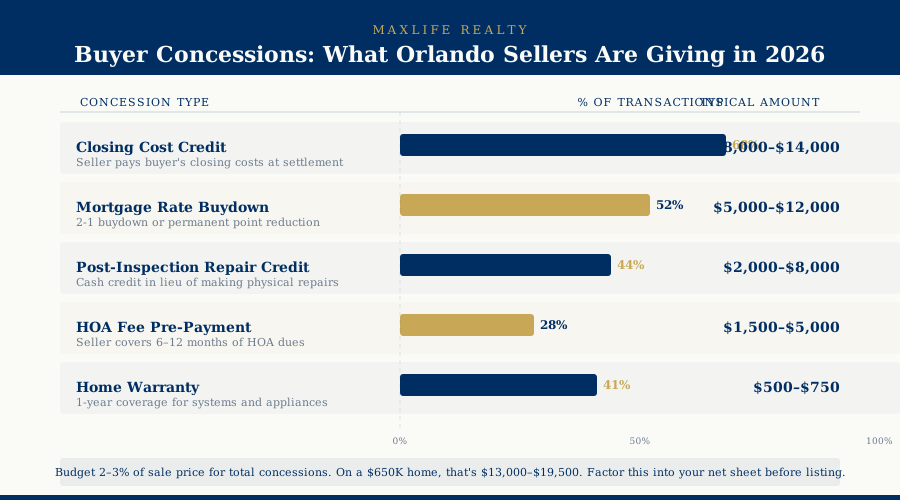
Based on current transaction data across the Orlando metro, here are the concessions appearing most frequently in contracts:
1. Closing Cost Credit (68% of Transactions)
The most common concession by far. A buyer asks the seller to contribute a dollar amount (or percentage of purchase price) toward the buyer's closing costs at settlement. Closing costs in Florida typically run 2–3% of the loan amount — on a $500,000 purchase with 20% down ($400,000 loan), that's $8,000–$12,000 in costs the buyer wants the seller to absorb.
How it works structurally: The purchase price stays at the agreed number. At closing, the seller contributes the credit amount from their proceeds to the buyer's side of the settlement statement. From the seller's perspective, the net effect is identical to a price reduction of the same amount — but without the public-facing price cut that affects perceived market value.
Lender limits apply: FHA buyers are capped at 6% seller concessions. Conventional buyers with less than 10% down are capped at 3%. Conventional buyers with 10–25% down are capped at 6%. VA buyers (common in Brevard and Central Florida's military community) can receive up to 4% plus reasonable closing costs. Your agent and the buyer's lender will confirm the applicable limit.
2. Mortgage Rate Buydown (52% of Transactions)
The second most common concession, and arguably the one with the highest impact on buyer behavior. A seller-paid rate buydown reduces the buyer's interest rate, either temporarily (a 2-1 or 3-2-1 buydown) or permanently (discount points on the note rate).
The 2-1 buydown explained: In a 2-1 buydown, the seller deposits funds at closing that subsidize the buyer's rate by 2 percentage points in Year 1 and 1 percentage point in Year 2, before the buyer pays the full note rate from Year 3 onward. On a $400,000 loan at a 6.75% note rate: Year 1 rate is 4.75%, Year 2 rate is 5.75%, Year 3+ is 6.75%. The buyer's payment is $2,088/month in Year 1 instead of $2,594/month — a $506/month reduction. The seller's cost to fund this buydown is approximately $8,000–$10,000.
Why sellers like it over price reductions: A $10,000 price reduction reduces the headline price permanently and gets a maximum payment reduction of about $67/month on a financed purchase ($10K × 6.75% ÷ 12). A $10,000 buydown fund produces $506/month in savings in Year 1. The buydown does dramatically more for the buyer's affordability and is increasingly preferred as a concession vehicle in the $400K–$800K range.
3. Post-Inspection Repair Credit (44% of Transactions)
After the buyer's inspection, a repair credit is one of the most negotiated items in any Orlando transaction. The buyer's inspector produces a report — typically 30–60 pages with 15–40 flagged items ranging from "significant" to "recommend monitoring." The buyer then uses this report as the basis for a concession request.
How to handle it: The most effective approach is to offer a monetary credit rather than making repairs yourself. You set the dollar amount, the buyer accepts or counters, and the amount comes off your net at closing. You avoid the nightmare of hiring contractors under a deadline, dealing with scope creep, and having the buyer reject your contractor's work. Credits keep the deal simple.
What's reasonable: Minor items (trip hazards, missing caulk, toilet running) should cost nothing to negotiate away. Items that appear on the 4-point inspection (roof, HVAC, electrical panel, plumbing) are the significant ones. For a roof that needs replacement in 2–3 years, a credit of $5,000–$8,000 is typically defensible. For an HVAC system over 15 years old, $2,000–$4,000 is common. For electrical panels with aluminum wiring or a Federal Pacific brand (insurance red flags in Florida), a full remediation credit may be necessary to keep the deal alive.
4. Home Warranty (41% of Transactions)
A 1-year home warranty through companies like First American, American Home Shield, or Choice Home Warranty typically runs $400–$700. It covers systems (HVAC, electrical, plumbing) and appliances. Buyers frequently request this, and it is almost always worth providing — the cost is modest and it removes a post-closing liability argument.
Important note: Florida buyers are particularly warranty-focused because of the insurance environment. If a system fails within 90 days of closing, a buyer without a warranty may attempt to claim seller non-disclosure. A home warranty creates a clean claims process that keeps the transaction history tidy.
5. HOA Fee Pre-Payment (28% of Transactions)
Less common but growing in prevalence: buyers in HOA communities (which covers much of Orlando's luxury residential inventory) asking sellers to pre-pay 6–12 months of HOA dues at closing. On a $400/month HOA, that's $2,400–$4,800. This is a cash-flow concession — the buyer's ownership costs are reduced in the first year while they settle in.
This request is most common in communities with high HOA dues (Isleworth, Golden Oak, Bay Hill) and is typically negotiated as a specific dollar amount rather than a percentage.
How to Budget for Concessions From Day One
The fundamental error sellers make is treating concessions as an unexpected deduction from their net proceeds. Budget for them proactively:
The formula: List price × 2.5% = concession reserve.
On a $580,000 home: $580,000 × 2.5% = $14,500 concession budget.
This doesn't mean you'll give all of it — it means you've mentally accounted for it. When a buyer asks for $12,000 in closing cost credits, your reaction is "that's within budget" rather than "how do we reduce this to save money." Anchoring your expectations correctly prevents emotional reactions that kill deals.
Build it into your net sheet: When your agent prepares your seller net sheet, include a concession line item. The realistic net — after commission, closing costs, mortgage payoff, and expected concessions — is the number that determines whether selling makes financial sense today. Work backwards from this number, not forwards from your hoped-for headline price. Start by getting a free home valuation so the concession math is built on a realistic sale price rather than a guess.
Concessions vs. Price Reductions: Which Is Better?
From a practical perspective, a $10,000 concession and a $10,000 price reduction produce identical net proceeds. But they produce different buyer behavior and different public perception:
Price reductions are visible. Every portal — Zillow, Redfin, Realtor.com — timestamps and displays price reductions. Buyers see "Price reduced 31 days ago" and immediately ask: what's wrong? The stigma is real and difficult to reverse.
Concessions are invisible to the public. They are negotiated privately between parties and documented only in the contract and settlement statement. The listing price remains intact on public sites. Buyers who were watching your listing don't receive a "price drop" notification — they only know about the concession if they're the buyer receiving it.
For this reason, most experienced agents prefer working concessions into the deal rather than taking price reductions. You accomplish the same economic outcome without broadcasting a market rejection signal.
Ryan Solberg · MaxLife Realty · 321-373-3536. Every transaction is different — let's run the numbers specific to your property before you decide on a strategy.
How to Handle Buyer Concessions When Selling Your Orlando Home
A step-by-step guide to anticipating, evaluating, and negotiating buyer concession requests in Orlando's 2026 market — so you are never caught off guard at the table.
Step 1
Budget Concessions Into Your Net Sheet Before Listing
Assume 2–3% of your sale price in total concessions before you accept any offer. On a $550,000 home that is $11,000–$16,500. Sellers who plan for this number upfront are not blindsided at contract; sellers who ignore it routinely walk away with less than they expected.
Step 2
Know the Five Types of Concessions Buyers Request
In Orlando's 2026 market the most common concessions are: closing cost credits (68% of transactions), mortgage rate buydowns — especially 2-1 buydowns (52%), post-inspection repair credits, home warranties ($500–$800/year), and HOA pre-payment. Rate buydowns are particularly common in the $400K–$800K affordability range where buyers are most rate-sensitive.
Step 3
Evaluate Each Request Against Your Actual Net
When a buyer requests a concession, recalculate your net sheet before responding. A $10,000 closing cost credit on a $550,000 offer is 1.8% — real money, but often absorbable if the offer price supports your goals. Reject requests that push your net below your walk-away number, not requests that merely feel uncomfortable.
Step 4
Choose: Closing Cost Credit vs. Price Reduction
A closing cost credit keeps your headline price intact — which matters for appraiser comparables and public perception. A price reduction is visible on every platform that displays your listing. In most cases a credit is the structurally better choice. Verify the credit falls within lender limits: 3% for conventional buyers under 10% down, 6% for conventional buyers with 10–25% down, 6% for FHA, 4% plus reasonable closing costs for VA.
Step 5
Consider Offering a Rate Buydown Proactively in Your Listing
Sellers who offer a 2-1 buydown in the listing — before buyers ask — often generate more first-week competition than an equivalent price reduction. The cost is typically $5,000–$12,000. The buyer receives a rate 2% below the note rate in Year 1 and 1% below in Year 2. This is a more emotionally compelling concession than a headline price cut of the same dollar amount.
Step 6
Negotiate Inspection Credits vs. Contractor Repairs
When a buyer submits a repair request after inspection you have three options: repair it yourself before closing (cheaper but requires contractor access and scheduling), provide a closing cost credit equal to the estimated repair cost, or reject the request. For items under $3,000 a credit is usually the cleaner and faster path. For major items (roof, HVAC, foundation) get a contractor quote before responding.
Step 7
Confirm All Concessions on the ALTA Settlement Statement
Before closing, verify that every agreed concession appears on the ALTA settlement statement at the exact dollar amounts in your contract. Concessions appear as seller-paid credits to buyer on the seller's side. Any discrepancy from the purchase contract must be flagged with your closing attorney before you sign.
Frequently asked questions
- What are buyer concessions in real estate?
- Buyer concessions are costs a seller agrees to cover on behalf of the buyer at closing. The most common types in Orlando are closing cost credits, mortgage rate buydowns, post-inspection repair credits, home warranties, and HOA pre-payments. Concessions are negotiated as part of the purchase contract and are reflected on the settlement statement.
- How much in concessions should Orlando sellers expect to give in 2026?
- Budget 2–3% of your sale price in total concessions. On a $550,000 home, that's $11,000–$16,500. This is now a standard line item in net sheet calculations — not an unexpected surprise. Sellers who factor this in from the beginning are not caught off guard when buyers make their requests.
- Should I offer a rate buydown to attract buyers for my Orlando home?
- Offering a 2-1 buydown upfront as a listing feature (rather than waiting for a buyer to request it) can be a powerful differentiator, particularly in the $400K–$800K range where buyer affordability is most rate-sensitive. It typically costs $5,000–$12,000 and often generates more buyer interest than an equivalent price reduction.
- Can I refuse to pay buyer closing costs in Orlando?
- You can refuse. But in today's market, buyers expect concessions, and a refusal to negotiate often means the buyer moves to a comparable listing that does accommodate their request. The negotiation cost of saying no is frequently higher than the cost of the concession itself.
- What is the difference between a price reduction and a closing cost credit?
- A price reduction lowers your headline price (and appears on every public listing platform). A closing cost credit keeps the headline price and directs funds to the buyer at closing. Many sellers prefer the credit because it doesn't visibly signal price weakness. However, the credit must be within lender limits — typically 3–6% of the loan amount depending on loan type.
The next step
Thinking about a move?
Whether you're two months out or two years out, the right information now saves real money later. Let's talk — no pressure, no pitch.