· Updated · 8 min read· By Ryan Solberg, Broker #BK3354351
How Rising Inventory Is Affecting Orlando Home Prices in 2026
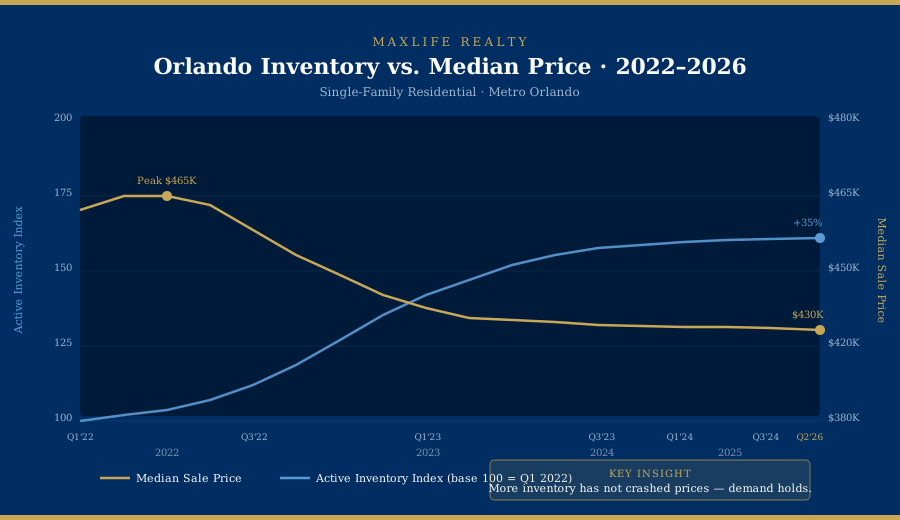
Inventory is up 35% from 2022 lows, and prices are down roughly 6% from the peak. But Orlando hasn't crashed — and the data shows why. Understanding the inventory-price relationship is essential for anyone selling in 2026.
When inventory rises, prices fall — that's the first principle most sellers invoke, and it's why rising inventory news causes so much seller anxiety. But that relationship is not linear, and in Orlando's specific case, the structural demand factors are counteracting inventory growth in ways that matter enormously for anyone considering a sale. Here is what the data actually shows.
What the Inventory Data Actually Shows
Active inventory in the Orlando metro has increased by approximately 35% from the historic lows reached in 2021–2022. To understand why this sounds alarming but is actually manageable, you need context on what "historic lows" actually meant.
At the peak of the 2021–2022 seller's market, active inventory in Orange and Seminole Counties combined was below 1,500 homes — representing less than 1 month of supply at then-current sales rates. Buyers were competing for properties that received 20–30 showings in the first weekend, going 5–10% over asking price with waived inspection and appraisal contingencies. That was not a normal market. It was a once-in-a-generation distortion driven by historically low rates, massive pandemic-era migration, and a complete freeze in seller activity.
Today, with "35% more inventory," we were at 4.9 months of supply in August 2026, per the Orlando Regional REALTOR Association. To put that in perspective: real estate professionals define a balanced market as 5–6 months of supply, and a buyer's market as 6+ months. We are still in moderately seller-favorable territory by historical standards. It is not 2022. It is also not a buyer's market.
Why Prices Have Stabilized Rather Than Collapsed
The headline number — the single-family median down about 6% from the $465,000 peak to $436,456 in August 2026 (ORRA) — tells one story. What it doesn't tell is why prices have found a floor rather than continuing to decline as inventory rose.
Demand is structurally persistent. Metro Orlando adds 50,000–60,000 net new residents per year. These people need to live somewhere. Population growth does not pause because mortgage rates are at 6.75%. Migration continues to flow from high-cost northeastern and midwestern metros, from international markets, and from within Florida itself as people move from Miami and Tampa to Orlando for relative affordability. This creates a demand floor that inventory growth cannot easily overwhelm.
Supply is artificially constrained by rate lock-in. The most counterintuitive aspect of the current market: higher interest rates have actually limited how much inventory enters the market. Approximately 40% of Florida homeowners financed at sub-4% rates between 2020 and 2022. Selling means giving up that rate. On a $450,000 loan, the monthly payment difference between 3.25% and 6.75% is nearly $960. Most of those homeowners are choosing to stay put, even if they'd prefer to move. This means the "natural" supply of resale inventory — people who would sell under normal rate conditions — is being held back. Without this constraint, inventory would be considerably higher and price pressure would be more severe.
New construction has been disciplined. During the 2004–2008 cycle, builders overbuilt aggressively in the Orlando exurbs — particularly in Osceola County and south Lake County — creating a supply glut that took years to absorb. Current-cycle builders have been significantly more disciplined, tying starts more closely to sales pace and backing off when demand softened. The excess isn't there in the same way.
Where Inventory Is Rising Fastest — and What That Means for Sellers
Not all Orlando submarkets are experiencing inventory growth equally. Understanding where the supply increase is concentrated helps sellers make informed decisions about timing and pricing.
New construction-heavy corridors (Horizon West, Lake Nona, Apopka northern expansion): These areas have seen the most significant inventory increases, partly from speculative buying during 2021–2022 that is now coming to market, and partly from continued builder pipeline completions. Sellers in these markets face direct competition from brand-new homes with builder incentives (rate buydowns, appliance packages, closing cost credits). Resale sellers here need to compete aggressively on price or condition to differentiate.
Established luxury markets (Windermere, Dr. Phillips, Winter Park): Inventory has increased from genuinely low levels to merely low levels. These markets are not oversupplied — they are simply normalized. A Windermere neighborhood that had 8 active listings in 2022 and now has 18 is not a distressed market; it's a market with normal competition. Sellers here retain significant pricing leverage because physical land constraints limit how much supply can ever enter these markets.
Condo and townhome segment: This is where inventory growth has been most problematic, and where price pressure is most acute. Post-Surfside legislation (SB 4D) is forcing condo associations to complete structural inspections and fund reserves, leading to significant special assessments. This has created motivated sellers and cautious buyers in the condo market specifically. If you own a condo built before 1990, the market dynamics are meaningfully different from what's described above.
The Price Forecast: What Actually Happens Next
Based on current inventory, demand, and employment trends, the most likely price trajectory for Orlando single-family homes through 2027–2028 is modest appreciation in the 2–4% annual range. The scenarios where prices would deviate materially from this forecast:
Bearish scenario: A national recession that pushes Orlando unemployment above 6–7% would increase forced selling, reduce qualified buyers, and could push prices down another 5–10% from current levels. This is a real risk, not a remote one — it depends primarily on national macroeconomic conditions outside of Orlando's control.
Bullish scenario: If mortgage rates normalize to 5.5–6%, the rate lock-in effect reverses — both sides of the market (locked-in sellers and rate-sensitive buyers) re-enter simultaneously, demand spikes faster than supply can respond, and prices likely re-accelerate toward 2022 peak levels within 18–24 months.
Base case (most likely): Rates remain in the 6.25–7% range, inventory continues modest growth but stays below 5 months of supply, and prices appreciate slowly. Sellers who price correctly and present well sell successfully. Sellers who expect 2022 dynamics and price accordingly get frustrated.
What This Means If You're Selling in 2026
Price accuracy is more important than ever. In a low-inventory environment, overpriced homes still sell — buyers had fewer alternatives. In today's market, buyers have options, and they will wait rather than overpay. An overpriced home doesn't just sit — it creates a stigma. After 30–45 days without an offer, buyers assume something is wrong with the property itself, not the price. Price reductions reduce buyer confidence rather than increasing urgency. Start with a free home valuation to see where your property actually sits relative to this shifting inventory picture before you settle on a number.
Concessions are the cost of doing business. When inventory was below 1 month of supply, buyers waived everything. Today, buyers in the $400K–$800K range routinely request 2–3% in closing cost credits or rate buydown contributions. Factor this into your net sheet from day one rather than treating it as an unexpected hit.
First-week momentum is decisive. The first 7–10 days after listing remain the highest-intensity period for buyer interest. Homes that generate showings and offers in Week 1 capture buyers at peak motivation. Homes that don't generate first-week activity go into a slower search mode that often requires price reductions to re-ignite interest. Everything — pricing, presentation, photography, marketing launch — should be optimized to win Week 1.
Ryan Solberg · MaxLife Realty · 321-373-3536. Data reflects ORRA MLS and market conditions as of May 2026.
Frequently asked questions
- Is inventory rising in Orlando in 2026?
- Yes. Active inventory in the Orlando metro is up approximately 35% from the 2022 lows, sitting at 4.9 months of supply as of August 2026, per the Orlando Regional REALTOR Association. This is still below the 6-month threshold that defines a balanced market, but it represents a significant shift from the sub-1-month supply of 2021–2022.
- Are Orlando home prices dropping in 2026?
- Prices have already corrected. The median sale price fell from approximately $465,000 at the 2022 peak to a single-family median of $436,456 in August 2026 (ORRA) — about a 6% decline. The current trajectory is flat to modest appreciation (2–4% annually), not continued decline. Strong population growth and limited resale supply from rate-locked homeowners are preventing further price erosion.
- How much supply is needed for a buyer's market in Orlando?
- Six or more months of supply is the conventional threshold for a buyer's market. Orlando sat at 4.9 months in August 2026 (ORRA). While buyers have more choices than in 2022, pricing power has not fully shifted to buyers. Sellers who price correctly retain significant leverage.
- Why haven't rising inventory levels crashed Orlando prices?
- Three factors offset rising inventory: 1) Population growth of 50,000–60,000 net new residents per year creates persistent demand. 2) Rate lock-in keeps approximately 40% of existing homeowners from selling, limiting how much supply actually hits the market. 3) New construction has not overbuilt relative to demand in the desirable corridors.
- What does rising inventory mean for Orlando sellers in 2026?
- More competition. Buyers have options, which means overpriced homes sit and correctly-priced homes sell. It also means buyer concessions (closing cost credits, rate buydowns) are now standard practice. Sellers need to price accurately and present well to capture first-week buyer attention.
The next step
Thinking about a move?
Whether you're two months out or two years out, the right information now saves real money later. Let's talk — no pressure, no pitch.