· Updated · 9 min read· By Ryan Solberg, Broker #BK3354351
Is Now a Good Time to Sell in Orlando? A Data-Driven Answer for 2026
Orlando's market has normalized — it's no longer 2022, but it's also not broken. Homes priced correctly are selling in under 60 days. Here is what the data actually says about selling in 2026.
Orlando's housing market has been through a correction, a normalization, and now a plateau. If you're waiting for a clear "yes" or "no" on whether to sell in 2026, the honest answer is this: the market is workable, not exceptional. Homes priced correctly are selling. Homes priced optimistically are sitting. What follows is a data-grounded analysis of exactly what you're walking into.
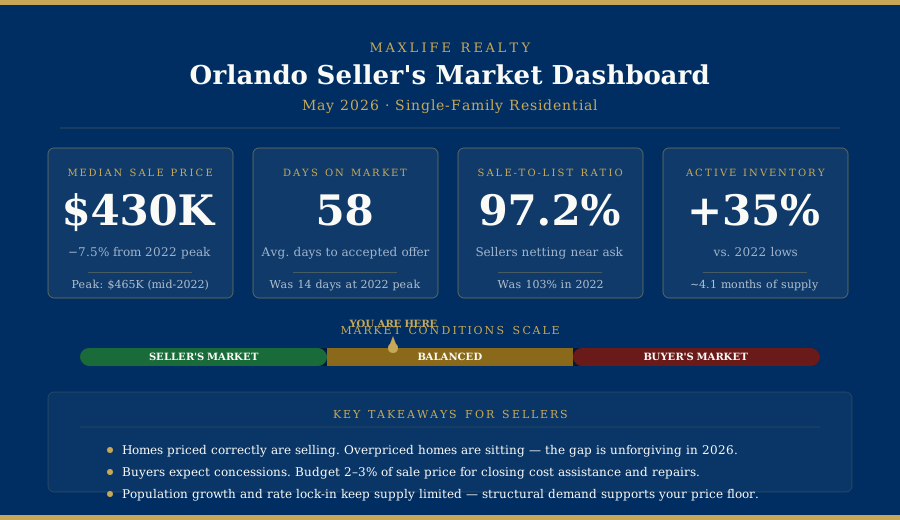
The Four Numbers Every Orlando Seller Needs to Know Right Now
Before anything else, anchor yourself in the current data. As of May 2026:
Median single-family sale price: $436,456 (ORRA, August 2026). Down roughly 6% from the mid-2022 peak of $465,000, and essentially flat year-over-year. This is not a crash — it is a partial correction after a 35–40% run-up during 2020–2022. The market has not given back all of the pandemic-era gains, and structural demand factors (discussed below) suggest it will not.
Average days on market: 64 days (ORRA, August 2026). At the 2022 peak, homes routinely went under contract in 7–14 days with multiple offers. Today, 64 days is the average across all price points. Well-priced homes in strong corridors are doing better — around 45–52 days. Overpriced homes are dragging the average up by sitting for 90–120 days before either selling at a reduced price or being pulled from the market.
Sale-to-list ratio: about 97.3% (Orlando residential sales, August 2026, Stellar MLS). Sellers are netting about 97 cents for every dollar of list price. In 2022, the ratio was above 103% — meaning buyers were paying over asking. Today, some discount is expected. If you list at $600,000, your likely sale price is around $583,000–$588,000 based on current averages. Factor this into your net sheet before you price.
Active inventory: up 35% from 2022 lows. More supply means buyers have options, which means they negotiate. We were at 4.9 months of supply in August 2026, per the Orlando Regional REALTOR Association — below the 6-month threshold typically considered a "balanced" market, but well above the sub-1-month frenzy of 2021–2022. You're selling into a market with real competition, not a vacuum.
What the Market Looks Like by Price Band
Not all Orlando homes are in the same market. Here is how demand breaks down by price:
Under $350,000: Supply is extremely thin. This segment gets multiple offers consistently and moves fast. If you own in this range, you have significant pricing power. The challenge is finding a replacement home — at this price point, you're often buying in the same tight inventory pool you're selling into.
$350,000–$600,000: The engine of the Orlando market. This is where the largest volume of transactions occurs, where buyer demand is deepest, and where correctly-priced homes move in 45–58 days. Expect buyer-requested concessions — typically 2–3% of sale price in closing cost credits or repair allowances — but not desperate negotiation on price if you're positioned correctly.
$600,000–$1,000,000: More discretionary buyers, longer decision cycles. Many in this bracket are trade-up buyers from the $400K–$600K range, or relocation buyers with specific criteria. Days on market extend to 60–80 days. Staging and presentation quality matter significantly more at this price point.
Above $1,000,000: A fundamentally different market. Buyers are fewer, more patient, and have alternatives including new construction from builders like Toll Brothers and Pulte who are actively competing in this space. Median days on market for luxury homes exceeds 90 days. Pricing accuracy is critical — overpriced luxury homes can sit for six months to a year.
The Structural Factors That Keep Orlando From Crashing
Sellers sometimes ask whether they should wait because the market might improve, or whether they should rush because it might worsen. Understanding the structural demand factors helps you answer that question more clearly.
Population growth at 50,000–60,000 net new residents per year. Metro Orlando is one of the fastest-growing metros in the country. These people need housing. That demand does not turn off because mortgage rates are elevated.
Rate lock-in suppresses competing supply. Approximately 40% of Florida homeowners financed at sub-4% rates during 2020–2022. Selling means giving that rate up — and on a $450,000 loan, the difference between 3.25% and 6.75% is over $960 per month. Most of those owners are staying put, which artificially limits how much resale inventory comes to market. Fewer competing listings means less downward pressure on your price.
Diversified, low-unemployment economy. Orlando's unemployment rate sits near 3.4%. The regional economy has moved well beyond tourism and hospitality — Lake Nona's medical cluster, defense and aerospace in Brevard, UCF's tech ecosystem, and financial services all contribute. A single-sector contraction is unlikely to produce the forced-selling cascade that drives real price crashes.
Geographic supply constraints in desirable corridors. Seminole County is largely built out. Southwest Orange County — Dr. Phillips, Bay Hill, Windermere — has limited infill land. The lake-chain communities face physical constraints. In these markets, supply scarcity supports prices even when broader demand softens.
The Honest Headwinds
Providing a balanced picture means acknowledging what's working against sellers in 2026.
Buyer concessions are now standard. In 2022, buyers were waiving inspections and throwing in escalation clauses. Today, they expect sellers to contribute 2–3% of the sale price toward closing costs or a rate buydown. On a $550,000 home, budget $11,000–$16,000 in concessions into your net proceeds calculation.
Insurance costs are affecting buyer purchasing power. Florida homeowner's insurance premiums have increased 40–60% over the past few years. A buyer who qualifies for a $450,000 mortgage at a given rate may find the total PITI (principal, interest, taxes, insurance) exceeds their comfort threshold because insurance is running $4,000–$8,000 annually on many properties. This particularly affects older homes and those in flood-zone-adjacent areas.
Appraisals are tighter. During 2021–2022, appraisers were frequently coming in below sale price, but buyers were waiving appraisal contingencies. Today, buyers are not waiving appraisals. If you overprice and get an offer, the appraisal often kills the deal or forces a renegotiation. Price correctly and this is a non-issue.
Buyer psychology has shifted. After two years of rate shock and watching prices from a distance, buyers are cautious. They take their time. They do thorough inspections. They request concessions. This is not 2022. Sellers who internalized the 2022 market and still expect it today will be frustrated.
When Is the Best Time of Year to List in Orlando?
Unlike northern markets where seasons dramatically affect real estate activity, Orlando's climate extends the selling season considerably. That said, there are still meaningful patterns.
February through May is historically the strongest window. School-timing buyers want to be settled before the August school start, creating a concentrated surge of buyer activity in spring. Competition among buyers peaks in March and April.
June through August remains active but the urgency subsides once school enrollment deadlines pass. Buyers who missed spring are still active. Humidity and Florida summer heat mean fewer casual lookers and more motivated buyers.
September through November sees a secondary bump as part-year migration begins and northern buyers visit Florida. This window is underrated for premium properties — buyers from cold climates are highly motivated and often cash-heavy.
December through January is typically the slowest period. Inventory is low, but so is buyer activity. Some sellers do well here because competition from other listings drops.
If you're reading this in spring or early summer 2026, you're in the prime window. If it's later in the year, the next opportunity peaks in February–April 2027.
So: Should You Sell Now?
The answer depends on your specific situation, not on whether the market is at its absolute peak. Here is a framework:
Sell now if: You have a life reason to move (growing family, downsizing, relocation, divorce, estate), your home is in the $350K–$750K range where buyer demand is deepest, you're willing to price at market value and manage concession expectations, and you've run a proper net sheet that shows the proceeds meet your needs.
Consider waiting if: Your home is significantly above $1M and you're not in a hurry, you're expecting 2022 conditions to return (they won't on a short timeline), or you need maximum proceeds and the current net sheet falls short of your goal by more than a few percent.
The market is unlikely to dramatically improve in the next 12–18 months. The most likely scenario is modest 2–4% appreciation annually through 2028. You're not missing a peak by selling now, and you're not walking into a collapsing market either. The window is workable. The execution is what determines your outcome.
Ryan Solberg is a licensed Florida real estate broker with MaxLife Realty, based in Orlando. All data reflects conditions as of May 2026. This is market analysis, not financial advice. Contact Ryan at 321-373-3536 for a personalized seller consultation.
Frequently asked questions
- Is it a good time to sell a house in Orlando in 2026?
- Yes, with calibrated expectations. Homes priced correctly at market value are selling in 45–60 days at 97–98% of list price. The market has normalized from 2022's extreme conditions but remains active — particularly in the $350K–$750K range.
- What is the Orlando housing market like for sellers in May 2026?
- The single-family median was $436,456 in August 2026, roughly 6% below the 2022 peak of $465,000, and days on market averaged 64, up from 14 days in 2022 (Orlando Regional REALTOR Association, August 2026). Active inventory is up about 35% from 2022 lows, giving buyers more choices but not enough to flip pricing power to their side.
- How long will it take to sell my Orlando home in 2026?
- Correctly priced homes in high-demand areas like Dr. Phillips and College Park are selling in 45–55 days. Homes in premium markets like Windermere and Golden Oak typically require 65–100 days. Overpriced homes in any neighborhood can sit for 90–120+ days and often require price reductions.
- What price range sells fastest in Orlando right now?
- The $350,000–$600,000 range has the most active buyer pool in metro Orlando. Above $750,000, the buyer pool narrows significantly and days on market extend. Below $300,000, inventory is extremely thin and competition among buyers remains intense.
- Should I sell my Orlando home now or wait for the market to improve?
- Waiting assumes the market will materially improve on a predictable timeline — which is not what the data supports. Prices are likely to stay flat to modestly appreciate 2–4% annually through 2028. If you have a life reason to sell, now is a workable market. If you're waiting for 2022 conditions to return, that could be a multi-year wait.
The next step
Thinking about a move?
Whether you're two months out or two years out, the right information now saves real money later. Let's talk — no pressure, no pitch.