· Updated · 8 min read· By Ryan Solberg, Broker #BK3354351
How Long Will My Home Sit? Days on Market by Orlando Neighborhood (2026)
Days on market varies dramatically across Orlando — from 46 days in College Park to 98 days in Golden Oak. Understanding your specific neighborhood's absorption rate is the single most important thing you can know before setting your sale timeline.
The average days on market in Orlando was 64 days in August 2026, per the Orlando Regional REALTOR Association. But "average" is one of the least useful numbers in real estate. If you're selling a $680,000 Dr. Phillips home, 52 days is your realistic target. If you're selling a $1.2M Windermere estate, 67 days is the starting point, not the finish line. And if you're in the ultra-luxury markets of Isleworth or Golden Oak, 90+ days is not a market failure — it's the normal marketing period for properties with six-figure price tags that require finding one specific buyer among a very small global pool.
Understanding your neighborhood's specific absorption rate before you list is not a minor data point. It determines your moving timeline, your carrying cost calculations, and your psychological preparation for what "normal" looks like.
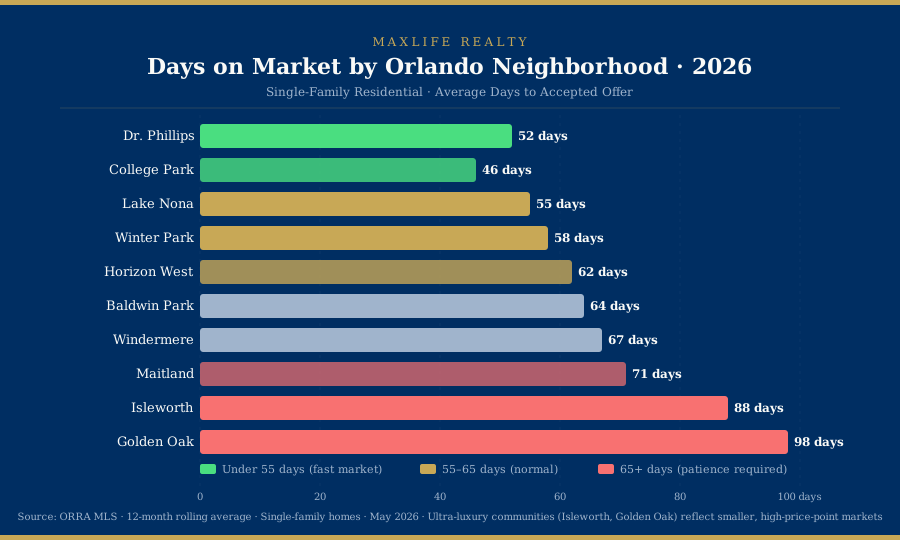
Fast Markets (Under 55 Days)
College Park — 46 Days Average
College Park is Orlando's fastest-moving residential market among established neighborhoods. The draw: walkable streets, Edgewater Drive dining and retail, Lake Ivanhoe access, and proximity to downtown — all at a price point ($380K–$650K) that is accessible to a broad buyer pool, including downtown-adjacent lifestyle buyers.
The neighborhood's inventory is structurally constrained — College Park's stock of early–mid 20th century bungalows, cottages, and craftsman homes simply cannot be replicated. When a well-priced, well-presented College Park home hits the market, buyers who have been waiting (and there are always buyers waiting) act quickly. Multiple offers in the first week are more common here than in almost any other submarket.
Implication for sellers: In College Park, pricing at market value typically generates maximum first-week competition. The faster absorption rate gives you less margin for pricing error — overpriced homes here get passed over for the next College Park listing that comes along, and there's usually a queue.
Dr. Phillips — 52 Days Average
Dr. Phillips benefits from one of the broadest and most consistent buyer pools in metro Orlando. The combination of Restaurant Row, top-tier schools, proximity to major employment corridors, and a range of luxury communities (Bay Hill, Vizcaya, Toscana, Phillips Cove, and others) creates deep buyer demand across the $450K–$1.2M range.
Epic Universe, which opened at Universal in May 2025, has added a new layer of interest — entertainment and hospitality professionals relocating to the southwest Orange corridor frequently put Dr. Phillips at the top of their list, though no independent study has yet isolated the park's effect on prices.
Implication for sellers: 52 days means you should plan for a 45–60 day marketing window. A well-priced, well-presented Dr. Phillips home should receive serious offers within the first two weeks. If you haven't had a quality offer by Day 21, something is wrong with the price or presentation — not the neighborhood.
Lake Nona — 55 Days Average
Lake Nona is experiencing a structural transition. The USTA National Campus, the expansive medical city, and a planned community design that emphasizes walkability, tech integration, and A-rated schools have attracted a highly educated, high-income buyer profile that generates consistent demand.
The challenge in Lake Nona is new construction competition. Builders remain active, offering rate buydowns and move-in packages that create a headwind for resale sellers. Resale sellers who don't price competitively with new construction alternatives — accounting for the concession packages builders offer — risk extended days on market despite strong neighborhood fundamentals.
Normal Markets (55–65 Days)
Winter Park — 58 Days Average
Winter Park runs slightly faster than the metro average (Winter Park-address sales averaged 57 days in June–August 2026, per Stellar MLS) — and for a luxury market with a median well above $700,000, 58 days reflects strong underlying demand. Park Avenue, the Rollins College campus environment, and the cultural cache of the city (Morse Museum, Central Park, the Chain of Lakes system) create a buyer audience that is specifically motivated and financially qualified.
The challenge in Winter Park is the wide price range — a 2/1 near Fairbanks is a fundamentally different sale than a lakefront estate on the Isle of Sicily. Days on market across this spectrum varies dramatically, but 58 days is a reasonable planning horizon for a non-lakefront property in the $650K–$1.2M range.
Horizon West — 62 Days Average
Horizon West is Orlando's most active new construction corridor, and that is simultaneously its opportunity and its challenge for resale sellers. The combination of strong-rated Windermere Preparatory and Bridgewater schools, well-planned community infrastructure, and genuine walkability has attracted a consistent stream of buyers from across the country.
Resale sellers compete directly with builders who are offering 2-1 buydowns, design center credits, and closing cost assistance on new homes. Resale homes that offer comparable concessions and price competitively with new construction comps do well. Those that price as if the new construction competition doesn't exist struggle.
Baldwin Park — 64 Days Average
Baldwin Park is a genuine mixed-use community — one of the few in metro Orlando — with a walkable "village" at its center, frontage on Lake Baldwin, and a cohesive neighborhood character that attracts a broad range of buyers. The price range ($400K–$1.2M+) is broad, and buyer profiles vary accordingly.
The 64-day average reflects the somewhat niche nature of the community — buyers who love Baldwin Park tend to be very targeted about it, which means strong eventual outcomes for sellers, but potentially a longer wait for the right match.
Patience Required (65+ Days)
Windermere — 67 Days Average
As discussed in the Dr. Phillips vs. Windermere analysis, Windermere's slightly longer absorption period reflects the premium nature of the buyer pool rather than weak demand. Buyers purchasing at Windermere's median of $850,000 (August 2026, Stellar MLS, ZIP 34786) are deliberate — they tour multiple times, they bring architects or interior designers on second visits, and they take weeks rather than days to make decisions.
The 67-day average also reflects significant variance — non-lakefront Windermere homes in communities like Sawyer Lake or Keene's Pointe trade faster (often 45–55 days), while direct Butler Chain frontage properties with $2M+ price tags can take 90–120 days to find the specific buyer willing to pay for that specific asset.
Maitland — 71 Days Average
Maitland sits between the Winter Park premium and the suburban alternatives of Casselberry and Longwood — a positioning that makes it challenging to price. Buyers who can afford Maitland prices often stretch slightly to Winter Park or Altamonte Springs. Sellers compete against a broader geographic market than in more defined neighborhoods.
The 71-day average is workable, but sellers should be particularly attentive to pricing accuracy and competitive positioning against Winter Park and Baldwin Park comps. Maitland's best assets — Lake Maitland frontage, proximity to Maitland Art Center, the quieter character of the community — should be front and center in the marketing narrative.
Isleworth — 88 Days Average
Isleworth is one of the most exclusive gated communities in Florida, with a guard-staffed private island location on the Butler Chain, a world-class golf course, and a roster of celebrity and executive residents that creates its own brand equity. Homes range from $2M to $20M+.
At this price point, 88 days is not a distressed market — it is the normal marketing window for a product with a global buyer pool measured in the hundreds, not thousands. Marketing Isleworth requires international exposure through luxury network channels, private brokerage outreach, and direct contact with ultra-high-net-worth buyer communities. Standard MLS strategy is necessary but not sufficient.
Golden Oak — 98 Days Average
Golden Oak at Walt Disney World is the only private residential community on Disney property — homeowners have access to a private clubhouse, dedicated park-going privileges, and direct proximity to the parks in a way no other address in Central Florida can offer. Homes range from $3M to $10M+.
The 98-day average reflects the extraordinary specificity of the product. The buyer for Golden Oak is not just looking for a luxury home in Orlando — they are looking for this specific lifestyle intersection of privacy, Disney access, and luxury residential quality. That buyer pool is small and global. Marketing timelines reflect finding that specific person, not any failure of the market.
What Affects Your Days on Market
Neighborhood averages are the baseline. Your specific result can be faster or slower depending on:
Pricing relative to comps. The single largest variable. A correctly-priced home captures first-week buyer urgency. An overpriced home misses that window and begins its slow drift toward a price reduction.
Presentation quality. Professional photography, staging, and a walkthrough video measurably reduce days on market. This is particularly true in the $500K+ range where buyer expectations for presentation are highest.
Condition. Deferred maintenance (older roof, aged HVAC, outdated electrical) does not prevent sales — it extends timelines as buyers factor in their remediation costs and negotiate accordingly. Addressing major condition issues pre-listing shortens the path to contract.
Timing. Listing in February–May captures the peak buyer season in Orlando. Listing in December captures fewer buyers but faces less competition. Either works — the peak season advantage is real but not determinative.
Concession structure. Homes that offer clear concession information upfront (seller credits available, home warranty included, buydown fund available) convert more showings to offers because buyers can calculate their real cost with clarity.
Using Days on Market to Set Realistic Expectations
Before you list, sit with your agent and review your neighborhood's specific absorption rate. Then ask:
- Am I pricing within the range where my neighborhood's fastest sales occurred?
- Is my home's condition comparable to what sold quickly, or does it need work?
- Do I have a hard deadline that changes my pricing strategy?
- Am I emotionally prepared for the neighborhood's typical timeline, or do I need to price more aggressively for speed?
These questions matter more than any national headline about the real estate market. Your sale happens in your neighborhood, with your specific buyers, on your specific timeline. The data above is your map.
Ryan Solberg · MaxLife Realty · 321-373-3536. Data: ORRA MLS 12-month rolling average, single-family homes, May 2026. Ultra-luxury community figures reflect limited transaction volume and should be used as directional estimates.
How to Use Days-on-Market Data to Sell Your Orlando Home Faster
A step-by-step process for using your neighborhood's specific absorption rate and days-on-market data to time your listing, set your price, and plan your showing strategy in 2026.
Step 1
Look Up Your Specific Neighborhood's Average DOM
Ask your agent for the median and average days on market for your specific neighborhood over the last 90 days — not metro-wide data. In 2026 this ranges from 46 days in College Park to 98+ days in Golden Oak and Isleworth. Metro averages (64 days as of August 2026, per ORRA) hide meaningful variation. Your planning timeline should be anchored to your neighborhood's number.
Step 2
Calculate Your Neighborhood's Absorption Rate
Absorption rate is the number of months of active inventory at your price point. Ask your agent: how many homes at my price have sold in the last 90 days (divide by 3 for monthly rate), and how many are currently active? Divide active listings by the monthly sales rate. Under 3 months is a seller's market; 3–6 months is balanced; above 6 months favors buyers. This number sets your negotiating leverage.
Step 3
Identify Your Optimal Launch Window
In Orlando, the highest buyer activity window is February through May. Listings launched in this window typically see 20–30% more first-week showings than comparable listings in July or November. If your timeline is flexible, align your launch with the spring market. If you must list outside the peak window, price more aggressively to compensate for lower foot traffic.
Step 4
Price for First-Week Urgency in Your DOM Bracket
In fast markets (45–60 day avg DOM), pricing at the midpoint of comparable sales drives first-week urgency and competitive energy. In slower luxury markets (90+ day avg DOM), buyers are less price-sensitive and more condition-sensitive — invest in the property's presentation rather than racing to the bottom on price. Know which dynamic applies to your neighborhood before you set your number.
Step 5
Set Up Daily Showing and Feedback Tracking
From day one, track four data streams: showings booked (your agent should report these daily or via the ShowingTime dashboard), Zillow saves (visible in Zillow Premier Agent), agent feedback after each showing, and whether any showings are converting to second visits or offers. These signals tell you within 7–10 days whether your price and presentation are working.
Step 6
Define Your Price-Review Threshold Before You List
Before going live, set a specific trigger for reviewing price. A typical benchmark in mid-market Orlando ($400K–$800K): fewer than 6 showings in 14 days with no offers signals a price problem. In a 90+ day luxury market: 2–3 showings in the first 21 days is normal. Define the threshold appropriate for your specific neighborhood — not a generic rule — and commit to acting on it rather than waiting and hoping.
Step 7
Act Before You Cross 30 Days on Market
Buyer perception shifts at 30 days on market. A listing that has not gone under contract at 30 DOM begins to attract the question: 'What's wrong with it?' Price reductions after 30 days are significantly less effective than a correct price at launch. If your data signals a problem at 14–21 days — too few showings, no second visits, consistently negative price feedback — adjust before the perception shift makes your correction harder to recover from.
Frequently asked questions
- How long does it take to sell a house in Orlando in 2026?
- The metro-wide average was 64 days on market in August 2026, per the Orlando Regional REALTOR Association. However, this average conceals significant variation by neighborhood. College Park averages 46 days; Dr. Phillips averages 52 days; Golden Oak and Isleworth exceed 90 days. Your neighborhood's specific absorption rate should drive your timeline expectations.
- What Orlando neighborhoods sell the fastest?
- As of 2026, the fastest-selling markets in metro Orlando are College Park (46 days avg), Dr. Phillips (52 days avg), and Lake Nona (55 days avg). These neighborhoods benefit from consistent buyer demand, broad price-point accessibility, and strong location stories that attract both local and relocation buyers.
- Why do some Orlando neighborhoods take much longer to sell?
- Ultra-luxury markets like Isleworth and Golden Oak serve a very narrow buyer pool — there are simply fewer buyers for $3M–$15M properties than for $500K–$800K homes. Longer days on market in these markets is normal, not distressed. It reflects the time required to connect a specific high-value property with the right buyer.
- Does days on market affect my sale price in Orlando?
- Yes, significantly. Homes that go under contract in the first 7–14 days routinely sell at 98–100% of list price. Homes that sit for 30–60 days before going under contract average 95–97% of list price. Homes that sit 60+ days and take price reductions often end up at 93–96% of an already-reduced price — meaning the total proceeds are meaningfully lower.
- How do I sell my Orlando home faster than average?
- The three factors with the most impact on days on market are: pricing accuracy (correctly priced homes attract first-week buyer urgency), presentation quality (professional photography and staging generate showings), and launch timing (listing in February through May captures peak buyer activity). All three are within your control.
The next step
Thinking about a move?
Whether you're two months out or two years out, the right information now saves real money later. Let's talk — no pressure, no pitch.