· Updated · 14 min read· By Ryan Solberg, Broker #BK3354351
What Is the Orlando Real Estate Market Doing in 2026? A Broker's Honest Read
The Orlando housing market in 2026 looks nothing like the frenzy of 2021–2022 and nothing like the crash some predicted. Prices are essentially flat year-over-year, inventory is elevated, and buyers finally have room to breathe. Here's what the numbers actually say.
The Orlando real estate market in 2026 is not what either camp predicted. The crash crowd got it wrong. The "prices only go up" crowd got it partially right but missed the shift in market dynamics entirely. What actually happened is more interesting than either narrative: a market that absorbed enormous inventory growth, held prices roughly flat, and is now showing signs of stabilizing into something that works for both sides of the table.
I pull MLS data every week as part of my work as a broker here. I've closed over $85 million in Central Florida transactions across 11 years. This post is my honest read of the orlando real estate market 2026 data — what it means for buyers, sellers, and anyone trying to make a rational decision about housing in this metro.
If you're planning a move to Central Florida, our full Orlando relocation guide covers neighborhoods, taxes, and cost of living in detail.
What the Numbers Actually Say About Orlando Home Prices
The Orlando market recorded a median sale price of $400,676 in August 2026 — down 0.6% from $403,222 a year earlier, according to the Orlando Regional Realtor Association. That's not appreciation. It's not a crash. It's a market settling into something resembling normal after four years of anything but normal.
The headline number breaks down differently by property type. Single-family homes posted a median of $436,456 in August 2026. Condos and townhouses sat at $301,071 — a segment that has faced more headwind from insurance cost increases and rising HOA fees. If you're comparing Orlando metro prices against Zillow's city-of-Orlando figure ($372,206 as of June 2026), note that Zillow's number covers only the municipal city boundary — a much smaller and different geographic slice than the four-county ORRA metro definition. The metro number is the right comparison for most buyers.
According to the Orlando Regional Realtor Association's August 2026 Housing Market Narrative, Orlando recorded a median sale price of $400,676 — down 0.6% year-over-year. With 12,144 homes in inventory and 4.9 months of supply, the market sits just below the six-month threshold that defines a balanced market.
Days on market tells you something real about the pace. In August 2026, homes averaged 64 days on market (ORRA). Homes that are priced correctly still move; the ones that sit are almost always the ones priced to 2022 comps.
Here's something most sellers don't hear: roughly 25–26% of active listings have taken a price reduction — and that actually compares favorably to the pre-pandemic normal. In 2018–2019, price reduction rates in this market ran 28–31%. The market feels soft to sellers who remember 2021, but relative to historical norms, the current conditions are not unusual. The benchmark most people are using for comparison (2021–2022) was the outlier, not the standard.
For a detailed breakdown of how sellers should approach pricing in this environment, see how to price your home in Florida.
Inventory at 4.9 Months: What That Means for Buyers and Sellers
With 4.9 months of supply and 12,144 homes in inventory, the Orlando housing market trends toward a market that's neither a runaway seller's market nor a buyer's paradise (ORRA, August 2026). Real estate convention sets six months as the dividing line between seller and buyer territory. We're still below that line.
Supply is up from July's 4.4 months. But absorption is holding: Orlando residential sales closed at an average of 97.3% of list price in August 2026, per Stellar MLS data. Sellers are getting close to what they're asking; they're just not getting above-ask offers on every home anymore.
What does this mean in practice?
For buyers, you now have real negotiating room on overpriced homes. Inspection contingencies are back as standard practice. You can ask for seller contributions toward closing costs on appropriately priced homes without insulting anyone. That wasn't true in 2021.
For sellers, correctly priced homes are still moving. The roughly 97% sale-to-list ratio is the key data point here: if you list at market value, you're leaving very little on the table. The problem is sellers who anchor to 2022 peak comps. Those comps are 18 months stale and the market has repriced around them.
What I'm seeing in spring 2026 buyer conversations is real hesitation on the first offer — not because buyers don't want the home, but because they're still processing that the panic of 2021 is gone. They keep asking whether to wait. My answer is always the same: if you're buying a home to live in for five or more years in a market with structural population growth, waiting for a better entry point is a bet that rarely pays. search current Orlando listings and look at what's actually available versus six months ago.
Orlando Housing Market Trends by Neighborhood
Neighborhood-level price data tells a more textured story than the metro median, and in spring 2026, the spread between Orlando's premium submarkets and its mid-tier areas is significant — reflecting both lifestyle premiums and underlying demand differences.
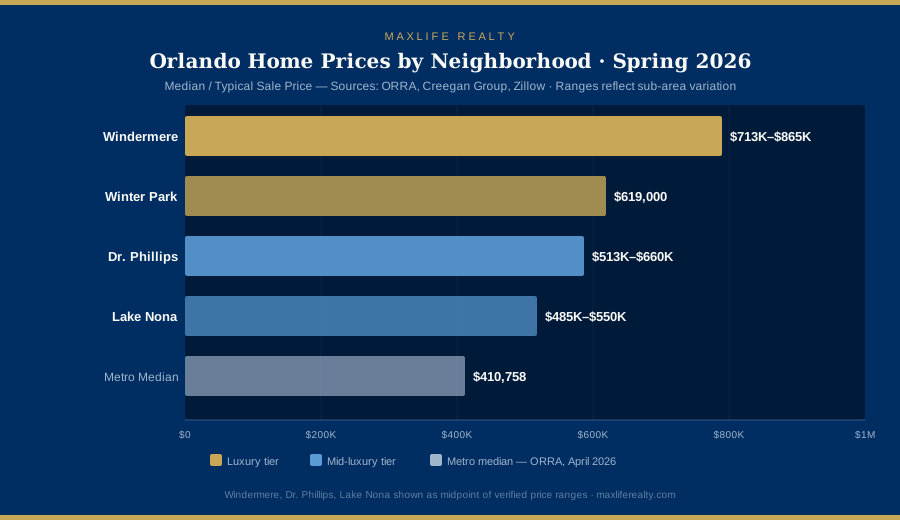
Winter Park recorded a median sale price of $619,000 as of March 2026, with 57 days on market and 392 active listings — down 12.3% in listings year-over-year, per the Creegan Group March 2026 market report. That inventory contraction is meaningful. Fewer listings and a price near $620,000 means the Winter Park market is tightening again at the top. See the full Winter Park market data for monthly updates.
Windermere ranges from roughly $713,000 (Zillow typical value, Zillow June 2026) up to $865,000 and above depending on the specific sub-community. Butler Chain waterfront access, lot size, and community tier drive wide variation within the Windermere postal code. The Windermere market report tracks this sub-area breakdown in detail.
Lake Nona single-family homes fall in the $485,000–$550,000 range for the community's mainstream product, with luxury estates in the $675,000–$780,000 range. Medical City proximity and the community's growth trajectory keep demand consistent. Lake Nona market report has the current absorption data.
Dr. Phillips runs $513,000–$660,000 on most of its non-lakefront inventory, with lakefront properties moving well above $900,000. The Butler Chain lots that come to market in Dr. Phillips don't last — they're the most consistently competitive segment in the submarket. Full breakdown at Dr. Phillips home values.
As of spring 2026, Winter Park's median sale price reached $619,000 with inventory contracting 12.3% year-over-year, per the Creegan Group March 2026 market report. Windermere's typical values range $713,000–$865,000 by sub-area. These figures reflect a consistent premium of 50–110% over the four-county metro median, driven by school districts, lake access, and community infrastructure.
For a deeper breakdown of pricing tiers and recent luxury transactions, read our Orlando luxury market analysis.
Florida's Luxury Market Is Surging — and Orlando Is in the Middle of It
Florida statewide luxury sales in Q1 2026 posted some of the strongest year-over-year gains in recent memory: $1M+ single-family home transactions rose 14% year-over-year, and the $5M–$10M segment jumped 31%, according to Florida Realtors (May 22, 2026). The condo numbers were even more striking: $1M+ condos rose 41% year-over-year, the $1.5M–$2M condo segment jumped 61%, and the $3M–$5M condo segment surged 69%.
What's driving this? A few converging factors.
Domestic migration from high-tax states continues. A buyer selling a $3 million home in California or a Manhattan co-op pays no Florida state income tax on their next dollar of earnings, saves substantially on property tax relative to New York, and often ends up with a nicer home for less money. The math still works, and the buyers still know it.
The equity markets held up through early 2026, keeping net worth intact for the buyers at this level. Luxury buyers are rarely rate-sensitive in the same way a first-time buyer is — they're often paying cash or putting down large down payments that make the rate almost secondary.
I've worked with several luxury clients this year who came to Central Florida specifically after researching the market data, not because a friend told them to move. They found Windermere and Isleworth on their own. By the time I was talking to them, they'd already narrowed to three or four communities. That's a different buyer than the one I worked with in 2015 who needed a full tour of the metro to understand the landscape. The sophistication of the luxury buyer coming into this market has increased sharply.
Distressed sales remain negligible: only 19 foreclosures and short sales occurred in the entire four-county metro in April 2026, representing 0.7% of all closed transactions (ORRA, April 2026). This market is not in distress at any price tier.
See our Orlando luxury market analysis for pricing by community and how luxury buyers are approaching 2026.
Population Growth Is Still the Fundamental Story
The Orlando MSA added 37,690 net new residents in 2024–2025 — roughly 725 people per week — pushing the total metro population to 2,957,672 as of July 1, 2025, according to the Orlando Economic Partnership (March 31, 2026). The metro's 1.3% growth rate outpaced Florida at 0.8% and the U.S. overall at 0.5%, ranking Orlando 6th among the 30 most populous U.S. metro areas.
The composition of that growth matters. International migration accounted for 82% of 2025's total net growth, bringing approximately 29,000 new residents from abroad. Net domestic migration was slightly negative at -1,785 — meaning more people moved from Orlando to other U.S. metros than arrived from them — but the international inflow more than absorbed that outflow. Over the five years since 2020, the metro has added a total of 284,300 residents.

Why does this matter to the housing market? Every one of those 725 people arriving per week needs a place to live. They're not all buying immediately — many rent first, especially the internationally arriving cohort. But the pipeline from new resident to buyer typically runs 18–36 months, which means the demand floor is being continuously replenished.
The Orlando MSA recorded a population growth rate of 1.3% in 2024–2025 — outpacing Florida (0.8%) and the U.S. (0.5%) — and ranked 6th fastest among the 30 most populous U.S. regions, per the Orlando Economic Partnership (March 2026). International migration drove 82% of the net gain, adding approximately 29,000 residents and sustaining a demand floor that pure domestic-migration data would understate.
This is the point where I push back on the "Orlando will crash" argument. You can construct a bear case using interest rate sensitivity or affordability metrics. What you cannot easily construct is a case where a metro adding 725 people per week, anchored by tourism, defense, healthcare, and tech employment, sees housing prices collapse. The structural demand is not speculative. It's demographic.
Read our full Orlando relocation guide if you're one of those people making the move.
Rent vs. Buy in Orlando: The Math Has Shifted
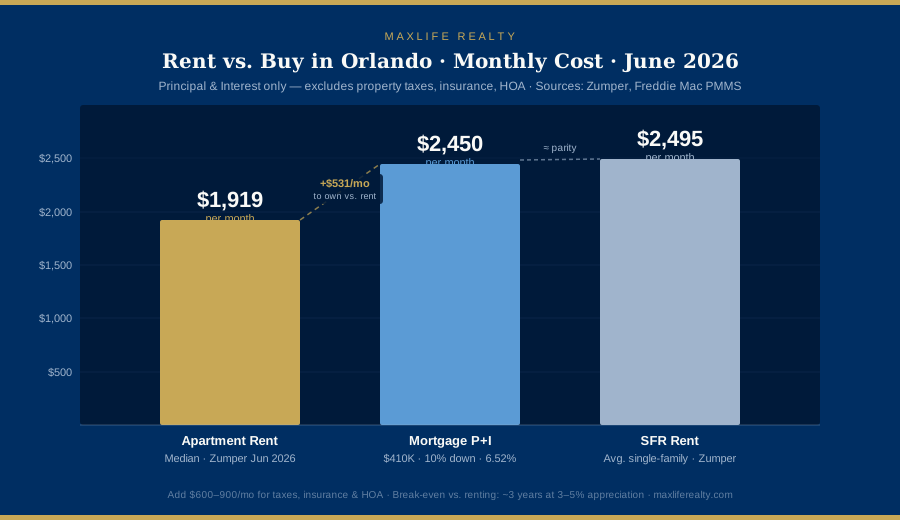
Orlando's median rent dropped to $1,919/month in June 2026 — a 7.4% decline year-over-year, according to Zumper — shifting the short-term cash-flow calculation meaningfully toward renting. That's approximately $98 less per month than a year ago. One-bedroom units fell 12% year-over-year to $1,435/month. Two-bedrooms are down 7% to $1,750/month. Only the three-bedroom segment is growing, up 1% to $2,335/month.
Run the numbers against buying. At a $410,758 purchase price with 10% down and a 6.52% mortgage rate, principal and interest runs roughly $2,450/month. After accounting for the down payment savings on principal, you're looking at approximately $2,142/month in debt service on a 90% LTV loan — about $223 more per month than renting a comparable unit. Add property taxes, insurance, and HOA fees on top of that mortgage, and the monthly ownership cost is clearly higher.
So why buy at all?
Because the rent vs. buy analysis is a break-even calculation, not just a monthly cash-flow comparison. The Realty Medics' December 2025 analysis placed the break-even point at roughly three years — the point at which equity accumulation and the fixed nature of your mortgage payment offset the initial rent-ownership gap. Orlando's 3–5% projected annual appreciation compounds that math further.
If you're staying three or more years, the equity argument wins. If you're staying 18 months and need maximum flexibility, renting at $1,919/month makes more sense right now.
Single-family rental homes average $2,495/month (Zumper, June 2026) — which changes the comparison substantially. A buyer looking at a single-family home versus renting a comparable SFR is actually in a near-parity situation on monthly cost, with ownership providing the equity upside.
New Construction: Opportunity and Caution
Central Florida residential construction permits rose 8% year-over-year in Q3 2025, with Osceola County posting a striking 30% increase (2,088 permits) according to HBWeekly (October 2025). The headline project driving Osceola's surge is Sunbridge — a 27,000-acre master-planned community spanning Orange and Osceola Counties, designed to accommodate up to 30,000 residential units at full build-out. Builders active there include Toll Brothers, Taylor Morrison, and Pulte.

New construction is legitimate competition for resale sellers — and an interesting option for buyers, with some conditions attached.
The opportunity: builders are offering incentives. Rate buy-downs, closing cost contributions, and upgrade packages are common right now. On a rate buy-down, a builder's preferred lender might get you to 5.5% on a 30-year fixed versus the 6.52% market rate — that's a meaningful monthly savings. If you're buying new construction, negotiate those incentives aggressively.
The caution: buyer beware on delivery timelines and HOA/CDD fee structures. Osceola County's aggressive growth comes with Community Development District (CDD) fees layered onto property taxes. A home with a $2,800 tax bill at closing can run $4,500 annually once the CDD fee is included. Ask for the complete fee disclosure before you make an offer.
There's also the appraisal risk in fast-growing new communities. If the builder raises prices 8% between your contract and your closing, the appraisal may not keep pace. Make sure your purchase contract includes an appraisal contingency if you're financing — especially in communities where comp data is thin.
Central Florida residential construction permits climbed 8% year-over-year in Q3 2025, with Osceola County surging 30% to 2,088 permits, per HBWeekly (October 2025). The Sunbridge master-planned community — 27,000 acres spanning Orange and Osceola Counties, up to 30,000 units — represents one of the largest residential development projects in Florida's recent history and will shape Osceola's housing supply for the next decade.
What Buyers Should Do Now — and What Sellers Should Do Now
If You're a Buyer
The spring 2026 window is genuinely better than anything we've seen since 2019. You have inventory. You have time. You have contingency rights back. Mortgage rates at 6.52% are not historically low, but they're a full 32 basis points below where they were a year ago (Freddie Mac PMMS, June 11, 2026). (Update, September 2026: that downward drift reversed over the summer — the 30-year average was 7.03% on September 24, per Freddie Mac — which makes negotiated seller credits and builder buydowns even more valuable.)
Don't try to time the market. If you're buying to live in the home for five or more years, the relevant question is not "will rates drop to 5%?" — it's "does this home work for my life, and is it priced fairly?" If the answer to both is yes, buy it. Refinance when rates fall. Wait for 5% and you may be competing against twelve other buyers again.
Get pre-approved before you search. Not pre-qualified — pre-approved, with income and asset documentation in hand. Sellers still want to see strong financing, and a genuine pre-approval letter from a reputable lender separates you from the tire-kickers.
Hire a buyer's agent who has MLS access and knows the specific submarkets you're targeting. Zillow and Realtor.com are useful for browsing. They are not useful for understanding whether a specific street in Windermere has drainage issues or why a house has sat 90 days without an offer. That information lives in the MLS and in local market knowledge.
If You're a Seller
Price is everything. The roughly 97% sale-to-list ratio (Stellar MLS, August 2026) tells you what the market will bear — but it only applies to homes that are priced at market value. Overpriced homes are sitting, taking price cuts, and eventually selling below where they could have if the seller had priced correctly in week one.
Run a current competitive market analysis. Not one based on what your neighbor sold for in 2022. One based on what's sold and closed in the last 90 days within a half-mile. If your agent can't provide that analysis in writing, find a different agent.
Presentation matters more now than it did in 2021. When buyers have 11,418 listings to choose from instead of 4,500, they skip the ones that look worn or dated in photos. Professional photography is not optional. Deep cleaning, decluttering, and fresh neutral paint are the cheapest return-on-investment home improvements you can make before listing.
Get your home's current value before you commit to a list price — the market has repriced enough since 2022 that last year's estimate is probably stale.
Talk to Ryan directly for a no-pressure conversation about your specific situation.
Read the full guide on how to price your home in Florida before you commit to a list price.
Frequently Asked Questions
What is the median home price in Orlando in 2026?
The Orlando median sale price was $400,676 in August 2026, down 0.6% from $403,222 a year earlier, according to the Orlando Regional Realtor Association. The single-family median was $436,456 and the condo/townhouse median was $301,071.
Is Orlando a buyer's market or seller's market in 2026?
Neither purely. With 4.9 months of supply (ORRA, August 2026) and homes closing at about 97% of list price (Stellar MLS, August 2026), Orlando sits close to balanced, still slightly seller-favoring territory. Buyers have more choice and negotiating room than in 2021–2022, but sellers who price correctly retain real leverage.
How much are luxury homes selling for in Orlando in 2026?
Florida statewide luxury sales surged in Q1 2026: $1M+ single-family home transactions increased 14% year-over-year, and the $5M–$10M segment jumped 31%, according to Florida Realtors. Luxury condos above $1M rose 41%, with the $1.5M–$2M condo segment up 61%.
What are home prices in Windermere, Winter Park, Lake Nona, and Dr. Phillips?
As of spring 2026: Winter Park median $619,000 (57 days on market); Windermere typical value approximately $713,000–$865,000 depending on sub-area; Lake Nona single-family homes range $485,000–$550,000; Dr. Phillips homes typically $513,000–$660,000. Prices vary significantly by street and sub-neighborhood.
Is it better to rent or buy in Orlando in 2026?
Renting is cheaper on a monthly cash-flow basis — median rent fell to $1,919/month while the estimated mortgage payment on a median-priced home runs approximately $2,142/month at current rates. However, buyers who stay three or more years typically offset this gap through equity accumulation, given Orlando's 3–5% projected annual appreciation.
What is the mortgage rate forecast for Orlando buyers in 2026?
The 30-year fixed mortgage rate was 6.52% as of June 11, 2026 — down from 6.84% a year ago, according to the Freddie Mac Primary Mortgage Market Survey. ORRA's April 2026 market data cited a 6.3% average for Orlando-area transactions. Rates have since turned higher: Freddie Mac's 30-year average reached 7.03% on September 24, 2026, after the Federal Reserve raised its policy rate a quarter point on September 16.
The Bottom Line
The orlando real estate market 2026 is a market in transition — from a seller's paradise to something more balanced, without tipping into buyer's territory. Prices are holding. Inventory is rising. Demand is structurally supported by population growth that shows no sign of reversing.
The winners in this environment are buyers who are prepared, patient, and working with accurate information. The losers are sellers who are pricing to 2022 comps and buyers who are waiting for a crash that the underlying fundamentals don't support.
What I'll be watching in the second half of 2026: whether the Freddie Mac rate continues its gradual decline (the 15-year fixed is already at 5.84%), whether Osceola's construction surge starts putting measurable resale pressure on the move-up market, and whether luxury absorption rates hold through the traditionally slower summer months.
If you want a data-driven second opinion on a specific property, neighborhood, or price range, talk to Ryan directly. I'm not going to tell you what you want to hear. I'm going to tell you what the data says.
Frequently asked questions
- What is the median home price in Orlando in 2026?
- The Orlando median sale price was $400,676 in August 2026, down 0.6% from $403,222 a year earlier, according to the Orlando Regional Realtor Association. The single-family median was $436,456 and the condo/townhouse median was $301,071.
- Is Orlando a buyer's market or seller's market in 2026?
- Neither purely. With 4.9 months of supply (ORRA, August 2026) and homes closing at about 97% of list price (Stellar MLS, August 2026), Orlando sits close to balanced, still slightly seller-favoring territory. Buyers have more choice and negotiating room than in 2021–2022, but sellers who price correctly retain real leverage.
- How much are luxury homes selling for in Orlando in 2026?
- Florida statewide luxury sales surged in Q1 2026: $1M+ single-family home transactions increased 14% year-over-year, and the $5M–$10M segment jumped 31%, according to Florida Realtors. Luxury condos above $1M rose 41%, with the $1.5M–$2M condo segment up 61%.
- What are home prices in Windermere, Winter Park, Lake Nona, and Dr. Phillips?
- As of spring 2026: Winter Park median $619,000 (57 days on market); Windermere typical value approximately $713,000–$865,000 depending on sub-area; Lake Nona single-family homes range $485,000–$550,000; Dr. Phillips homes typically $513,000–$660,000. Prices vary significantly by street and sub-neighborhood.
- Is it better to rent or buy in Orlando in 2026?
- Renting is cheaper on a monthly cash-flow basis — median rent fell to $1,919/month while the estimated mortgage payment on a median-priced home runs approximately $2,142/month at current rates. However, buyers who stay three or more years typically offset this gap through equity accumulation, given Orlando's 3–5% projected annual appreciation.
- What is the mortgage rate forecast for Orlando buyers in 2026?
- The 30-year fixed mortgage rate was 6.52% as of June 11, 2026 — down from 6.84% a year ago, according to the Freddie Mac Primary Mortgage Market Survey. ORRA's April 2026 market data cited a 6.3% average for Orlando-area transactions. Rates have since turned higher: Freddie Mac's 30-year average reached 7.03% on September 24, 2026, after the Federal Reserve raised its policy rate a quarter point on September 16.
The next step
Thinking about a move?
Whether you're two months out or two years out, the right information now saves real money later. Let's talk — no pressure, no pitch.