· 7 min read· By Ryan Solberg, Broker #BK3354351
Florida Sinkholes: What Buyers Need to Know Before Purchasing in a Sinkhole-Prone Area
Florida leads the nation in sinkhole activity — but the risk is highly localized. Here's what buyers need to understand about sinkhole geology, insurance requirements, and how to evaluate a property in a sinkhole area.
Florida leads the country in sinkhole occurrences — the state's karst geology creates conditions that no other state faces at the same scale. But "Florida sinkholes" is not a uniform risk: some counties see multiple sinkholes per week, while others see virtually none.
Here's what buyers need to understand.
Florida's sinkhole geography
Sinkhole risk in Florida is fundamentally a geology question — and the geology varies significantly by region.
The highest-risk areas — "Sinkhole Alley": The most active sinkhole belt runs through west-central Florida where limestone is shallow and water table fluctuations are significant:
- Pasco County: The most sinkhole-dense county in the United States
- Hernando County: Adjacent to Pasco, similar geology
- Hillsborough County: Tampa Bay area, significant activity in specific zones
- Polk County: Central Florida's "phosphate belt," active sinkhole zone
- Marion County: Ocala area, karst topography
- Alachua County: Gainesville area
Central Florida (lower risk): Orange, Seminole, and Osceola counties have meaningfully lower sinkhole incidence — the limestone layer is deeper and covered by more clay and overburden that provides more natural protection. Sinkholes occur here but are less common than in Sinkhole Alley.
East Coast (very low risk): Brevard, Volusia, Indian River, and other east coast counties have very low sinkhole risk — the geology is different (more sand, different aquifer pressure dynamics).
What sinkhole activity looks like
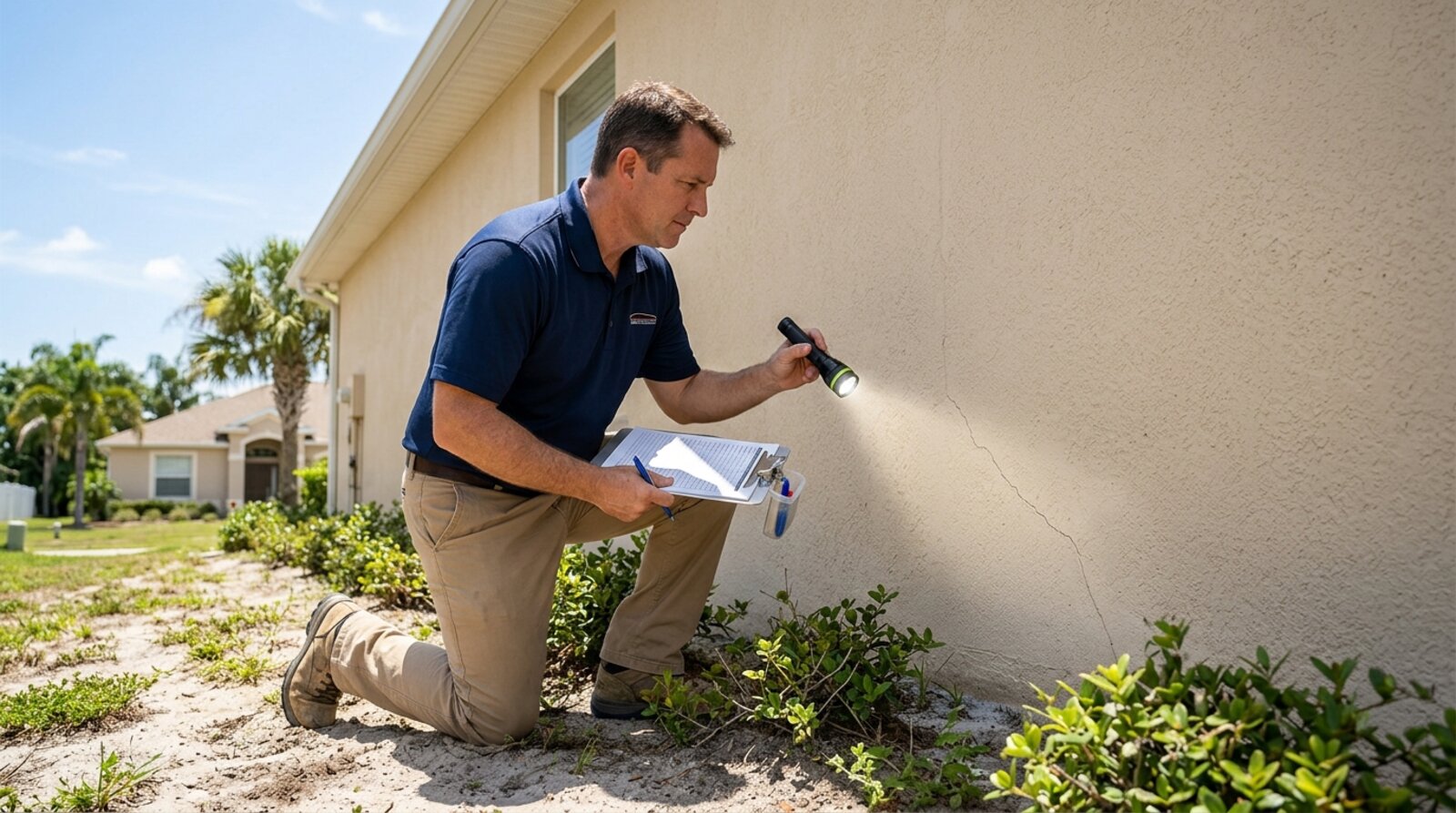
Before a dramatic collapse, sinkhole activity often shows subtle warning signs:
Exterior signs:
- Cracks in the foundation, especially diagonal or stepped cracks
- Depressions or bowls in the yard
- Trees or fence posts tilting
- Cracks in the pool deck or pool structure
- Settling of the driveway or walkways
Interior signs:
- Doors or windows that stick or don't close properly (sudden change)
- Cracks in walls, especially diagonal cracks at corners of windows and doors
- Floors that feel bouncy or soft
- Cracks in the floor tiles or slab
These signs can also indicate non-sinkhole issues (settling, poor construction) — which is why professional assessment is essential.
Insurance: what's covered and what isn't
Florida's sinkhole insurance landscape is complex:
Catastrophic Ground Cover Collapse (required coverage): All Florida homeowners policies must include this coverage. It applies when:
- The ground collapses abruptly
- A depression in the ground cover clearly visible to the naked eye forms
- Structural damage to the building results
- The building is condemned and requires evacuation
This is a high bar — requiring sudden, dramatic collapse and condemnation.
Sinkhole Coverage (optional): A broader policy endorsement covering sinkhole activity that damages the structure even without dramatic collapse. This includes gradual sinkhole development — settling, foundation damage, wall cracks — that is far more common than sudden catastrophic collapse.
Where to buy sinkhole coverage: Most standard market insurers offer sinkhole coverage as an optional endorsement in high-risk counties. Citizens Property Insurance (Florida's insurer of last resort) offers it in designated sinkhole activity areas.
Cost: In high-risk counties, sinkhole coverage adds $1,000–$4,000+/year to the insurance premium. In lower-risk Central Florida counties, sinkhole coverage is inexpensive (often under $200/year) if available.
Due diligence before purchasing
Check the databases
Florida Geological Survey Sinkhole Database: Public database of reported sinkholes by county and location. Search by address or area to understand the historical incidence near your target property.
Florida DEP Subsidence Incident Database: Additional database of reported subsidence incidents.
Property claims history: Florida law requires disclosure; ask for the CLUE (Comprehensive Loss Underwriting Exchange) report, which shows insurance claims history for the property.
The seller's disclosure
Florida's seller disclosure form requires sellers to disclose known sinkhole activity or repairs. Look specifically for:
- Prior sinkhole repair
- Prior sinkhole insurance claims
- Known foundation issues
- Any engineering reports or assessments previously conducted
Undisclosed sinkhole history that the seller knew about creates fraud liability — but discovering it post-purchase is an expensive legal problem. Do the due diligence before contracting.
Sinkhole engineering assessment
In high-risk areas (Pasco, Hernando, Hillsborough, Polk), a sinkhole engineering assessment is the definitive pre-purchase evaluation. A general home inspector is not qualified to assess sinkhole risk — this requires a professional engineer specializing in geotechnical assessment.
Assessment methods:
- Ground Penetrating Radar (GPR): A surface scan that identifies subsurface voids and anomalies — non-invasive, $500–$1,500
- Standard Penetration Test (SPT): Boring and soil sampling to test soil density at depth — more definitive, $1,500–$4,000+
- Full geotechnical investigation: Combining GPR and borings for comprehensive assessment
If the GPR scan shows anomalies, a full geotechnical investigation is advisable before proceeding.
Timing: Schedule the sinkhole assessment early in the inspection period — these take time to complete and results affect your go/no-go decision.
Prior sinkhole repair: not automatically disqualifying
Many buyers assume a property with prior sinkhole activity or repair is uninvestable. This isn't necessarily true.
A properly engineered sinkhole repair — grout injection or compaction grouting of the subsurface void — can stabilize the ground and make the property insurable. Florida has established standards for sinkhole repair, and engineering certification of a properly completed repair is a prerequisite for insurance.
What matters:
- Was the repair professionally engineered and documented?
- Was it completed according to Florida's repair standards?
- Did the insurer confirm the property is insurable post-repair?
- Are there ongoing monitoring requirements?
A property with documented, engineered sinkhole repair and confirmed insurability is not the same as a property with undisclosed sinkhole activity or a failed repair.
Practical guidance by area
Buying in Pasco, Hernando, or Polk County:
- Order a GPR scan as standard practice (not optional)
- Verify sinkhole coverage availability and cost before making an offer
- Review the sinkhole database for the specific street and neighborhood
- Seller disclosure review is critical
Buying in Orange, Seminole, or Osceola County:
- Sinkhole assessment is typically not necessary for standard single-family residential
- Check the database if you're near a historically active zone or notice warning signs
- Sinkhole coverage is inexpensive and worth purchasing anyway ($50–$200/year in most Central Florida counties)
Buying on the Space Coast (Brevard) or Volusia County:
- Sinkhole risk is minimal — standard due diligence is sufficient
- Sinkhole coverage adds minimal cost and provides peace of mind
Ryan Solberg helps buyers navigate Florida's property-specific risks. If you're evaluating a home in a sinkhole-prone area or have found warning signs during inspection — contact Ryan before you proceed.
Frequently asked questions
- What causes sinkholes in Florida?
- Florida's geography is the cause: the state sits on a foundation of porous limestone and dolomite (karst geology) that dissolves over time as acidic groundwater percolates through it. This creates underground voids. When the void grows large enough that the surface soil above it can no longer support its own weight, the surface collapses — a sinkhole. Florida's unique geology, combined with heavy rainfall and aquifer pressure fluctuations, makes it the most sinkhole-prone state in the country. The risk is highest where the limestone is close to the surface and where water table fluctuations are significant.
- What areas of Florida have the highest sinkhole risk?
- The highest-risk area is 'Sinkhole Alley' — a belt across west-central Florida including Pasco County (the highest per-capita sinkhole incidence in the US), Hernando County, Hillsborough County, Polk County, Marion County, and Alachua County. In Central Florida (Orange, Seminole, Osceola counties), sinkhole risk is significantly lower — the limestone is deeper and covered by more overburden. Coastal counties (Brevard, Volusia) have very low sinkhole risk. If you're buying in Pasco, Hernando, or Hillsborough, sinkhole evaluation is a serious consideration; if you're buying in Seminole or Orange, it's much less of a concern.
- What is the difference between sinkhole coverage and catastrophic ground cover collapse coverage?
- Florida insurance law requires all homeowners policies to include 'catastrophic ground cover collapse' coverage — covering situations where the ground collapses suddenly and dramatically, causing the home to be condemned and requiring evacuation. This is a narrow definition. 'Sinkhole coverage' is broader — it covers damage from sinkhole activity even when there's no sudden dramatic collapse, including gradual settling and damage to the structure or foundation. In high-risk areas, sinkhole coverage is worth purchasing separately. It's not cheap — $1,000–$4,000/year in addition to regular homeowners insurance — but it covers the more common, gradual forms of sinkhole damage.
- How do I find out if a property has had prior sinkhole claims?
- Two methods: (1) Request a claims history report — Florida law requires insurers to disclose prior claims on the property. The seller's disclosure form should reveal known sinkhole history. (2) Search the Florida Geological Survey's Subsidence Incident Reports database (hosted by the Florida DEP — the FGS is a division of DEP, so these are one and the same resource, not two). It's a public, statewide record of *reported* sinkhole incidents by location — note it tracks reported incidents, not insurance claims, and the FGS cautions the data is incomplete and not field-verified, so the absence of a report does not mean the absence of risk. Prior sinkhole repair on a property is not necessarily disqualifying — if properly engineered and documented, a repaired sinkhole site can be insurable. Undisclosed prior sinkhole activity is a red flag.
The next step
Thinking about a move?
Whether you're two months out or two years out, the right information now saves real money later. Let's talk — no pressure, no pitch.