· 12 min read· By Ryan Solberg, Broker #BK3354351
What Germans Need to Know Before Buying Property in Florida
Germany sends more Florida buyers per capita than almost any other European country — and has for decades. Cape Coral has such a deep German community that long-time residents...

Buyer Profile
German buying Florida real estate
#7 source country for Florida foreign buyers
Annual purchases
~700 homes/yr
Typical price range
€450K–€1.1M ($500K–$1.2M)
Min. down payment
20–25%
Home currency
EUR
Source region
Munich, Hamburg, Frankfurt
Primary use
Lifestyle second home / STR
What This Money Buys
At home versus in Orlando
Munich, Germany
€500K
A 1.5-bed apartment in Schwabing — 65 sq m, no pool, leasehold parking sold separately, high maintenance costs.
Cape Coral, FL
$600K
4-bed waterfront pool home — 2,400 sq ft, private pool, Gulf access canal, direct boating to the Gulf.
Property comparisons are illustrative. Market prices change — confirm current listings with a local agent.
What You'll Actually Pay Each Year
True carrying cost of a $700K Florida home
On a $700K Orange County home — non-residents don't qualify for the homestead exemption
Flood insurance is separate and mandatory in many zones; Florida premiums have risen sharply since 2022
Full-service STR management runs 15–25% of gross rental revenue; seasonal-only oversight for lifestyle properties is lower
Exchange Rate Reality Check
At EUR/USD 1.16, a home with $17,000/yr in U.S. carrying costs runs the equivalent of €14,655 — before mortgage. Run the numbers in both currencies before you fall in love with a listing.
The Rule That Surprises Everyone at Closing
How FIRPTA works when you sell
01
Offer accepted
Agreed sale price: $700,000 USD
02
15% withheld at closing
$105,000 sent directly to the IRS by the title company
03
You receive net proceeds
$595,000 (before commissions and closing costs)
04
File Form 1040-NR
IRS refund issued after 6–12 months
Critical detail
That 15% is calculated on the gross sale price — not your profit. On a $700,000 sale, the IRS holds $105,000 regardless of what you paid for the home. You can recover it, but only after filing a US non-resident return — a process that typically takes 6–12 months. Use a cross-border CPA who handles German nationals, not just a German Steuerberater.
Before You Make an Offer
What your Florida home really costs in euros
| USD Price | 1.12EUR near low (2025) | 1.16Current (May 2026)Current | 1.20EUR near high (2026) |
|---|---|---|---|
| $500,000USD | €446.429EUR | €431.034EUR | €416.667EUR |
| $700,000USD | €625.000EUR | €603.448EUR | €583.333EUR |
| $950,000USD | €848.214EUR | €818.966EUR | €791.667EUR |
| $1,300,000USD | €1.160.714EUR | €1.120.690EUR | €1.083.333EUR |
Estimates only. Bank spreads, wire fees, and specialist FX broker rates vary — confirm the rate before you wire. A specialist broker typically saves €2,500–€4,500 vs. a standard German bank transfer on a large conversion.
Where German Buyers Actually Buy in Florida
Gulf Coast heartland or Orlando?
Gulf Coast
Established German community
Cape Coral · Fort Myers · Naples · German-speaking network in place
- ◆Cape Coral — largest German community in Florida; extensive canal waterfront
- ◆Fort Myers — established German-speaking agents, businesses, and social networks
- ◆Naples — higher price point; quieter pace; strong appreciation history
- ◆Direct Condor/Lufthansa flights to Southwest Florida International (RSW)
- ◆Strong resale market to other European buyers who know the area
Orlando / Central Florida
Disney economy & lifestyle
STR investment · Home base · International schools · Long-term appreciation
- ◆Disney-corridor STR communities: Reunion Resort, Champions Gate, Davenport
- ◆Dr. Phillips — established, 10 min to Disney
- ◆Windermere — lakefront character on the Butler Chain of Lakes
- ◆Lake Nona — master-planned, newer construction, medical and tech employment
- ◆For buyers who already know Orlando from vacations; schools and parks matter here
Who You Need in Your Corner
Your cross-border buying team
01
Florida Real Estate Attorney
Title review, deed preparation, contract interpretation — and critically, US-Germany estate tax treaty elections on Form 706-NA. A German Notar cannot do this; a general Florida estate attorney may not know the treaty exists.
Must have German/US cross-border experience
02
Cross-Border CPA (German/US)
FIRPTA planning, Form 1040-NR filing, STR income reporting on Schedule E, and structuring rental income to avoid double taxation under the US-Germany income tax treaty. Must file in both jurisdictions.
Must know both German and US tax law
03
Local Realtor
STR-permitted community knowledge, HOA CC&R verification, Disney-corridor access, and neighbourhood intelligence for lifestyle buyers. Getting the community wrong invalidates the entire strategy.
MaxLife Realty works with European buyers regularly
04
Foreign National Mortgage Specialist
Specialist lenders structure loans using German income documentation (Gehaltsabrechnungen, Steuerbescheid) and bank references — no SSN or US credit history required. You will need an ITIN before closing. 25–35% down, 30-year terms available.
Optional for all-cash buyers
05
Licensed STR Property Manager
For Disney-corridor buyers: platform management, dynamic pricing, guest services, pool and spa servicing, hurricane prep, and emergency response — from Central European Time, 6–7 hours ahead of Florida. Non-negotiable for absentee owners.
15–25% of gross STR revenue
Free Download
German Buyer Checklist —  Florida Real Estate
35+ step checklist covering ITIN, financing, due diligence, closing, post-closing obligations, and german-specific tax and transfer rules. Print it or save it to your phone.
Official IRS Documents
Key IRS forms for foreign property owners
Downloaded directly from IRS.gov. Forms are revised periodically — check the revision date on page one before filing and confirm you have the current version with your CPA.
Certificate of Foreign Status of Beneficial Owner
Filed by: Foreign buyer
When you need it: At closing and when opening a US bank account or brokerage
Certifies to US payers (lenders, title companies, banks) that you are a non-US person. Required by your US financial institutions to apply the correct withholding rate on any passive US-source income — interest, dividends, rental income. Without it, payers must withhold at the maximum 30% backup rate. File with each institution that holds or pays US funds on your behalf.
Application for IRS Individual Taxpayer Identification Number (ITIN)
Filed by: Foreign buyer without a US SSN
When you need it: Before your first US tax filing; required before closing in some transactions
If you don't have a US Social Security Number, you need an ITIN to file US tax returns (including recovering FIRPTA withholding) and to appear on a deed in some counties. The application requires certified copies of identity documents — your passport is the primary option. Processing takes 7–11 weeks when filed by mail; an IRS Certifying Acceptance Agent can expedite it. Apply early — don't wait until the year you sell.
U.S. Withholding Tax Return for Dispositions by Foreign Persons
Filed by: Buyer's closing agent (on your behalf)
When you need it: Filed by the title company within 20 days of closing when you sell
This is the FIRPTA withholding return. When you sell your Florida property, the buyer's title company is legally required to withhold 15% of the gross sale price and remit it to the IRS using this form. You do not file it — the withholding agent does. But you should request a copy at closing: it documents the exact amount withheld, which you'll need to reconcile when you file your 1040-NR and claim a refund of any excess withholding.
Statement of Withholding on Dispositions by Foreign Persons
Filed by: Provided to the foreign seller by the withholding agent
When you need it: Issued at closing alongside Form 8288
Your copy of the FIRPTA withholding record — stamped and returned to you by the IRS after processing Form 8288. Think of it as your receipt for the withheld funds. Attach the stamped copy to your Form 1040-NR when you claim a refund of excess withholding. Keep this document in a safe place; without it, reconciling your refund with the IRS is significantly more complicated.
Application for Withholding Certificate for Dispositions by Foreign Persons
Filed by: Foreign seller (or their CPA)
When you need it: File with the IRS BEFORE closing — ideally 90+ days in advance
If your actual US capital gains tax on the sale will be less than the standard 15% FIRPTA withholding, you can apply for a Withholding Certificate to reduce the withheld amount before closing. Example: you paid $500,000 for a property and are selling for $520,000 — your actual gain is $20,000, but 15% of the $520,000 sale price is $78,000. File Form 8288-B with supporting documentation and the IRS may authorize the title company to withhold only the amount covering your actual liability. The IRS has 90 days to respond; if no response before closing, the full 15% must be withheld regardless.
U.S. Nonresident Alien Income Tax Return
Filed by: Foreign owner of US rental property; foreign seller recovering FIRPTA withholding
When you need it: Filed annually by June 15 (or April 15 if US wages exist); filed after a sale to recover FIRPTA overage
The primary US tax return for non-resident alien property owners. Two situations trigger this form: (1) You earn rental income from your Florida property — report it here annually on Schedule E, deduct allowable expenses, and pay tax on net income. (2) You sold your property and had 15% FIRPTA withheld at closing — file this return to report your actual gain, calculate the correct tax, and claim a refund of any amount withheld in excess of your liability. Refunds on FIRPTA recoveries typically take 6–12 months from filing. Work with a CPA who handles non-resident US returns — this is not a standard US tax return and general tax software does not handle it well.
Note for your situation
If your country has a US income tax treaty, report treaty-based positions on Schedule OI (Other Information) within Form 1040-NR to claim treaty benefits on rental income.
United States Estate Tax Return — Estate of Nonresident Not a Citizen
Filed by: Estate of the deceased foreign property owner
When you need it: Filed within 9 months of date of death if US-situs assets exceed $60,000
If a non-US citizen who owns Florida real estate dies, their estate must file this return if the fair market value of their US-situs assets (real estate, US stocks, tangible property in the US) exceeds $60,000. The non-resident alien estate tax exemption is only $60,000 — compared to $13.6 million for US persons in 2026. On a $700,000 Florida property, approximately $640,000 is potentially subject to US federal estate tax at rates up to 40%. This is why ownership structure (personal vs. LLC vs. foreign corporation) must be decided before purchase, not after. Proper planning can eliminate or dramatically reduce this exposure.
Note for your situation
If your country has a US estate tax treaty (UK and Germany both do), your estate can claim a proportionate share of the full US exemption rather than the $60,000 non-resident limit. The treaty election is made on this form — file with a US estate attorney who knows the specific treaty terms.
These forms are provided for informational purposes only. Tax law changes frequently. Always confirm the current version and applicability with a qualified cross-border CPA before filing.
Go Deeper
IRS publications for foreign property owners
These reference guides explain the rules behind the forms — worth reading before you hire a CPA so you can ask the right questions.
Residential Rental Property
Reference — not filed; used for tax preparation
When to use it: Before your first rental season and at tax time each year
The IRS's complete guide to tax rules for residential rental property. Covers what rental income to report, which expenses are deductible (mortgage interest, repairs, insurance, depreciation, management fees), how to calculate depreciation on a US rental property, and passive activity loss rules. Foreign owners who rent their Florida property on a short-term or long-term basis should read this before hiring a CPA — understanding the basics makes the 1040-NR Schedule E process far less opaque.
U.S. Tax Guide for Aliens
Reference — not filed; used to determine residency status and filing obligations
When to use it: Before your first US tax year and whenever your visa or residency status changes
The authoritative IRS reference for non-US persons with any US tax obligation. Explains the difference between resident aliens (taxed like US citizens) and nonresident aliens (taxed only on US-source income), how to apply the Substantial Presence Test, how to determine your filing status, and which tax treaties may reduce your US liability. Particularly valuable for Indian nationals on H-1B or green cards who need to understand whether they file Form 1040 or Form 1040-NR in a given tax year.
Withholding of Tax on Nonresident Aliens and Foreign Entities
Reference for withholding agents; relevant to foreign buyers receiving US-source income
When to use it: When setting up US rental income payments or reviewing withholding on passive income
Explains the rules US payers (banks, title companies, rental agents) must follow when paying income to foreign persons. As a foreign property owner, this publication helps you understand why your US bank or property manager withholds at certain rates, which treaty exemptions can reduce that withholding, and what documentation (typically Form W-8BEN) you need to provide to claim a lower rate. Also covers the NRA withholding rules that apply to rental income paid to non-US owners.
Note for your situation
If your country has a US income tax treaty, Publication 515 explains the specific reduced withholding rates available to residents of treaty countries — and the W-8BEN documentation your payers need to apply them.
Information Return of U.S. Persons With Respect To Foreign Disregarded Entities and Foreign Branches
US persons who own a foreign LLC or disregarded entity that holds US real estate
When to use it: Filed annually with your US tax return if a foreign entity owns your Florida property
If you hold your Florida investment property through a foreign LLC, foreign partnership, or similar entity that is treated as a disregarded entity for US tax purposes, the US member or owner may be required to file this information return annually. This is a reporting form — not a tax payment form — but failure to file carries significant penalties ($10,000+). Relevant primarily to buyers who have set up foreign holding structures to own US real estate. Ask your cross-border CPA whether your ownership structure triggers this filing.
Required Filings & Licenses
State and federal obligations beyond the IRS
Florida Vacation Rental License Application
Florida DBPR (Dept. of Business & Professional Regulation)
Florida law requires a state vacation rental license for any property rented for periods of less than 30 days more than three times per year. This is separate from any county or city STR permit — you need both. The application requires proof of ownership, a property inspection, and an annual renewal fee. Operating without this license exposes you to fines and potential rental income clawback. Apply before your first rental booking.
FinCEN FBAR — Report of Foreign Bank and Financial Accounts (FinCEN 114)
US Financial Crimes Enforcement Network (FinCEN)
If you are a US person (green card holder, H-1B meeting the Substantial Presence Test, or US citizen) and the combined value of your foreign financial accounts exceeds $10,000 at any point during the calendar year, you must file an FBAR annually by April 15 (automatic extension to October 15). This includes foreign bank accounts, brokerage accounts, and certain foreign trusts. Penalties for non-filing are severe — up to $10,000 per violation for non-willful, much higher for willful. NRIs who become US tax residents are commonly surprised by this requirement.
External links open official government websites. MaxLife Realty is not responsible for changes to third-party sites. Always verify requirements with a licensed CPA, attorney, or the relevant agency before filing.
Germany sends more Florida buyers per capita than almost any other European country — and has for decades. Cape Coral has such a deep German community that long-time residents sometimes call it Klein Kap. German-speaking real estate agencies operate out of Fort Myers. Oktoberfest in Cape Coral draws thousands of people. The Gulf Coast connection is real and established.
Orlando is different. German buyers come to Orlando primarily for one of two reasons: the Disney vacation rental corridor, or lifestyle relocation for buyers who have spent time in Central Florida as tourists and decided they want a base here. Neither is a small niche — but it is worth being honest that if you're German and want the largest German-speaking community, waterfront canals, and a built-in cultural network, Cape Coral is where that infrastructure exists. Orlando offers something different: the world's most visited theme park in your backyard, international school options, and a growing city with real long-term capital appreciation.
Here's what makes a cross-border purchase work — and what trips people up.
Know the Real Carrying Cost Before You Fall in Love With a House
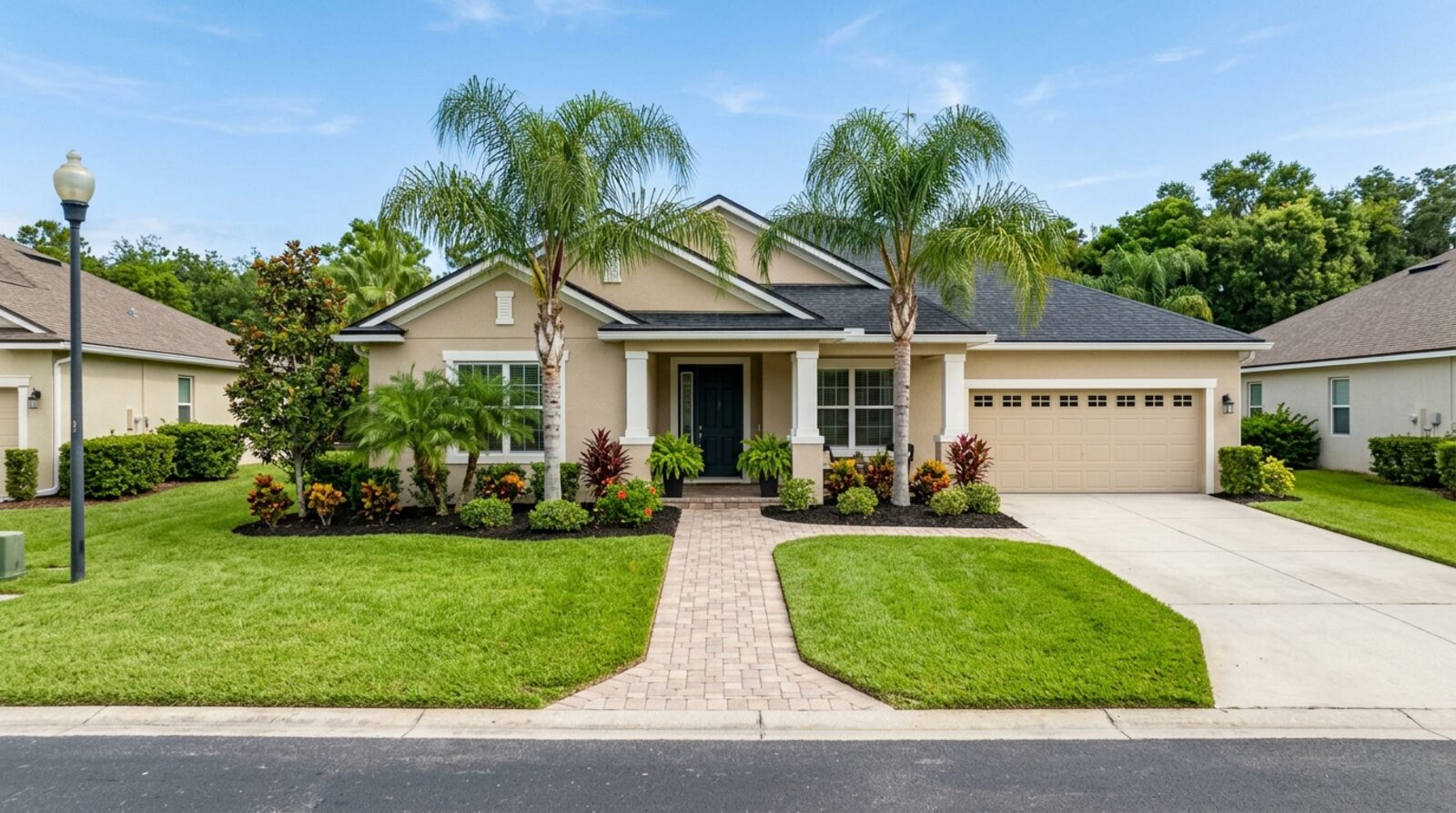
German buyers tend to be methodical. Apply that discipline to carrying costs before you run the purchase price. On a $700,000 home in Orange County, expect annual property taxes around $7,000–$10,000 — non-residents do not qualify for the Florida homestead exemption. Wind and general homeowners insurance has risen sharply since 2022; budget $4,000–$7,000/year depending on construction year, roof type, and location. Flood insurance is separate and mandatory in many zones.
If you are buying as an STR investment near Disney, add full-service property management: 15–25% of gross rental revenue. On a property generating $55,000/year in STR income, that is $8,000–$14,000 in management fees. Total annual carrying cost on a well-run STR property can exceed $30,000 before any mortgage payment. Run the full number in both USD and euros before you run the price.
Financing as a German National
You can get a US mortgage without a Social Security number, US credit history, or green card. Specialist lenders structure loans using German income documentation — pay slips, annual tax assessment (Steuerbescheid), and bank statements — along with credit references from your German bank. You will need a US Individual Taxpayer Identification Number (ITIN) before closing; your US attorney or CPA can help you apply.
Typical foreign national mortgage terms: 25–35% down payment, fixed rates 0.5–1% above conventional, 30-year terms available. With EUR/USD near 1.16, many German buyers in the €600K+ range pay cash — it simplifies the transaction, removes the financing contingency, and makes offers more competitive. If financing, work with a currency specialist rather than your German bank or a US retail bank on the wire. The spread between a retail bank and a specialist on a large euro transfer can cost you several thousand dollars.
FIRPTA — The Rule That Surprises Everyone at Closing
FIRPTA (Foreign Investment in Real Property Tax Act) requires the buyer's title company to withhold 15% of the gross sale price when a foreign national sells US real estate. That is 15% of the sale price — not the gain.
On a $700,000 sale, $105,000 is withheld at closing and submitted to the IRS, regardless of what you paid for the home. You can recover it — it requires filing a US non-resident return (Form 1040-NR) after the sale, and the refund process typically takes 6–12 months. Plan for it and engage a cross-border CPA well before you are anywhere near ready to sell.
Your Estate Tax Advantage — The Treaty Most German Buyers Don't Know About
This is the most important tax planning conversation for German buyers — and almost nobody brings it up.
Non-resident aliens without a treaty get only a $60,000 US estate tax exemption on US-situs assets. On a $900,000 Florida property held personally by a German national, that leaves $840,000 potentially exposed to federal estate tax at rates up to 40%. It is the most commonly overlooked financial risk for foreign buyers — and the most expensive one to discover after the fact.
The US-Germany Estate and Gift Tax Treaty changes this significantly. German-domiciled owners can claim a proportionate share of the full US exemption — calculated as (US assets ÷ worldwide assets) × the current US exemption (~$13.6M in 2026). A German buyer holding $700,000 in Florida property against $3M in total worldwide assets gets a proportionate exemption of approximately $3.2M — well above the property value. US estate tax on the Florida property is eliminated entirely.
This mechanism works almost identically to the US-UK treaty, which gives German buyers the same advantage as British buyers — one that nationals of most other countries, including Canada, Australia, and most Latin American countries, do not have.
Critical caveats: This benefit is not automatic. The estate must proactively claim treaty benefits on Form 706-NA (the US Estate Tax Return for non-resident aliens). Claiming it requires disclosure of worldwide assets to the IRS. It must be structured with a US estate attorney who handles German/US cross-border cases — not a general Florida estate planning attorney and not a German Notar or Steuerberater. Set it up before closing, not after.
Two Very Different Strategies: STR Investor or Lifestyle Relocator?
If you are an STR investor: The Disney vacation rental corridor is one of the strongest STR markets in the US. Communities like Reunion Resort, Champions Gate, and the Davenport/Haines City corridor permit short-term rentals, sit 15–20 minutes from Disney, and generate 40–50 week occupancy when managed professionally. Entry prices run from approximately $420,000 (Davenport townhomes and condos) to $750,000+ for larger resort homes in Reunion. Gross yields of 8–12% are achievable on well-managed properties — net yield after management, taxes, insurance, and maintenance is a different number. Verify STR permitting at the community level before making an offer. Two communities on the same street can have completely different rules.
If you are a lifestyle relocator: Dr. Phillips has a long-established international buyer community and positions you between Disney and downtown Orlando — practical for part-time owners who want a real neighborhood rather than a resort compound. Windermere's lakefront communities along the Butler Chain offer the kind of quiet, residential water character that Germans who have spent time on the Baltic coast or at Bavarian lakes tend to appreciate. Lake Nona suits buyers drawn to newer construction, a master-planned walkable community, and employment-corridor proximity that supports long-term rental demand if you are not in residence full-time.
If you already know you want a German-speaking community, waterfront canals, and an established European social network, Cape Coral is the honest answer. It is a three-hour drive from Orlando. Some buyers buy in both markets.
HOA Rules Can End a Rental Strategy Before It Starts

Florida communities vary widely on rental rules — some allow nightly STR, some impose 30-day minimum tenancies, some prohibit all rentals. The communities in Dr. Phillips and Windermere that work well as lifestyle properties often prohibit short-term rentals or restrict them severely. The STR-permitted communities in the Disney corridor charge a premium specifically because of that permission.
I have had buyers fall in love with a community, negotiate a price, and only discover on day three of due diligence that short-term rentals were prohibited. The title company will not catch this for you. Pull the CC&Rs before you make an offer.
Property Management Is Not Optional
An STR in Reunion or Champions Gate requires full-service management: platform listing, dynamic pricing, guest communication, cleaning and turnover coordination, pool and spa servicing, hurricane shutter deployment, and emergency response. For German owners operating on Central European Time — six to seven hours ahead of Florida — real-time response to guest issues is not realistic without on-the-ground management. Budget 15–25% of STR gross revenue. It is not optional; it is the cost of operating the asset from 9,000 kilometers away.
For non-STR lifestyle properties, seasonal oversight services — routine inspections, contractor coordination, and storm prep — typically run $2,500–$4,000/year.
Get the Right Professionals in Place Early
You need a US real estate attorney familiar with German/US cross-border transactions, a CPA who handles German nationals with US rental income, a licensed property manager for STR operations, and a local agent who knows which communities permit STR and which don't. At MaxLife Realty, I work with European buyers regularly — on both the STR corridor and the lifestyle relocator end. Reach out to start the conversation.
Planning a longer-term move to Florida? The Complete Orlando Relocation Guide covers income tax, home price comparisons, and which neighborhood fits where you're coming from.
How to Buy Florida Real Estate as a German Citizen
What German nationals need to know before buying in Florida — carrying costs, financing without US credit history, FIRPTA withholding, the US-Germany estate tax treaty, ownership structure, and the best neighborhoods for German buyers.
Step 1
Run the Full Annual Carrying Cost Before Falling in Love With a Price
German buyers tend to be methodical — apply that discipline to carrying costs before you fall in love with a listing. On a $700,000 home in Orange County: annual property taxes run $7,000–$10,000 (non-residents do not qualify for the Florida homestead exemption); homeowners and wind insurance has increased sharply since 2022, budget $4,000–$7,000/year depending on construction year and location; flood insurance is separate and mandatory in many zones ($1,500–$3,500/year). If buying an STR near Disney, add full-service property management at 15–25% of gross rental revenue — on a property generating $55,000/year in STR income, that is $8,000–$14,000 in management fees. Run the full number in both USD and euros at your expected exchange rate before making an offer.
Step 2
Understand Your Financing Options as a German Buyer
Standard US conventional mortgages require a Social Security number and US credit history — German buyers without US residency don't qualify. The realistic options: foreign national mortgage programs through specialist lenders, or all-cash purchase. Specialist lenders structure loans using German income documentation — Gehaltsabrechnungen, Steuerbescheid, bank statements — and credit references from your German bank, without requiring a US SSN. You will need a US Individual Taxpayer Identification Number (ITIN) before closing. Down payments typically run 25–35%, with fixed rates modestly above conventional. With EUR/USD near 1.16, many German buyers in the €600K+ range pay cash to simplify the transaction and strengthen offers in competitive situations. If financing, work with a currency specialist rather than your German bank or a US retail bank on the wire — the spread on a large transfer can cost thousands.
Step 3
Understand FIRPTA Withholding When You Eventually Sell
FIRPTA (Foreign Investment in Real Property Tax Act) requires the buyer's title company to withhold 15% of the gross sale price and remit it to the IRS when a foreign national sells US real estate. On a $700,000 sale, that is $105,000 withheld at closing — regardless of your actual gain. You file a US non-resident return (Form 1040-NR) and the IRS refunds the excess over your actual tax liability. The process typically takes 6–12 months. Plan for it. Work with a cross-border CPA well before you are ready to sell.
Step 4
Use the US-Germany Estate Tax Treaty Before You Close
This is the most important financial planning step for German buyers specifically — and the most overlooked. Non-resident aliens without a treaty get only a $60,000 US estate tax exemption on US-situs assets. On a $900,000 Florida property held personally, that leaves $840,000 potentially exposed to federal estate tax at rates up to 40%. The US-Germany Estate and Gift Tax Treaty changes this significantly. German-domiciled owners can claim a proportionate share of the full US exemption — calculated as (US assets ÷ worldwide assets) × the current US exemption (~$13.6M in 2026). A German buyer holding $700,000 in Florida property against $3M in worldwide assets gets an exemption of roughly $3.2M — well above the property value. This benefit is not automatic. The estate must proactively claim treaty benefits on Form 706-NA (US Estate Tax Return for non-residents). It requires disclosure of worldwide assets to the IRS and, critically, it must be structured with a US estate attorney familiar with German/US cross-border work before you close — not after.
Step 5
Choose STR Investor or Lifestyle Relocator Before You Search
German buyers in Florida split into two distinct groups, and they require different neighborhoods and ownership structures. STR investors want communities that explicitly permit short-term rentals and have Disney-corridor proximity: Reunion Resort, Champions Gate, and the Davenport/Haines City corridor are the primary options. These communities generate 40–50 week occupancy with professional management, and gross yields of 8–12% are achievable on well-managed properties. Lifestyle relocators — German professionals or pre-retirees planning to spend significant time in Florida — want different neighborhoods: Dr. Phillips for established international community character, Windermere for lakefront character and A-rated schools, Lake Nona for newer construction and a master-planned community. Do not attempt an STR strategy in a non-STR-permitted community.
Step 6
Verify STR Permissions Before Making an Offer
Short-term rental permitting in Florida is governed at the community level, not the city or county level. Two communities in the same zip code can have completely different rules — one allowing nightly rentals, one requiring 30-day minimums, one prohibiting all rentals. The Disney-proximity communities that permit STRs charge a price premium specifically because of that permission. Always read the HOA CC&Rs before you close. Pull the governing documents during due diligence; the title company will not flag rental restrictions for you.
Step 7
Open a US Bank Account and Build Your Cross-Border Advisory Team
Open a US bank account before closing — it simplifies wire transfers, ongoing expense payments, and rental income collection. You will need an ITIN before closing (your US attorney or CPA can help you apply). Build your advisory team before you search: a US real estate attorney familiar with the US-Germany estate tax treaty, a cross-border CPA who files returns for German property owners, a foreign national mortgage specialist if financing, a licensed property manager for STR operations, and a currency specialist for conversion timing. At MaxLife Realty, I work with European buyers regularly and can connect you with professionals experienced in German-American transactions.
The next step
Thinking about a move?
Whether you're two months out or two years out, the right information now saves real money later. Let's talk — no pressure, no pitch.